


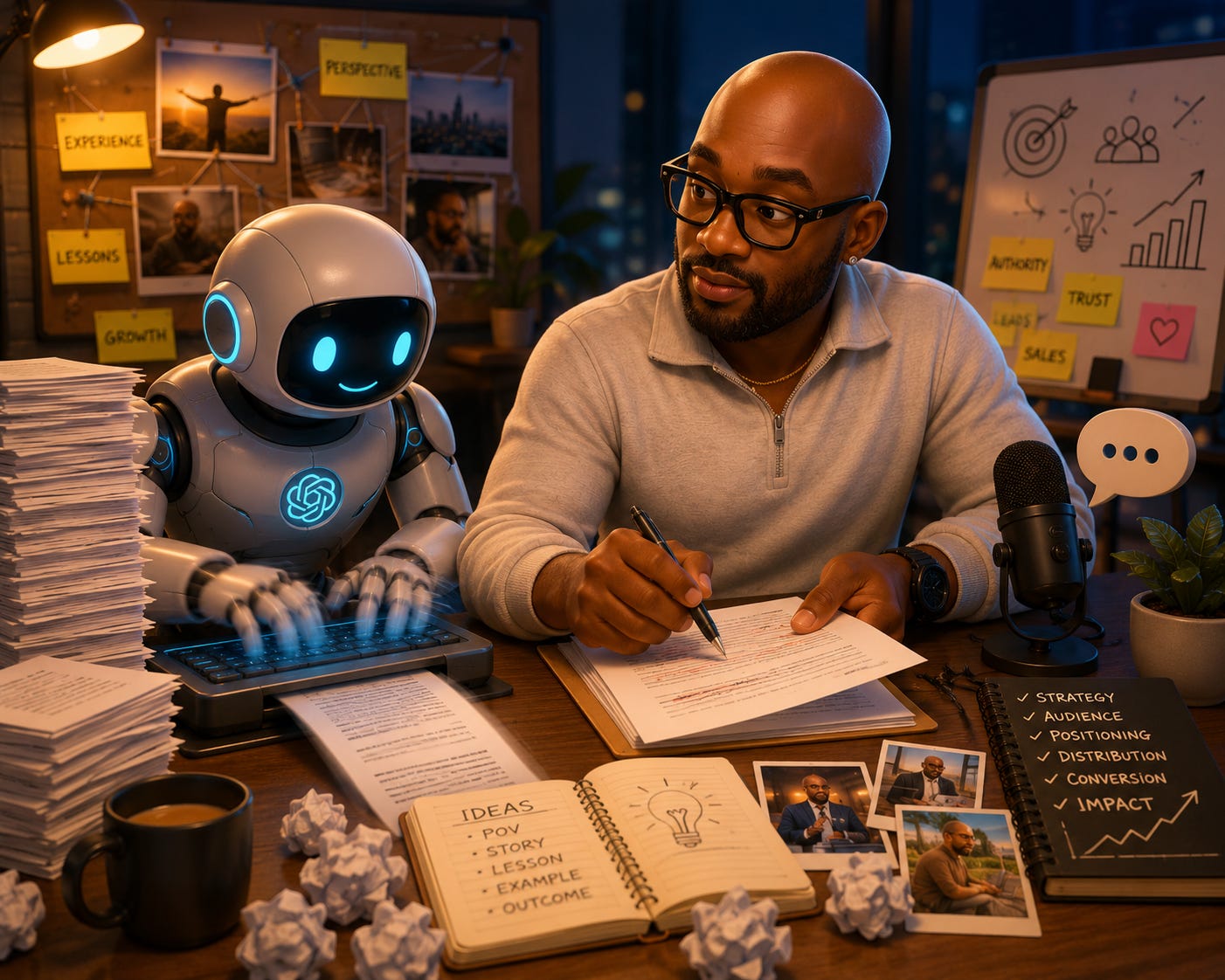
I’ve been writing professionally for more than six years.
For the last two, I’ve made a living ghostwriting for other people.
During that time, I’ve watched AI go from something obscure, reserved for the most technical people in society, to a generalized tool accessible to anyone.
And it’s pretty damn good at generating content.
Initially, I thought this would be the end of my writing career.
But as time has gone on, more people have reached out to me for writing help.
My rates have increased.
The value of my client engagements has increased.
And ironically, I probably use AI more today than I ever have.
The last part might sound contradictory…
If AI is capable of doing more of the writing, why would somebody pay me to write for them?
Because I’ve gradually realized that physically writing the words was never the most valuable part of my job.
There’s absolutely nothing wrong with letting AI help you write.
I do it.
But somebody still has to decide:
What’s worth saying?
What angle should we take?
What belongs in the piece?
What needs to be removed?
How should the argument flow?
And once AI produces something, somebody still needs to format, refine, challenge, and reshape those words until they’re worth reading.
AI can do the writing.
But the writer still needs to provide the thinking and strategy.
So despite spending the last six years watching AI become exponentially better at writing, writers aren’t going anywhere any time soon.
Here are five reasons why:
Reason #1: AI doesn’t have lived experience
One of the biggest advantages you have over AI is pretty simple:
You’ve actually lived a life.
I’ve written about:
Being made redundant
Building a business
Losing clients
Making six figures
Working 60+ hour weeks
Burning myself out
Making decisions that cost me money
Making decisions that completely changed my life
AI can write about every single one of those things.
But it hasn’t experienced any of them.
It doesn’t know what it feels like to lose your income unexpectedly.
It doesn’t know the anxiety of wondering where your next client is coming from.
It doesn’t know what it feels like to achieve something you’ve spent years chasing, only to realize the reality looks nothing like what you imagined.
I do.
And those experiences influence how I write about them.
Now, there’s an obvious counterargument here:
“But I can just give AI my experiences as context.”
And you’re absolutely right.
In fact, this is exactly what I do when ghostwriting.
But I still have to spend time editing and revamping the content to fit the structure of the platform I’m writing on, which changes dynamically, and align it with the voice of the person I’m writing for.
This is partly why people still hire me to write for them.
AI might make the process faster, but doing it well still requires time and judgment.
Giving AI context doesn’t remove the need for a writer.
It changes what the writer is responsible for…
Instead of spending time physically putting words on a page, you can spend more time deciding:
What parts of the experience are interesting?
What details make the story believable?
What should we leave out?
What lesson should the reader take from it?
How should we tell the story so it sounds like the person who experienced it?
AI can help you turn the raw material into words.
But the raw material still has to come from somewhere.
And the more AI-generated content floods the internet, the more valuable the raw material that isn’t perceived as AI-generated becomes.
So yes, you can absolutely give AI your lived experiences and let it help you write about them.
Matter of fact… You should!
But that doesn’t make the writer irrelevant.
If anything, it shifts the writer’s value away from generating words and toward:
Extracting
Interpreting
Shaping
… experiences into something other people want to read.
AI can help write the story.
But somebody still has to live it, understand it, and know how to tell it.
Reason #2: Great writing requires taste
AI has made generating options ridiculously easy.
You can give it an idea and ask for:
20 different hooks
10 ways to structure an argument
5 analogies
10 different CTAs
3 completely different versions of the same post
And it’ll give you a response in seconds.
But this creates a new problem…
“Which one is good?”
This is where taste comes in.
After writing professionally for more than six years, I’ve written thousands of pieces of content.
Some performed incredibly well.
Others completely flopped.
I’ve written for myself.
I’ve written for clients.
I’ve written articles, social posts, emails, and plenty of things I’d probably be embarrassed to read today.
And all of those reps have gradually developed my ability to look at something and think:
“Nah, this isn’t it.”
Sometimes I can immediately explain why.
“The hook gives away too much.”
“The story takes too long to get to the point.”
“The example doesn’t support the argument.”
“The sentence sounds clever but adds absolutely nothing.”
Other times, something simply feels off.
That instinct is taste.
And the best way I know to develop it is through doing the reps.
You have to write things that flop.
You have to publish things you thought were incredible, only for nobody to care.
You have to look back at something you wrote two years ago and wonder, “What the hell was I thinking?”
You have to spend enough time writing, editing, and publishing to start recognizing the difference between something that technically works and something that’s actually good.
AI can certainly help you develop that taste.
But ultimately, somebody still has to make the final decision.
The easier it becomes to generate content, the more valuable it becomes to know what’s worth publishing.
Reason #3: AI doesn’t have a voice of its own
AI can get pretty damn close to sounding like you.
Give AI enough examples of someone’s:
Previous writing
Interview transcripts
Opinions
Stories
Favorite phrases
Writing preferences
…and it can produce something remarkably good.
I know because this is how I write most of the content for my clients.
But there’s an important distinction between replicating a voice and actually having one…
Your voice isn’t simply:
Short sentences.
Using certain words.
Writing in a particular rhythm.
Those are expressions of your voice.
Your actual voice comes from things like:
Your experiences.
Your beliefs.
Your opinions.
Your values.
Your personality.
Your worldview.
Two people can experience exactly the same event and walk away with completely different interpretations of what happened.
This difference influences what they choose to say about it.
So when I start working with someone, I’m not only trying to understand how they write…
I’m trying to understand how they think.
What do they believe that other people in their industry disagree with?
What annoys them?
What are they unwilling to compromise on?
What experiences changed the way they see the world?
What would they never say publicly?
Once I understand those things, recreating their voice is far easier.
And yes, I can give all of that context to AI.
In fact, I do.
But once again, AI is working with a voice that already exists.
It didn’t form the opinions.
It didn’t develop the beliefs.
It didn’t have the experiences that shaped the worldview.
It’s only helping me express them.
You still have to give it a voice worth replicating.
Reason #4: Even AI companies are hiring writers
If AI were about to make professional writers completely redundant, you’d expect the companies building the most advanced AI models to know before the rest of us.
Yet…
They’re still hiring humans to work on content.
In 2025, OpenAI advertised for a content strategist to help shape the voice and content strategy for ChatGPT.com.
The reported salary?
$310,000 to $393,000.
Think about the irony for a second…
The company behind ChatGPT, a product capable of generating more content in a day than I could write in several lifetimes, was willing to pay a human hundreds of thousands of dollars to help shape its content.
Why?
Obviously, it’s not because OpenAI doesn’t have access to AI.
And it’s probably not because nobody at the company knows how to prompt ChatGPT to write an article.
The value sits somewhere else.
Companies still need people who can decide:
What should we talk about?
Who are we talking to?
What position should we take?
How should the company sound?
What stories are worth telling?
What should never be published?
How does all of this support the broader business?
Those are much bigger decisions than physically writing the words.
Anthropic’s hiring guidance gives us another clue…
When applying to the company, Anthropic tells candidates to create their first draft themselves and then use Claude to refine it.
The human provides the experience and thinking.
AI can help improve how it’s communicated.
That’s pretty damn close to the argument I’ve been making throughout this article.
Let AI help with the writing.
But give it something human worth writing about.
I don’t think any of this proves that every writing job is safe.
Far from it.
But if the companies building some of the most capable writing technology in the world still see enough value in human content professionals to hire them, it’s hard to argue that the profession simply disappears.
The job is changing.
The valuable part of being a writer isn’t how quickly you can put words on a page.
It’s everything you bring to the process before and after AI generates a piece of content.
Reason #5: You’re not being paid to write
This might sound strange coming from someone who makes a living writing for other people…
But clients don’t pay me to write.
They pay me because they want something to happen as a result of the writing.
They might want:
More authority
More visibility
More leads
More customers
A stronger personal brand
More time back
Writing is simply the mechanism I use to help them get there.
It took me years to understand this.
Before becoming a ghostwriter, companies would hire me because they needed an article.
I wrote the article.
They published it.
I got paid.
The article itself was the product.
And for that reason, I was constantly compared against other people who could produce the same thing.
AI has made that problem even worse.
Because it can produce content remarkably well, significantly faster, and for a fraction of what a professional writer would charge.
So don’t waste your energy trying to prove you can write better than AI.
Focus more on what the person on the receiving end gets from hiring you to write for them.
Because the more commoditized writing becomes, the more important the outcome becomes.
AI WILL replace this…
Now, I don’t want this article to give you the wrong idea.
I’m not saying AI won’t replace any writing work.
Because it already has.
And it will continue to put pressure on writers whose work is:
Generic
Formulaic
Easily replicated
Primarily informational
Produced without much original thinking
AI has made producing that kind of content significantly cheaper and faster.
And I don’t think pretending otherwise helps writers.
The writers most vulnerable to AI aren’t necessarily bad writers.
They’re writers whose primary value is producing something AI can now produce faster and cheaper.
How writers should adapt
Don’t try to compete with AI.
Use it.
Let it help you research.
Let it generate drafts.
Let it give you options.
Let it restructure your ideas.
Let it make you faster.
But as AI takes over more of the execution, you must become more valuable elsewhere.
This means moving up the value chain.
From writing → thinking
Don’t just turn somebody’s idea into words…
Help them figure out what’s worth saying.
From information → experience
Anyone can generate information.
Bring stories, observations, lessons, and experiences that aren’t sitting inside a generic prompt.
From execution → judgment
AI can give you endless options.
Develop the taste to know which ones are worth using.
From generic content → distinctive ideas
Don’t compete on who can produce another perfectly acceptable article.
Develop opinions, perspectives, and ideas people associate with you.
From selling words → selling outcomes
Stop thinking purely about how many articles, emails, or posts you can produce.
Think about what those things help the person paying you achieve.
AI is going to keep getting better.
There’s no point wasting your energy fighting that.
Let AI make the writing easier.
Then become exceptionally good at everything surrounding it.
Final thoughts
AI is going to get better at writing.
There’s not much point pretending otherwise.
The models I use today are significantly more capable than the ones I was experimenting with a few years ago.
And I fully expect the models I use a few years from now to make today’s versions look primitive.
But this doesn’t scare me nearly as much as it used to…
Because the better AI gets at producing words, the more I realize that physically writing them was only one part of what made a writer valuable in the first place.
You still need:
Experiences worth sharing
Taste to recognize what’s good
A voice worth listening to
An understanding of what people care about
A reason for the writing to exist in the first place
AI can help with all of those things.
And I think writers should let it.
I certainly will.
But I don’t think the future belongs to writers who refuse to use AI and insist on doing everything manually.
Nor do I think it belongs to people who outsource the entire process to AI and publish whatever comes back.
It belongs to the people who learn where AI is better than them and where they still need to add value.
So am I worried AI will change writing?
Absolutely.
It already has.
But am I worried that nobody will need writers anymore?
Not particularly.
Because generating words is becoming incredibly easy.
Being worth reading is still hard.
Thanks for reading!