

7 Steps to Build a High-Converting LinkedIn Personal Brand
Even if You Don't Have a Large Audience

In July 2024, I returned to LinkedIn after 2 years away from the platform.
At the time, I wasn’t convinced LinkedIn was worth the effort.
Like many people, I assumed success on the platform required:
Viral posts
A huge audience
Or spending all day online
None of those things appealed to me.
But my overdependence on referrals kept business slow, so I decided to give it another shot.
This time, I approached it differently…
Instead of chasing reach, I focused on building a presence that makes people want to work with me.
Over the next year, something interesting happened…
My audience hardly grew.
And I never went viral.
But the people finding my content were exactly who I was targeting.
Eventually, three of them became clients.
Together, those three clients generated over six figures in revenue for my business.
No cold outreach.
No complicated funnels.
That experience taught me something most people misunderstand about LinkedIn:
You don’t need a massive audience to generate business.
You need a high-converting presence.
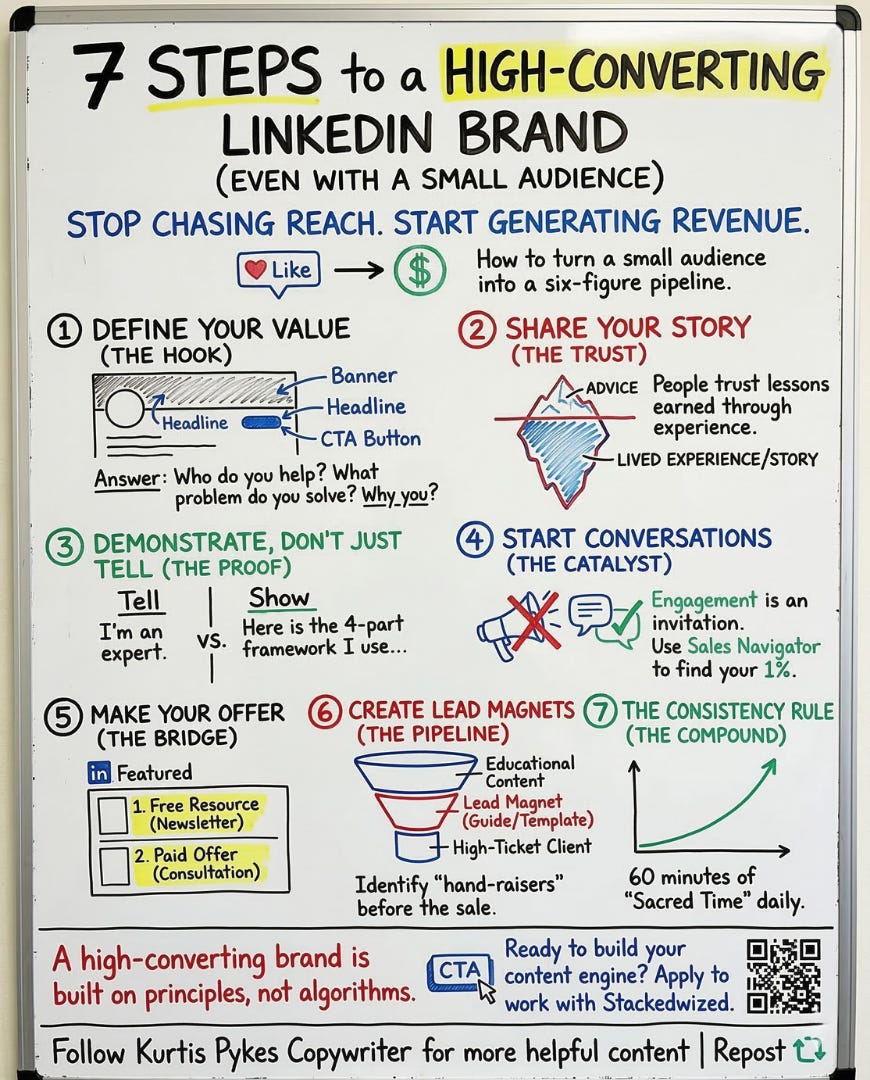
Here are the 7 steps that helped me build one:
1. Define your unique value proposition
In his classic book Scientific Advertising, Claude Hopkins made a simple observation about human behavior:
People are only interested in things that benefit them.
He said, “Remember that the people you address are selfish, as we all are. They care nothing about your interest or your profit.”
And you must keep this in mind with everything you create.
So the first question you should ask yourself is, “Why would someone want to listen to me?”
I’ve already alluded to this several times throughout this article.
For example:
In the title, I promised to help you achieve a desired objective.
In the subtitle, I addressed a potential doubt you might have about your audience size.
In the first paragraph, I shared my story so you could relate to me.
These are all reasons why you might want to keep reading.
And I’m consciously planting them throughout this article to give you a reason to stay.
You must do the same with your LinkedIn profile.
Three of the most valuable pieces of real estate on your LinkedIn profile are:
Your display banner
Your headline
Your custom button (CTA)
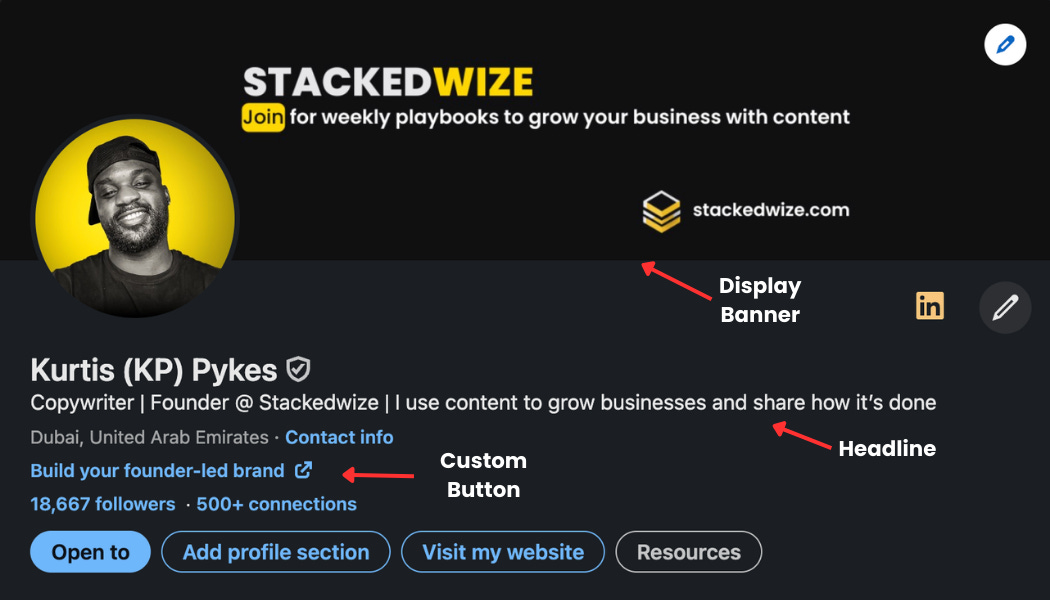
These areas matter because they’re the first things people see when they land on your profile.
And in most cases, they’ll decide whether to follow you within seconds.
If these sections are vague, generic, or focused on you instead of the reader, people will leave without taking action.
But if they immediately understand what they stand to gain by following you, they’re far more likely to stick around.
For example, your headline shouldn’t simply describe what you do.
“Founder.”
“Consultant.”
“Marketing specialist.”
None of these tells the reader why they should care about you… unless you’re already famous.
Instead, your profile should communicate three things as quickly as possible:
Who you help
What problem you solve
Why you’re uniquely positioned to solve it
When someone lands on your profile, they should instantly know, “This person solves a problem I care about.”
2. Share your story
One of the most powerful tools you have when building a personal brand is your story.
Because while people may follow you for the value you provide…
They trust you because of the context behind it.
Anyone can give advice online.
But when that advice is rooted in lived experience, it carries far more weight.
For example, I spent four years in a religious cult.
After leaving, I became obsessed with understanding how it happened.
I read every book I could find on psychology, persuasion, and mind control.
I even reached out to lecturers and researchers to learn how these same influence techniques could be used for good.
At one point, one of the leading researchers in this field contacted me after I published an exposé and sent me a signed copy of her book on cults, mind control, and influence.
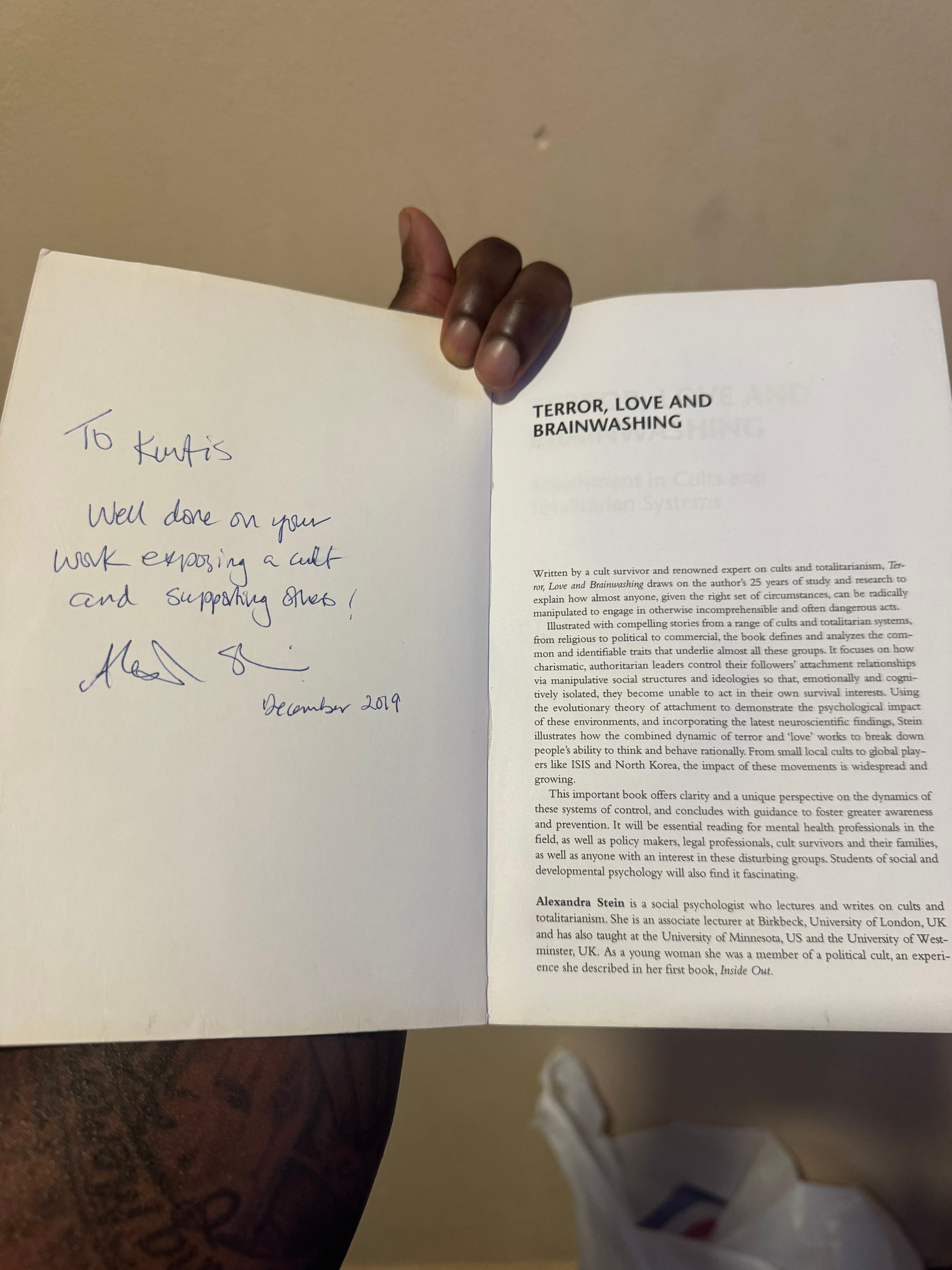
Now knowing this about me…
Would you be more likely to trust what I say about influencing people?
Probably.
And that’s exactly why your story matters.
Your story explains three important things:
Why you care about the problem
What you’ve experienced firsthand
What shaped your perspective
Without this context, your expertise can feel abstract.
But when people understand the journey behind your ideas, those ideas become far more believable.
In other words:
People trust lessons learned through experience.
This is why the people you’re creating content for must see the human behind the expertise.
And that human element is what builds trust.
Here are a few examples of stories you can share:
Mistakes you made
Lessons you learned
Experiences that shaped your thinking
How you achieved a result
How you helped someone else achieve a result
Some of this context should live in your LinkedIn “About” section.
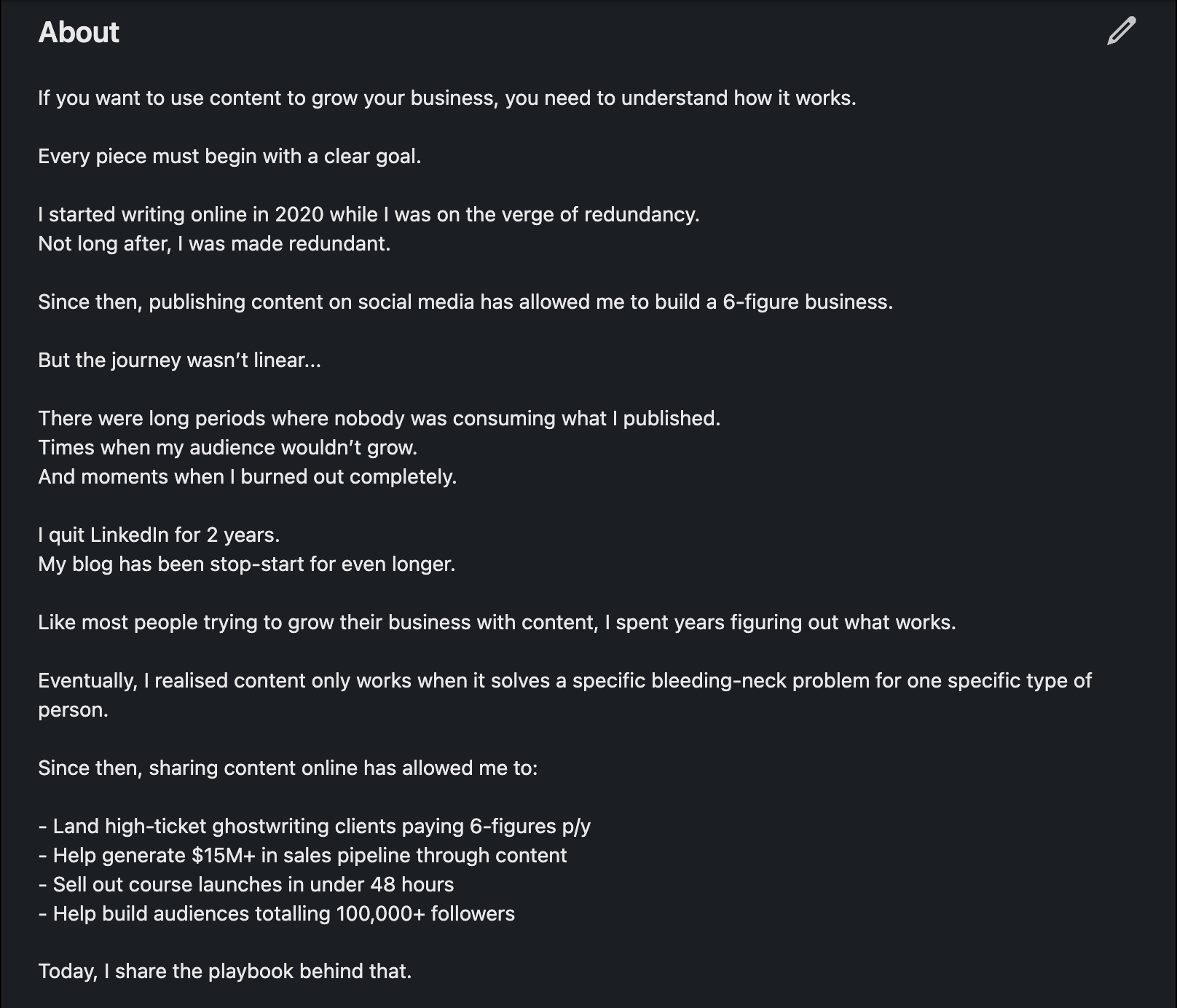
But it shouldn’t stop there.
Your story should also be woven into the content you create.
Because when people understand where your ideas come from, they’re far more likely to believe them.
3. Demonstrate what you know
In the late 1800s, there was a highly regarded Russian playwright named Anton Chekhov.
His older brother, Alexander, dreamed of becoming a successful writer.
So Anton regularly wrote him letters offering advice.
In one of those letters, Chekhov shared a tip that would later become one of the most famous principles in storytelling.
He wrote, “Don’t tell me the moon is shining; show me the glint of light on broken glass.”
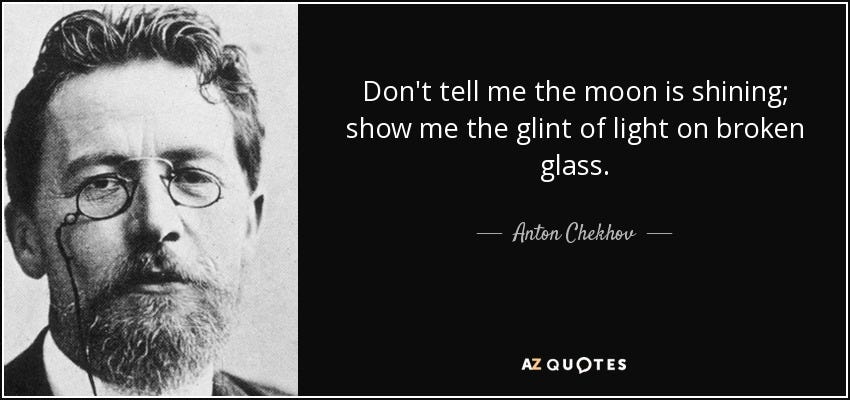
In other words, he was advising his brother that, instead of telling readers something directly, show them the evidence so they can arrive at the conclusion themselves.
For example:
Telling → “The night was beautiful.”
Showing → “Moonlight reflected off the broken glass in the road.”
Both communicate a similar idea…
But the second makes the reader experience it, so the message far more convincing.
The exact same principle applies when building a high-converting LinkedIn personal brand.
Nobody cares that you’re a “trusted advisor.”
… Or that you’ve got 10+ years of experience.
Because there are people with these same credentials who do not have the same results as you.
What people care about is how you got the results you have because they want to replicate them.
So you must demonstrate it by teaching them the steps you took.
For example, imagine two consultants…
The first says, “I’m an expert in B2B marketing. Schedule an appointment to improve your marketing engine.”
The second regularly posts:
The frameworks they use when diagnosing a client’s problem
Patterns they’ve noticed after working with dozens of businesses
Common mistakes they made on their journey
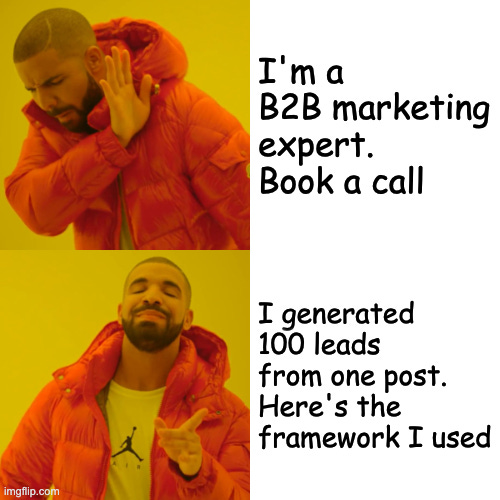
Both people might have the same level of expertise.
But the second person shows it.
And over time, readers naturally reach the conclusion that, “This person really knows what they’re talking about, and they can help me get what I want.”
That’s the goal of your content.
Instead of telling people you’re knowledgeable, demonstrate it through what you teach.
The best part?
You don’t need to invent anything new.
Most of the time, it’s simply about explaining things you already understand in a way that helps others see them more clearly.
4. Start conversations
For the first 4 years of my business, I made a mistake that almost made me give up on content entirely.
I treated LinkedIn like a broadcasting tool.
I would publish posts, share ideas, and occasionally write longer articles.
Then I would sit back and wait for something to happen…
Nothing did.
Nobody reached out to work with me.
Nobody asked questions about my services.
Nobody seemed particularly interested in what I was doing.
After a while, I convinced myself that content simply didn’t provide a meaningful return on investment.
I began to see it as a lot of effort for very little reward.
So eventually, I stopped posting.
Looking back now, I’ve realized the problem was never the content itself…
It was the way I was using it.
I assumed publishing ideas would automatically attract clients.
… and this is often how it’s portrayed by all of the social media gurus.
But I eventually realized content alone rarely converts people, especially if you’re selling a high-ticket service or product.
You must have conversations.
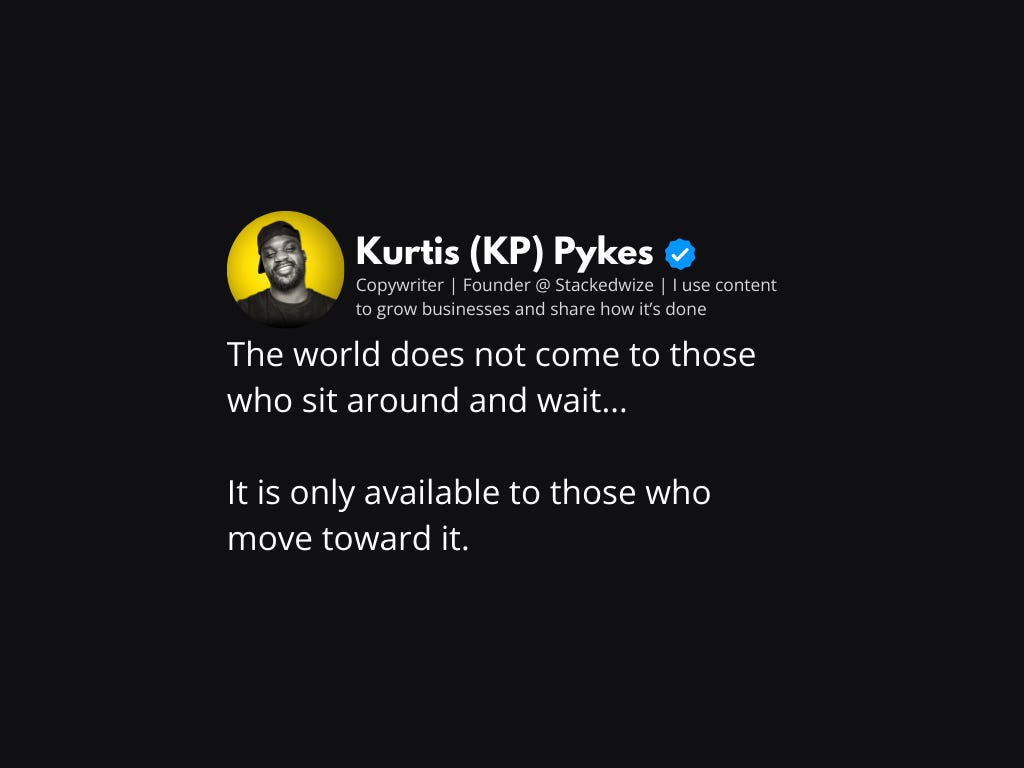
You’d think people would understand this implicitly, given it’s called social media.
But the penny didn’t drop for me.
The people who generate the most opportunities from LinkedIn are the ones who actively engage with others rather than simply posting and disappearing.
One of the easiest ways to start doing this is to treat engagement as an invitation.
If someone reacts to your post, leaves a comment, or shares your content, they’ve already signaled some level of interest.
That small interaction gives you a natural reason to reach out, thank them, and start a conversation.
But you don’t have to wait for those signals…
You can also start conversations proactively with the people you want to build relationships with.
Tools like Sales Navigator make this easier by allowing you to search for people who fit your ideal customer profile.
Once you’ve found them, you can begin engaging with their content and contributing to discussions that matter to them.
Over time, those small interactions compound.
A simple comment can turn into a conversation.
A conversation can turn into a relationship.
And relationships often turn into opportunities.
This idea reminds me of something the Stoic philosopher Epictetus once said, “Make the best use of what is in your power, and take the rest as it happens.”
You can’t control when someone decides they need your help.
But you can control how many conversations you start.
And the more conversations you have, the more likely it becomes that one of them eventually turns into a client.
In fact, two-thirds of the people I worked with last year were individuals I had been interacting with for years.
We had exchanged comments, messages, and ideas long before we ever discussed working together.
That’s the quiet power of starting conversations.
Content may attract attention.
But conversations are what turn attention into business.
5. Make your offer visible
You can’t buy what you don’t know exists.
Just because someone enjoys your content doesn’t mean they automatically understand how to work with you.
And most people aren’t going to spend time trying to figure it out.
If the next step isn’t clear, they’ll simply move on.
This is why everything you do on LinkedIn should ultimately guide people toward a next step.
Not in a pushy way.
But in a clear and natural way.
For example, at the end of your posts, there should usually be some form of call to action.
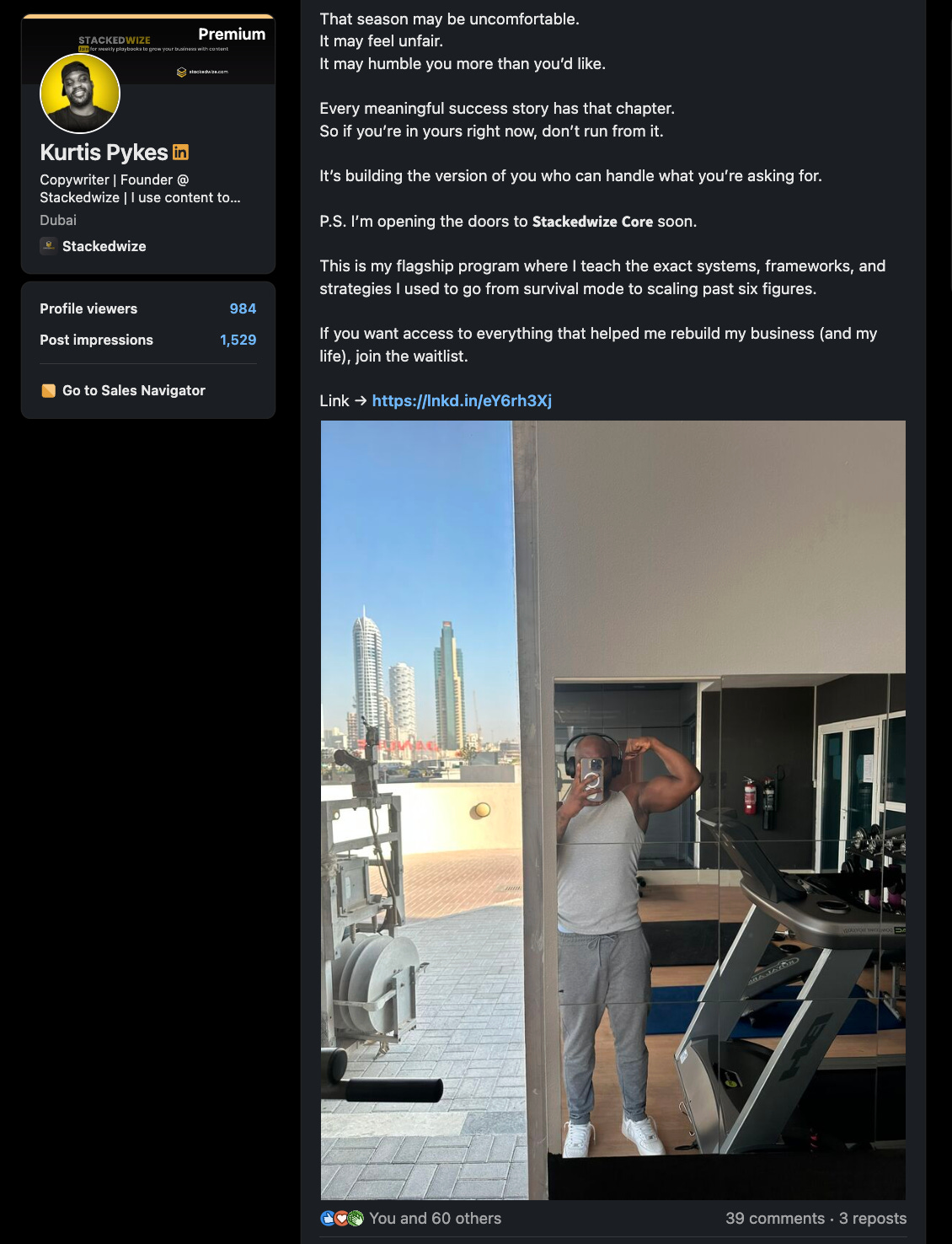
You don’t want people to read your content, react, and then disappear.
Give them something to do next.
For example:
Signing up for a lead magnet
Answering a question in the comments
Sending you a message
These small prompts turn passive readers into active participants.
But calls to action shouldn’t live only inside your posts.
You should also make your offer visible on your profile itself.
Why?
Think about what happens when someone visits your LinkedIn profile.
They rarely arrive randomly.
Something you said made them curious enough to click your name.
In other words, their attention has already been captured.
Your job is simply to show them what to do next.
One of the easiest ways to do this is through the Featured section of your profile.
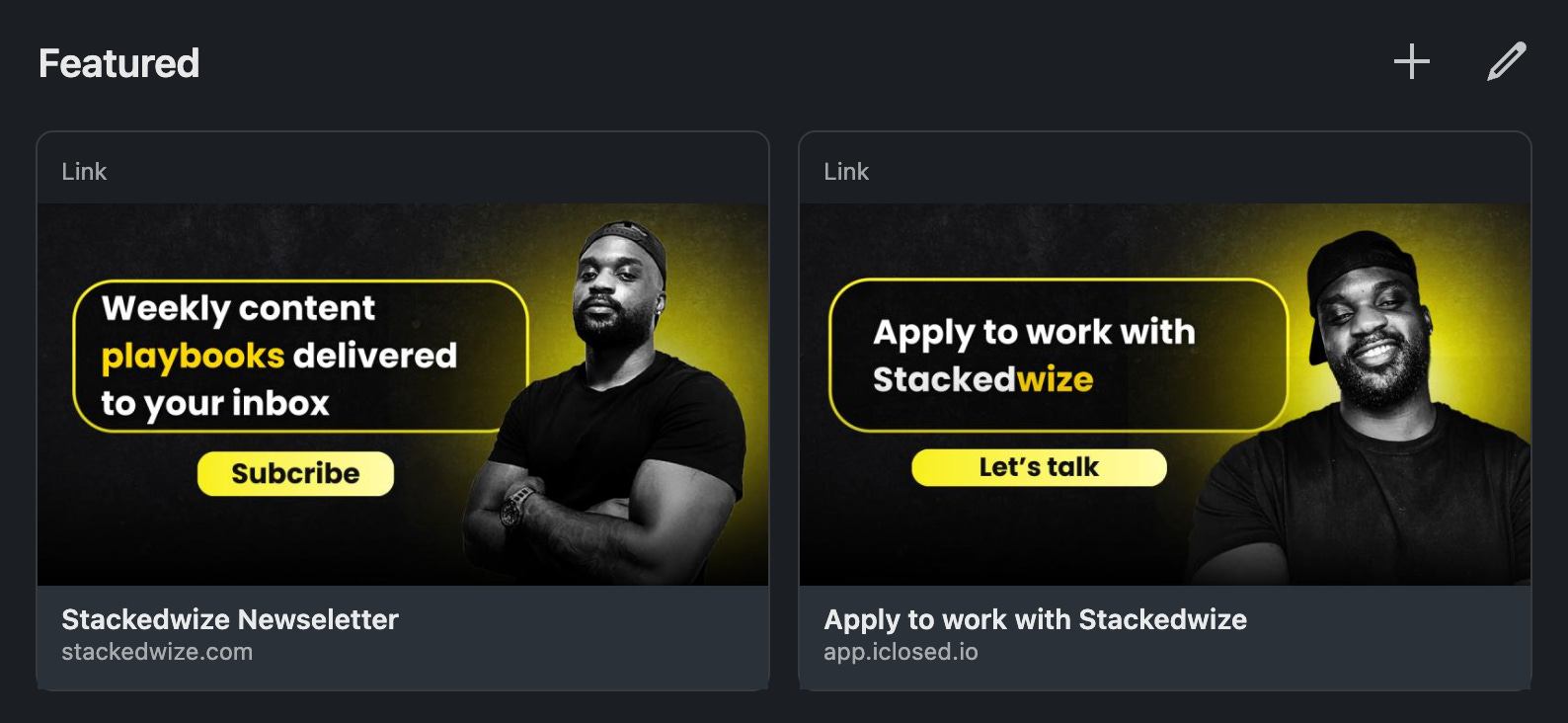
This section acts as a call to action for people who are already interested in what you’re doing.
Many people use this section incorrectly by placing their most popular posts there.
Please don’t do that.
Instead, use it to guide people toward working with you.
A simple rule of thumb is to include:
A free resource that helps solve part of the problem (e.g., your newsletter)
A paid offer or consultation link for people who want deeper help
The free resource captures people who aren’t ready to buy yet but want to stay connected.
The paid option gives people who are ready a clear way to move forward.
Because while content builds trust…
Offers are what turn trust into revenue.
And if people don’t know how to work with you, even the best content in the world won’t turn into business.
6. Create occasional lead magnets
One of the biggest reasons many online business struggle to grow consistently is simple:
They don’t have a pipeline of people interested in what they sell.
So they operate in cycles.
A few clients come in.
They get busy delivering the work.
Then the pipeline dries up.
Suddenly, they’re scrambling to find the next customer.
This was my life for the first 4 years of business.
Most people try to solve this problem in one of two ways.
The first is cold outreach.
They spend hours every day sending messages to people who have never heard of them before.
And while this can work, the numbers are often brutal.
Research from sales platforms consistently shows that cold email response rates are between 1–5%, with conversion rates even lower.
This means most of your time is spent talking to people who were never particularly interested in the first place.
The second approach is relying entirely on content.
This is what I did.
I spent hours creating and publishing content, and hoping the right people eventually reach out.
They didn’t.
Instead, it just gave me enhanced anxiety.
It turns out that when content is your only source of lead generation, your business growth becomes heavily dependent on algorithms and visibility, which you can’t fully control.
But this is where lead magnets become useful.
A lead magnet is simply a valuable resource you give away in exchange for someone’s contact information.
For example:
A Guide
A Framework
A Template
A Workshop
The goal isn’t to sell immediately.
It’s to identify people who care about the problem you solve.
When someone downloads one of your resources, they’re raising their hand and saying, “This is something I’m interested in.”
Once they’re in your ecosystem, you can nurture that relationship through email or future content.
Over time, those people begin to understand their problem more clearly.
They see what’s possible.
They recognize where they’re stuck.
And many eventually reach the same conclusion on their own:
They need help solving it.
This process is called self-discovery.
Instead of convincing someone to buy from you, your content and resources help them realize why your service might be the right next step.
And that’s why lead magnets are powerful.
They allow you to build a pipeline before you ever ask for the sale.
7. Stay consistent long enough to be remembered
I’ve been creating content to grow my business for about 6 years.
But if I’m being honest, I’ve only been truly consistent for around 36 months of that time.
There were long stretches where I stopped posting completely.
Sometimes I told myself I was too busy with client work.
Other times, I convinced myself the effort wasn’t worth it because nothing immediate seemed to be happening.
Looking back, I can see how much progress I probably delayed by stepping away.
If I had simply stayed consistent during those early years, I’m confident I would be much further ahead today.
That realization taught me something important:
Most people don’t fail because content doesn’t work.
They fail because they stop before the compounding effect begins.
There’s an idea a mentor told me not so long ago…
“If you were forced to finish everything you started and pursue every idea you’ve had, you would start fewer things and pursue less ideas.”
And it’s true.
This made me realize my biggest problem has been the fact that I’m not forced to finish or pursue ideas, hence, I start over a lot and have lots of ideas.
So here’s a simple practice that helped me when I finally decided to take content seriously:
Designate one sacred hour each day for LinkedIn.
No distractions.
No multitasking.
Just one focused block of time dedicated to writing, engaging, or improving your profile.
It doesn’t have to be perfect.
It just has to be consistent.
Because the longer you stay in the game, the more your content begins to compound.
People start seeing your name repeatedly.
They recognize your ideas.
And they begin associating you with a specific problem.
Final Thoughts
When I first started using content to grow my business, I thought all you had to was post good ideas and wait for opportunities to arrive.
It turns out the process is far more deliberate than that.
A high-converting LinkedIn presence is built from a handful of principles working together:
Define your unique value proposition so people instantly understand why they should follow you.
Share your story so your expertise has context and credibility.
Demonstrate what you know by teaching the frameworks, lessons, and patterns you’ve learned.
Start conversations because relationships are what create opportunities.
Make your offer visible so interested people know how to take the next step.
Create lead magnets to build a pipeline of people interested in the problem you solve.
Stay consistent long enough to be remembered so your authority compounds over time.
None of these steps are revolutionary on their own.
But when they work together, something interesting happens.
People begin recognizing your name.
They start associating you with a specific problem.
They learn from you repeatedly.
And when the moment arrives that they finally decide to solve that problem…
You’re already the person they think of.
P.S. If you'd like help building a content engine like this inside your business, apply to work with Stackedwized.