

7 Types of Content You Should Be Posting on LinkedIn (With Examples)
You can use one for each day :)


“I want to start building my brand on LinkedIn, but I don’t know what to post.”
I’m told this at least 5x per week.
What these people are actually saying is, “What should I write each day?”
So, I want to give you a crash course on how LinkedIn works.
… And help you filter through the noise to get started quickly.
But before we dive in, I want to point out something extremely subtle to you…
As a reader of my Medium articles, you expect content that will help you move forward as a Social CEO, right?
Well, this means it’s my duty to work my socks off to discover:
Any questions you have
The topics that tickle your fancy
What tutorials will benefit you the most
What problems you’re struggling to find non-obvious solutions to
And the outcomes you desire (personally and for your business)
This guide on how to start posting on LinkedIn as a CEO is a perfect example of me listening to what questions readers (like you) are asking and then creating content to answer them.
And that’s the key to building a strong digital brand on LinkedIn.
You don’t have to be Justin Welsh or Nicolas Cole…
You just have to be clear about your target audience, listen to their concerns, and address them with your content using the various formats available.
The more compelling your answer, the faster you’ll grow.
What makes an answer compelling?
Stories.
Don’t stress yourself about how to do all of that just yet.
Let me show you what type of content you should be posting, then give you concrete examples of what it may look like to give you a clear idea.
Client case studies
If you’ve been running your business for a while, the odds are quite high that you’ve achieved some results for your customers—or else you’d be on the street.
That’s good… talk about it!
You’ve just got to think about what happens whenever you watch a James Bond movie to see why this method is so effective…
It’s quite normal for us to picture ourselves in place of characters or people when following a storyline.
The same thing happens to prospective customers when you share client case studies.
You evoke emotions in them and give them a way to see themselves in the shoes of your customer
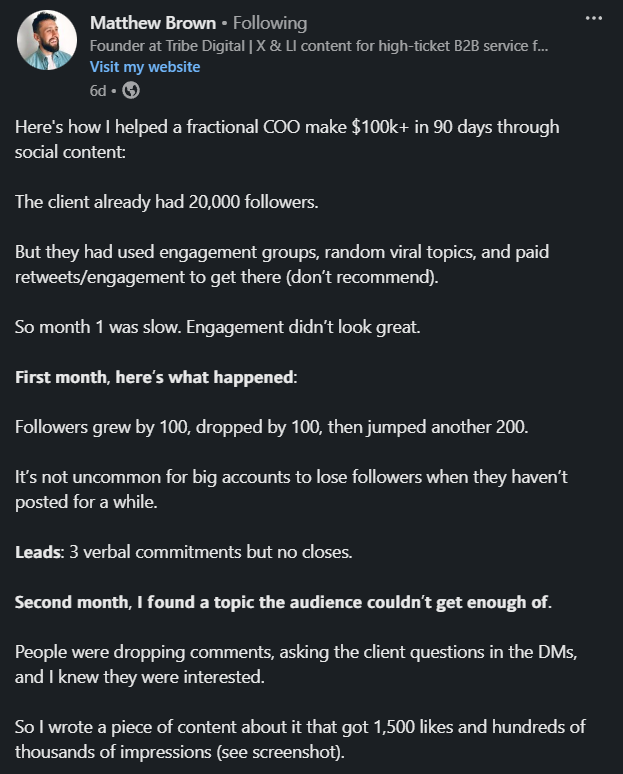
But there’s a way to do this on LinkedIn that makes it appealing - here’s the structure:
Use the end result you delivered for the client as a hook.
Move on to where the client was when you met them
Discuss what you did to help them move from A to B
Share how it transformed them (and their business)
Category opinions
You may not be a fan of Andrew Tate, but there’s a lot we can learn from him.
One such thing is the power of opinions.
Andrew Tate’s popularity online skyrocketed because of the controversial remarks he made.
This triggered a form of viral marketing for him, where his statements would cause widespread sharing and discussions.
Is this me telling you to be a polarizing figure?
Heck, no.
It’s me telling you to share your opinions — including the unpopular ones.
“But I don’t have any strong opinions.”
Cut the crap… everyone has strong opinions — especially about their category.
It’s the reason you do what you do in the way you do it.
Don’t be afraid to make them known.
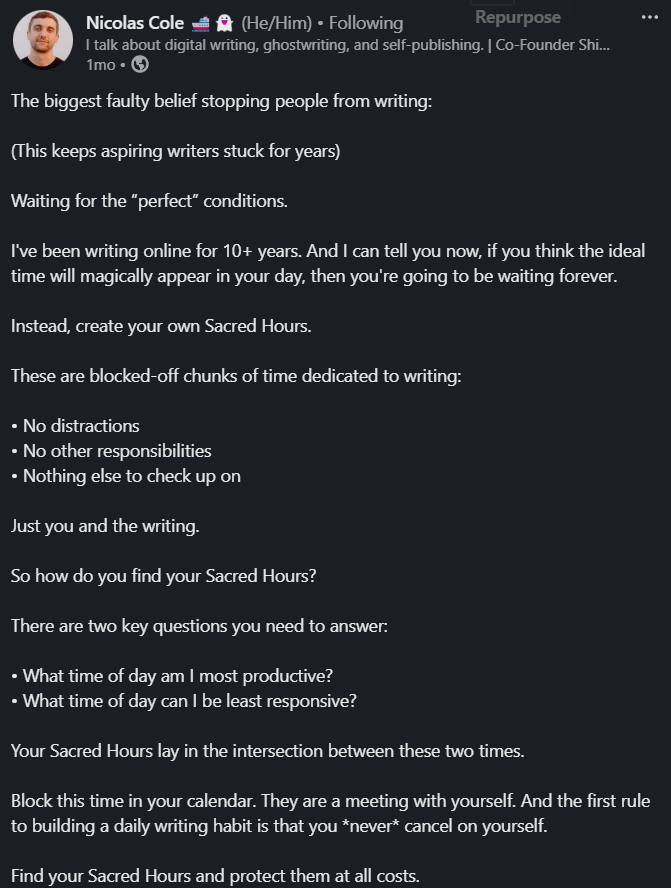
Here’s the structure of how that would look in a LinkedIn post:
State your strong opinion about your industry/category
Justify your opinion with good reasoning
Share examples, data, stories, etc. to make it memorable.
Actionable advice
Whenever I need financial advice, I ask my dad.
I ask my mom for operational advice (e.g., planning a vacation).
Why?
If I asked my mother for financial advice, she’d tell me to send the money to her, and if I asked my dad for operational advice, he’d tell me to “Ask your mom.”
On a deeper level, here’s the actual reason I do this:
Most actionable advice isn’t advice at all; it’s opinion.
In other words, context matters.
My dad has been a high earner for most of my life, whereas my mom has always handled structural things.
Both are experts at what they do — so it makes sense to listen to them.
You’re an expert at something (and you have an opinion).
Sharing this in an actionable way is a key people skill that will set you apart from others online who dole out advice that’s not specific, catered to a specific person, or unstructured.
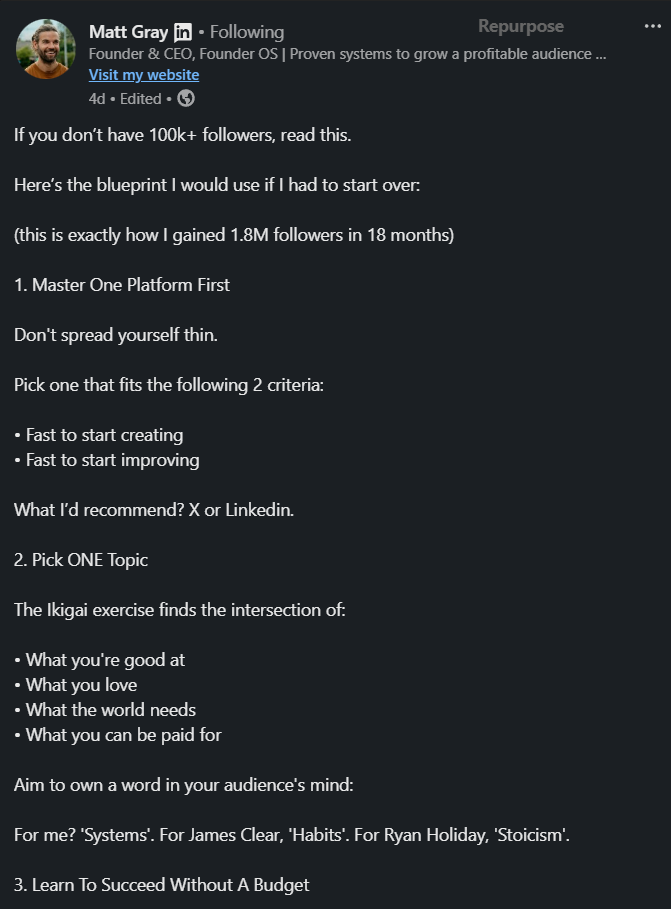
Here are some key tips to follow when sharing actionable advice on LinkedIn:
Use a listicle format
Make it something people can implement within 24 hours
Use examples to make it extremely clear
Curation
Michael George bought 2M acres of land. Put 55,000 chickens in it. Turned the land into a profitable business. Here’s the story:
There is no story — I completely made it up.
But that’s not the point…
I want you to think about what it did to you:
Did it make you feel like I’d done my research?
Did that make you trust me a little more?
Did my content seem more credible?
I’m sure you answered “Yes” to them all, and that’s exactly my point
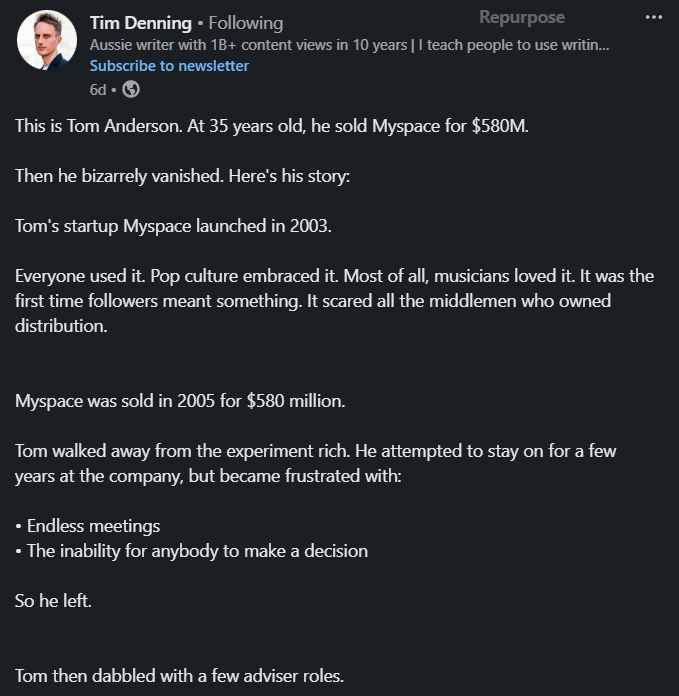
When you share relevant and valuable content from other sources, it helps you build trust and credibility with your audience.
They see you as a reliable source of information.
So, do it often.
But note there are two ways you can curate content:
One-to-one — you curate one resource or person.
One to many — you curate many other resources or people.
It doesn’t matter which you do as long as it saves people time and adds real value.
Another thing you should consider is whether you’re going to tag people you mention beforehand because this has a significant impact on what you’re going to write.
For example, if you’re going to say things the person being curated is unlikely to reshare, you’re probably better off not tagging them — and vice versa.
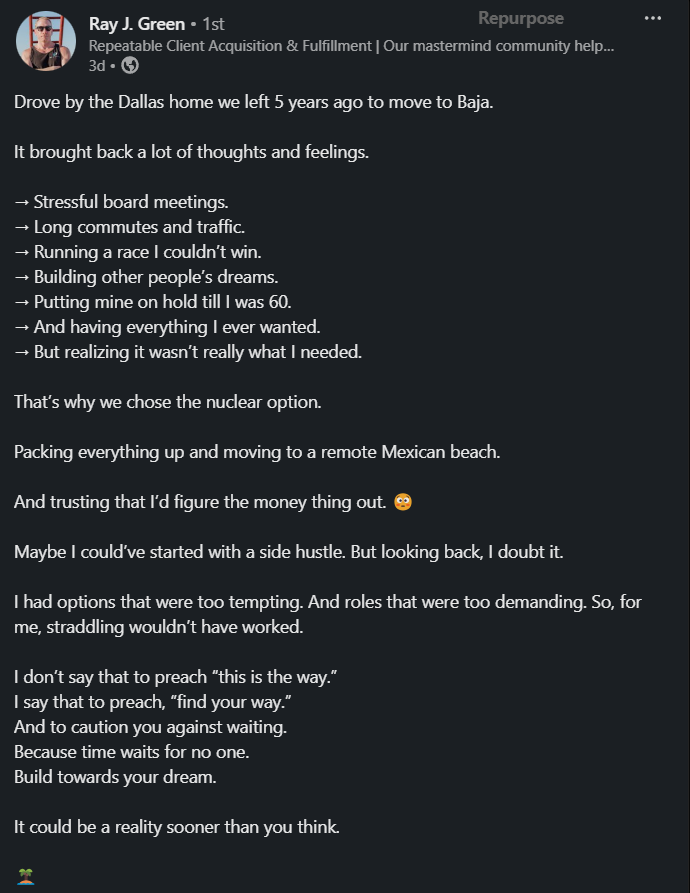
𝗪𝗵𝗮𝘁 𝘆𝗼𝘂 𝗱𝗶𝗱 𝗶𝗻 𝘁𝗵𝗲 𝘄𝗲𝗲𝗸
Being you is one of the coolest jobs on the planet.
Nobody knows what it’s like.
Leverage your position to your advantage by giving them “a week in the life” sample.
Note this isn’t only for other people’s benefit.
It’s a great strategy to keep yourself accountable.
As Pearson’s law states:
“That which is measured improves. That which is measured and reported improves exponentially.”
So, kill two birds with one stone.
Do cool stuff, then talk about it.
People enjoy following people who are winning, so make an effort to show you’re improving.
If that means sharing some numbers, so be it — but you don’t have to.
Random ideas from content you’ve consumed
Hopefully, you’re constantly learning and growing.
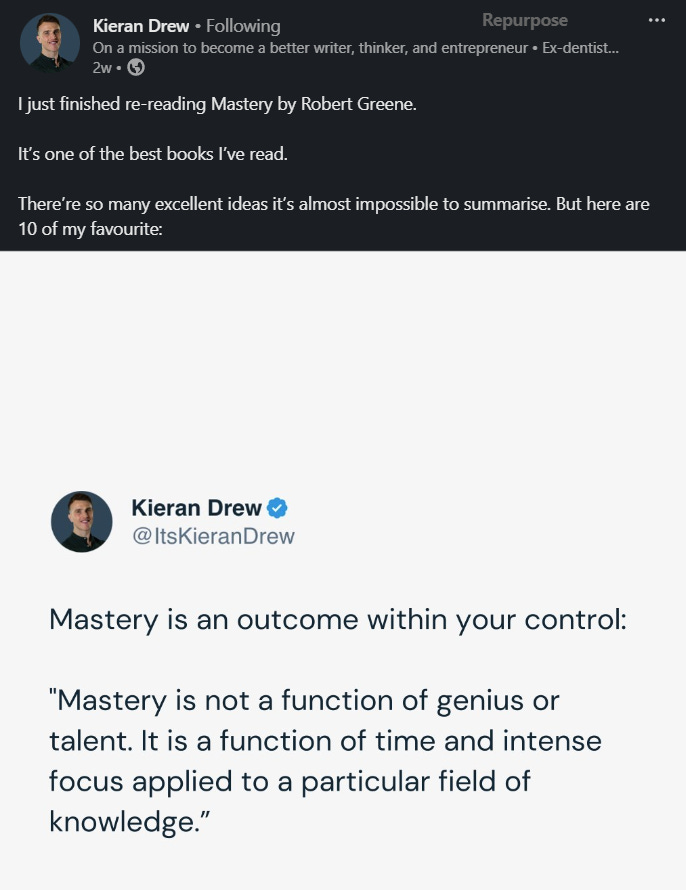
This is fertile ground for content.
Just take something that’s been on your mind and add a little twist to it…
For example, this week, I’ve been thinking a lot about “how to put yourself out there as a business leader.”
My search led me to insights from the dating world, which gives me unique perspective on gaining visibility.
In other words, nobody else could write it — and this sets me apart.
Here’s an example:
V𝘂𝗹𝗻𝗲𝗿𝗮𝗯𝗹𝗲 shares
One of the most powerful tools in storytelling is vulnerability.
It allows people to create connections between one another like no other.
Exposing your wounds helps people to see beyond your flesh.
And it’s here where they can begin sharing a deep emotional experience with you.
For example, I once shared a post about going bald at 25 and what it taught me about business, and a bunch of baldies started coming out and sharing their stories too.
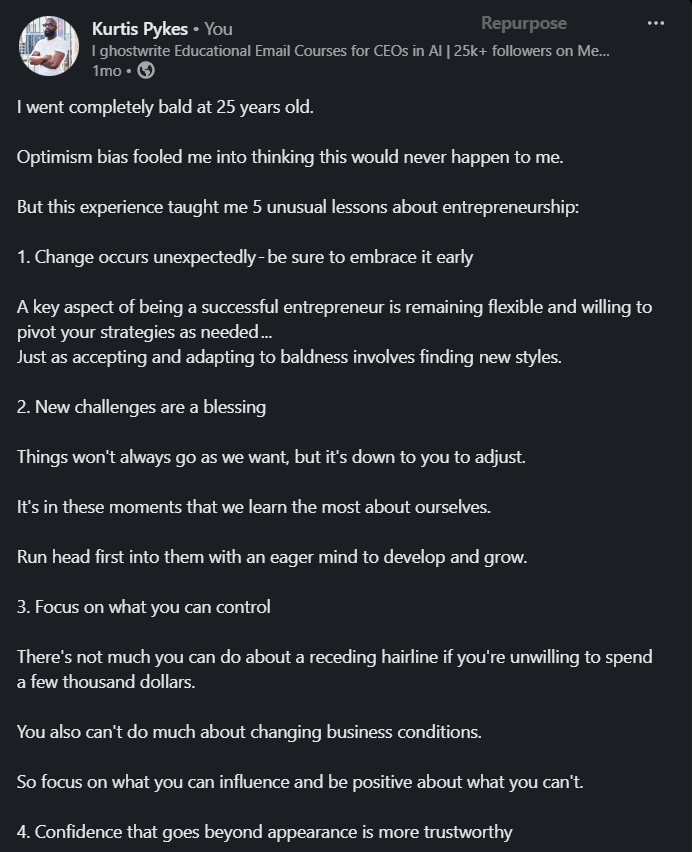
Here are the types of vulnerable content that make a mark:
Mistakes you’ve made
Costly lessons
Stories that scared you
The key is to be genuine if you want the emotional connection to happen.
Don’t make stuff up!
Reflect on things that have happened to you and draw meaning from them so you can help others.
That’s all from me…
Thanks for reading!