


Most ghostwriters I see on LinkedIn fall into one of two camps:
They post constantly without a clear strategy.
They barely post because they don't know what to talk about.
I used to fall into the first camp.
I’d wake up, open my database of LinkedIn posts I’d saved from other creators, find something I liked, and rewrite it using one of my own stories.
And unsurprisingly, hardly anyone reached out wanting to work with me.
This leads me to rule number one of ghostwriting (and business as a whole)…
You can’t copy other people’s strategy without understanding why it worked.
You’ll forever be one or more steps behind the people you’re stealing from, which means you lose any chance at a competitive advantage.
Rule number two is to act with intent.
Every post you publish should have a reason for existing.
You should know exactly what you want the reader to think, feel, or do after consuming it.
Then there’s the other camp of ghostwriters. ..
Those who barely post because they don’t know what the hell to talk about.
And I get it.
Coming up with something interesting to say every day is difficult.
But you have to take care of your own garden if you want someone to trust you with theirs.
Fortunately, you don’t need a groundbreaking idea every time you post.
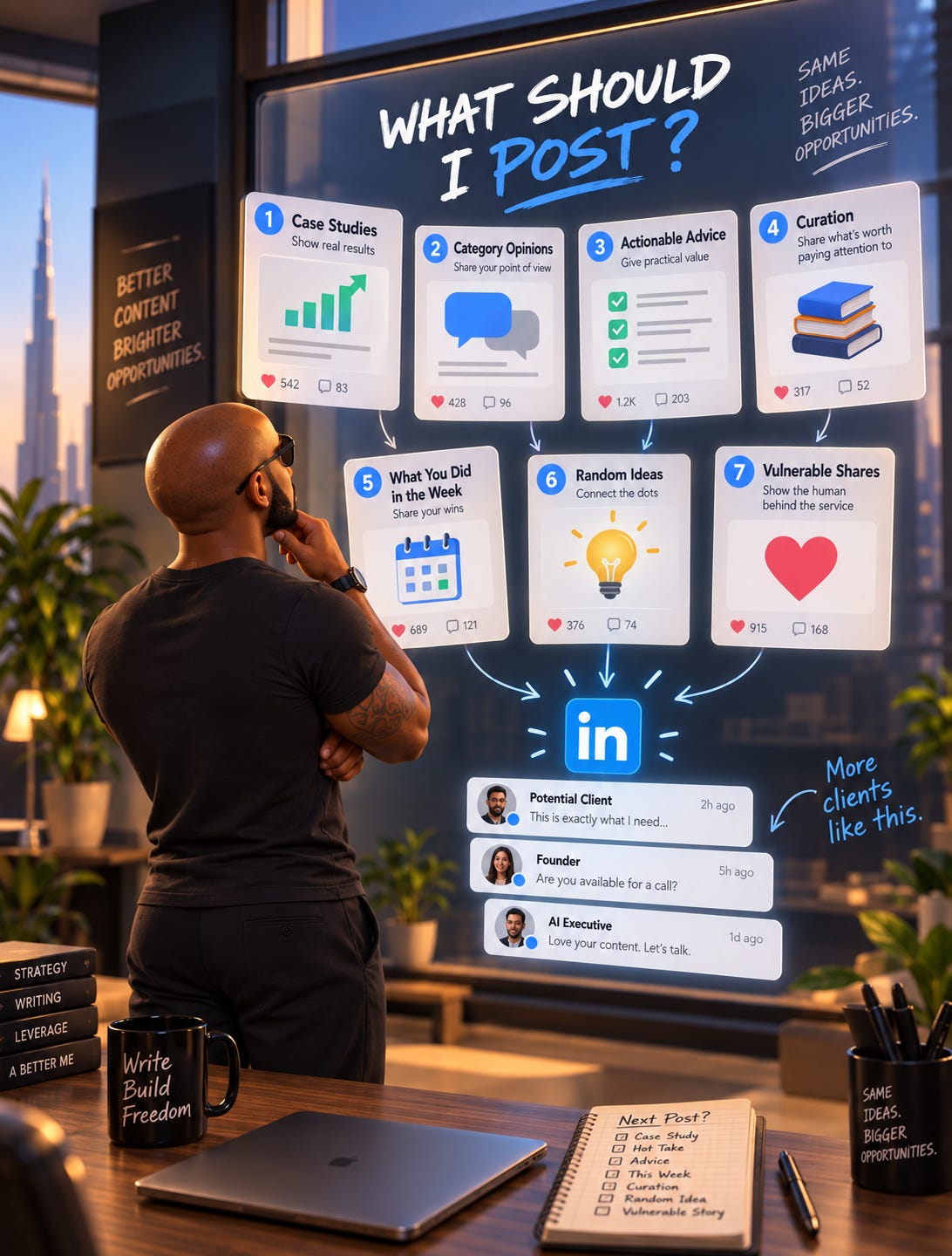
Most of my LinkedIn content falls into one of 7 categories:
Case studies
Category opinions
Actionable advice
Curation
What I did this week
Random ideas from content I’ve consumed
Vulnerable shares
Each serves a different purpose.
And together, they help potential clients understand:
What you know
How you think
What you’ve done
Who you are
So if you never know what to post - or you’re posting without knowing why - steal this framework instead.
Let’s start with the first…
1. Case Studies
Purpose: Prove you understand how to get results.
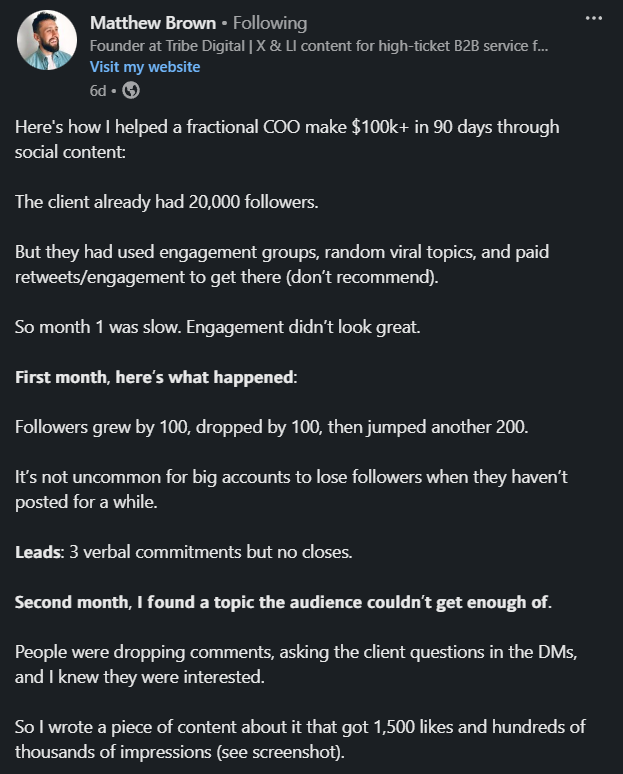
Case studies work because they allow prospective clients to experience the result before they buy.
It works just like movies do…
Think back to the last movie you watched.
Mine was American Gangster.
For the duration of it, you’re immersed.
You can feel the main protagonist's emotions.
I remember shouting at my TV when I sensed the drive-by was about to happen to Frank Lucas.
A good case study has the same effect on readers.
They see someone experiencing a problem they recognize.
They follow their journey.
And when they see their desired outcome fulfilled by someone else, they think, “That could be me.”
This is the emotion you want to provoke.
But before I show you how to do it, let’s backtrack to where you can find case studies.
There are 3 main sources:
Something you’ve done for yourself.
Something you’ve done for a client.
Something someone else has done that you can analyze.
If you’re just starting out, the first one matters most.
You must be your first case study because you’ll have far more conviction talking about something you’ve done.
Now, let’s get into the structure of a case study post…
1.1 Lead with the result
LinkedIn only gives you a small amount of space before hiding the rest of your post behind “...see more.”
So you need to give people enough context to care within those opening lines.
The best way I’ve found is to lead with the result.
Don’t make people wait until the end to find out what happened.
Use the outcome achieved as your hook.
For example:
I made my ghostwriting client $14,452 in 24 hours from one LinkedIn post.
Now they know exactly what happened.
But they don’t know how it happened.
That's what keeps them reading.
1.2 Show where they started
Next, paint a picture of how difficult circumstances were before the outcome.
What wasn’t working?
What was desired?
What was at stake?
This is how we relate to prospective clients.
They are likely going through a similar issue, so when they see someone where they are, it gives them the most powerful substance a human can have…
Hope.
1.3 Explain the transformation
Now show them how you helped move the client from Point A to Point B.
Explain the key decisions and actions that made the transformation possible.
What did you notice?
What did you change?
Why did you change it?
This is your opportunity to demonstrate expertise without ever having to say, “I’m an expert.”
You show them WHAT you did and WHY it worked.
Which naturally makes the ideal prospect curious about what you could do for them.
1.4. Show the transformation
Finally, show what changed because of the actions taken.
And don’t limit this to the headline metric.
What did the result do for the client?
Did they:
Sell out their workshop?
Generate more qualified leads?
Free up their time?
Build a more predictable pipeline?
This is where you bring the story full circle.
The prospect saw someone like them at Point A.
They watched you help them reach Point B.
And now they associate you with the bridge between the two.
They might not hire you immediately.
But you’ve given them a pretty damn good reason to remember you.
2. Category Opinions
Purpose: Show potential clients how you think.
I’m not a fan of Andrew Tate.
But we can still take a few marketing lessons from his online rise.
One of the most valuable lessons is the power of strong opinions.
Tate knew how to get people talking.
He would say something outlandish…
Some would agree.
Others would disagree.
And both sides went to great lengths to defend or discredit him.
All of this brought Tate more engagement and recognition.
That’s the power of opinions…
They give people something to react to.
The crazy thing is, we all have them.
But we don’t use them.
Why?
Because we don’t want to piss anyone off, so we water down what we really think to fit in.
Here’s the catch…
If you want to get attention, you don’t need everybody to agree with you.
As Tate showed us, disagreement can spread your ideas to people who agree with you.
So don’t be afraid to share your opinions.
Just follow this structure when you do:
2.1 State what you believe
Your opinion is the most interesting part of these posts, so start with it to grab attention.
For example:
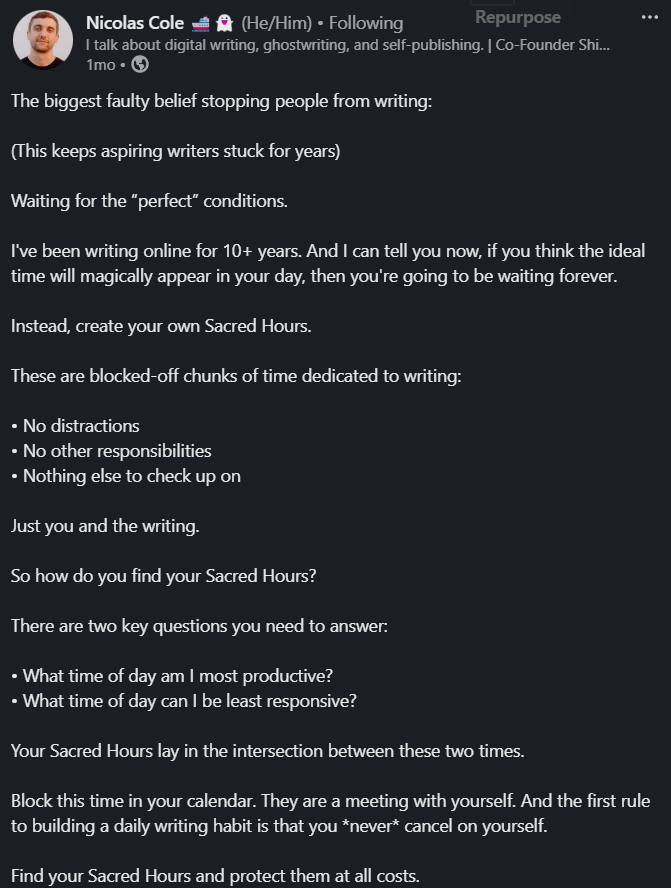
“The dumbest thing a writer can do is write every day.”
This is attention-grabbing because it:
Goes against societal norms
Leaves enough room for people to wonder, “but why?”
The key here is to share things you genuinely believe.
Don’t manufacture a controversial opinion because you think it’ll get engagement.
Say what you actually think.
Then be prepared to defend it.
2.2 Explain why you believe it
Remember, we’re posting on LinkedIn to get people to buy from us.
And in order to achieve this, we must convince people:
We know what we’re talking about
We can get results for them
We’re decent people
Reasoning shows people you’re capable of achieving all three.
… hence why you must justify your opinions.
This can be difficult for some because in everyday life, you don’t owe anyone an explanation for what you believe.
But we use these posts to show how we think.
So give people the reasoning behind the opinion.
2.3 Give them evidence
Evidence gives people grounds to believe your opinion.
Anyone can say:
“The dumbest thing a writer can do is write every day.”
But why should I believe you?
This is where you bring in:
Personal experiences
Client stories
Experiments
Examples
Data
For example, maybe you tried writing every day, and your work quality dropped.
Showing what led you to that conclusion gives people a chance to relate (or dissociate).
This is what will make the right people reach out.
3. Actionable Advice
Purpose: Help prospects get a quick win to experience working with you.
Whenever I need financial advice, I speak to my dad.
Whenever it’s something operational, like planning a trip, I speak to my mom.
Why?
If I asked my dad for operational advice, he would tell me to ask my mom.
And if I asked my mom for financial advice, she would tell me to send her the money.
The point is...
Context matters.
My dad has been a high earner for most of my life and has always handled the family finances.
My mom has always handled operational things.
Both are experts (to me) in their respective areas, so it makes sense to listen to them about that specific thing they’re good at.
How does this relate to you?
Well, you’re an expert at something and have your own opinions about how it should be done.
Sharing that knowledge in an actionable way will set you apart from people dishing out generic advice.
Because I want to learn how to make $1M from someone who has made $1M, not some random person dishing out second-hand advice from their pastor.
So share actionable advice about what you know.
But do it like this...
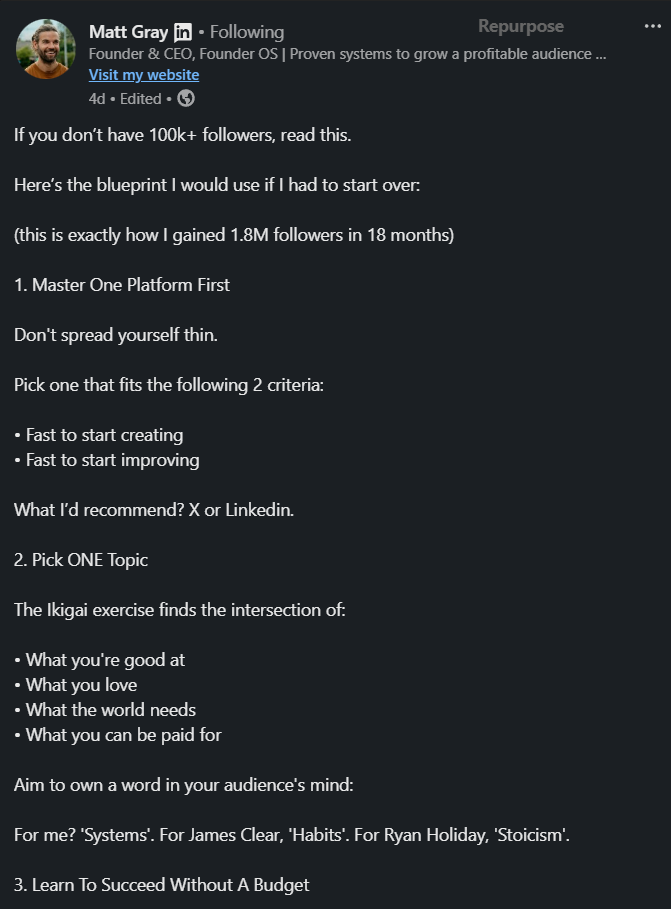
3.1 Use a listicle format
Readers love lists for two reasons:
They tell you exactly what you’re getting.
They’re easily consumable.
From a writer’s perspective, they’re great because they force you to break a broad idea into bite-sized steps.
You can structure the post around:
Steps
Mistakes
Lessons
Rules
Questions
Tools
Examples
Do’s and don’ts
The most important thing is that you give a clear promise, then organize the advice in a way that’s easy to follow.
3.2 Make it something people can implement within 24 hours
I have a simple rule for actionable advice:
The reader should be able to implement it within 24 hours.
Why?
Because the purpose of actionable advice is to help prospects get a quick win.
You want them to taste what it would be like to work with you.
This way, they will associate achieving their desired outcomes with you.
3.3 Use examples to make it extremely clear
Examples remove the need for interpretation.
For instance, let’s say I told you to “Write more specific hooks."
You might understand what I mean… but you still have to figure out what “more specific” looks like.
Now, let’s say I added this:
Don’t write hooks like → “Here's how I generate leads from LinkedIn.”
Instead, write hooks like → “I got 17 inbound leads from LinkedIn last month. Here are the 3 hooks responsible for most of them.”
Now you can see what I mean by “more specific.”
There’s no guessing.
So when you write actionable advice posts, remove as much ambiguity as possible.
Don’t just tell people what to do…
Show them what doing it well looks like.
4. Curation
Purpose: Demonstrate you know the market well
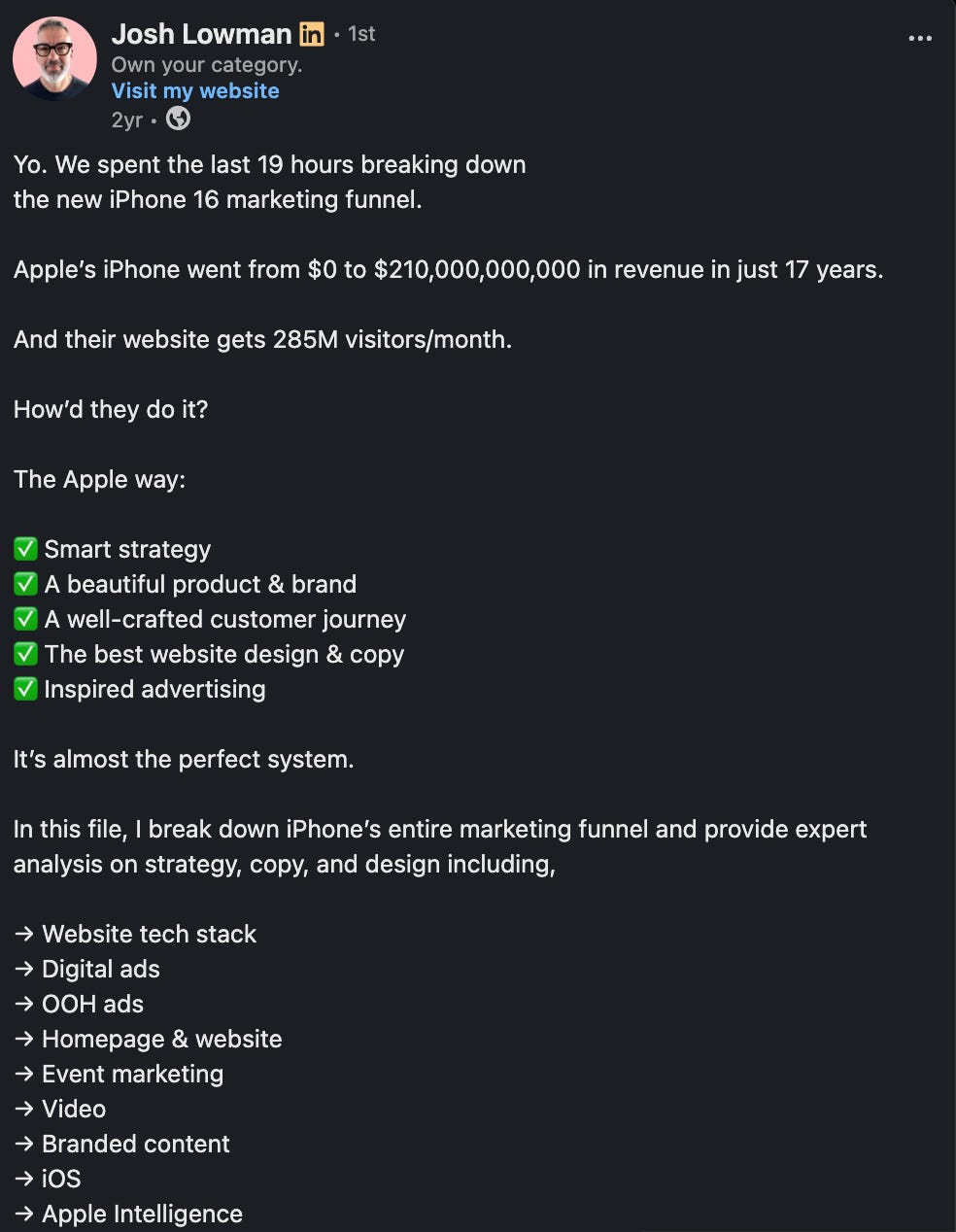
Michael George bought 2M acres of land.
Put 55,000 chickens on it.
Turned the land into a profitable business.
Here’s the story…
There is no story.
I completely made it up.
But that’s not the point…
I want you to think about what those first three lines did:
Did it make you feel like I’d done my research?
Did that make you trust me a little more?
Did my content seem more credible?
If you answered “yes” to even one, that’s my point.
When you consistently share relevant and valuable information from other sources, you demonstrate that you pay attention to your market.
Over time, people start seeing you as someone who finds interesting that is worth knowing.
And that’s valuable.
Your prospects are busy.
They don’t want to spend hours:
Reading every report
Listening to every podcast
Following every expert
Keeping up with everything happening in their industry
You can become their filter.
Find the useful stuff.
Remove the noise.
Give them what matters.
There are two main ways I like to curate content:
4.1 One-to-one curation
This is where you take one person, resource, idea, or piece of content and build a post around it.
For example, you could:
Break down an interesting case study.
Share something you learned from a podcast.
Analyze somebody’s strategy.
Explain an interesting piece of research.
React to an idea from a book.
But don’t just repeat what they said.
Add your interpretation.
Why did you find it interesting?
What can your audience learn from it?
What did they miss?
How could somebody apply the idea?
The original source gives you the material.
Your perspective gives people a reason to follow you for it.
4.2 One-to-many curation
This is where you collect multiple useful resources, people, examples, or ideas into one post.
For example:
I spent 10 hours researching the best resources for learning AI.
Here are the 7 I’d actually recommend:
You’re doing work your reader doesn’t want to do themselves.
You find everything.
You filter it.
You organize it.
And you hand them the useful bits.
4.3 Decide whether you want to tag people
There’s one more thing to consider when curating people on LinkedIn…
Are you going to tag them?
I like to decide this before writing the post because it can influence how I approach it.
If you’re praising somebody’s work or sharing an analysis they’re likely to appreciate, tagging them can make sense.
They might respond.
They might reshare it.
And their audience might discover you as a result.
But if you’re criticizing their work or saying something they’re unlikely to want associated with them, you probably don’t need to drag them into the conversation.
Good curation is pretty simple…
Find useful information → filter out the crap → add your perspective.
5. What You Did in the Week
Purpose: Humble bragging/share your wins
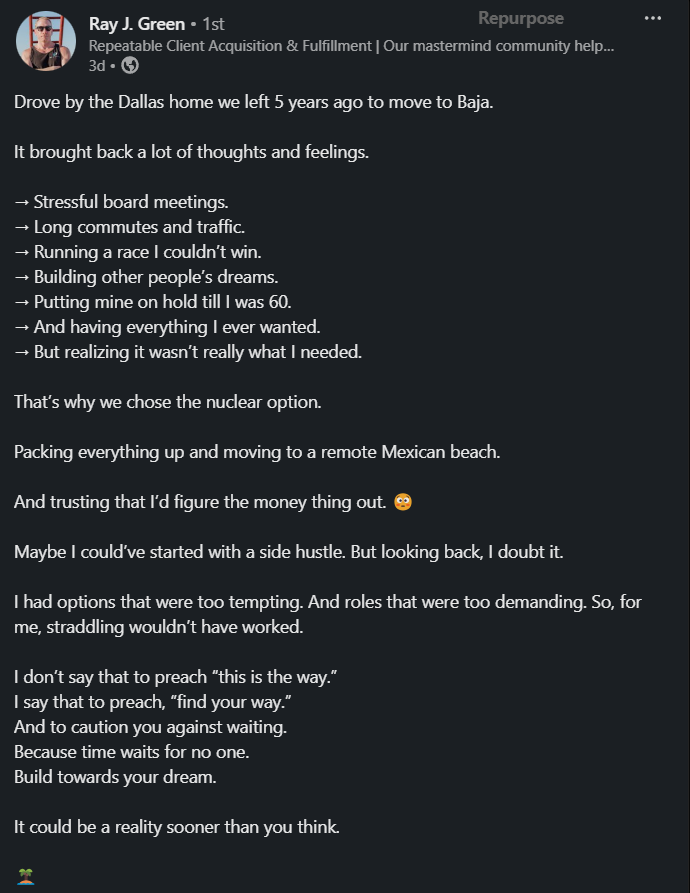
Being you is one of the coolest jobs on the planet.
Nobody knows what it’s like.
Leverage your position to your advantage by giving them “a week in the life” sample.
Note this isn’t only for other people’s benefit.
It’s a great strategy to keep yourself accountable.
As Pearson’s law states:
“That which is measured improves. That which is measured and reported improves exponentially.”
So, kill two birds with one stone.
Do cool stuff, then talk about it.
People enjoy following people who are winning, so make an effort to show you’re improving.
If that means sharing some numbers, so be it — but you don’t have to.
6. Random Ideas From Content You’ve Consumed
Purpose: Demonstrate intellectual curiosity and original thinking.
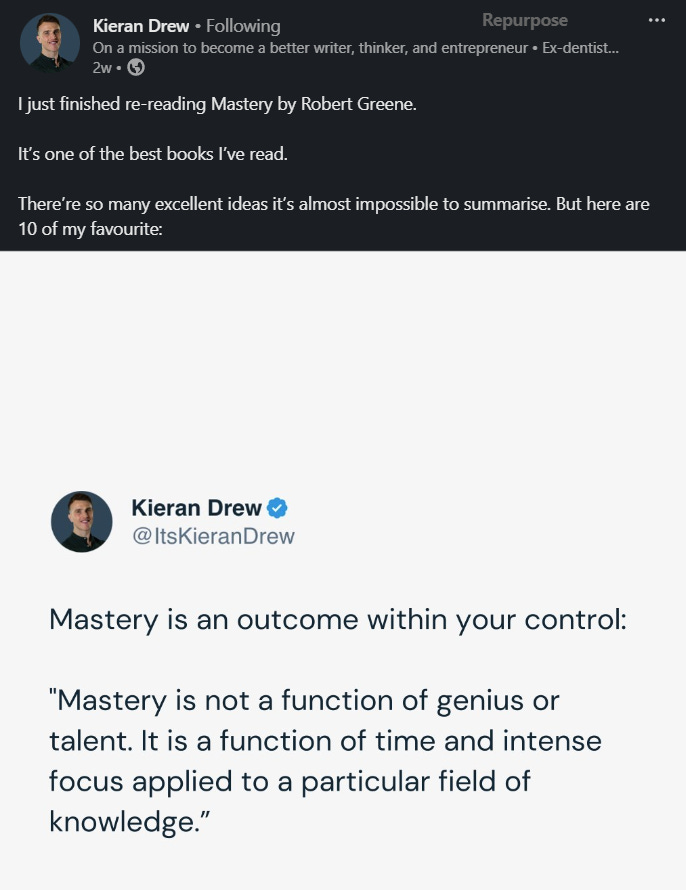
Hopefully, you’re constantly learning and growing.
This is fertile ground for content.
Take something that’s been on your mind and connect it to something you know.
For example, this week, I’ve been thinking a lot about “how to put yourself out there as a business leader.”
My search led me to insights from the dating world, which gave me a completely different perspective on gaining visibility.
This connection is where the interesting content comes from.
Someone else might consume the exact same information and reach a completely different conclusion.
In other words, nobody else could write the post exactly like you.
And that’s what sets you apart.
7. Vulnerable Shares
Purpose: Make people trust the human behind the service.
One of the most powerful tools in storytelling is vulnerability.
It allows people to create connections with one another like almost nothing else.
Exposing your wounds helps people see beyond your flesh.
And it’s there where they can begin sharing a deeper emotional experience with you.
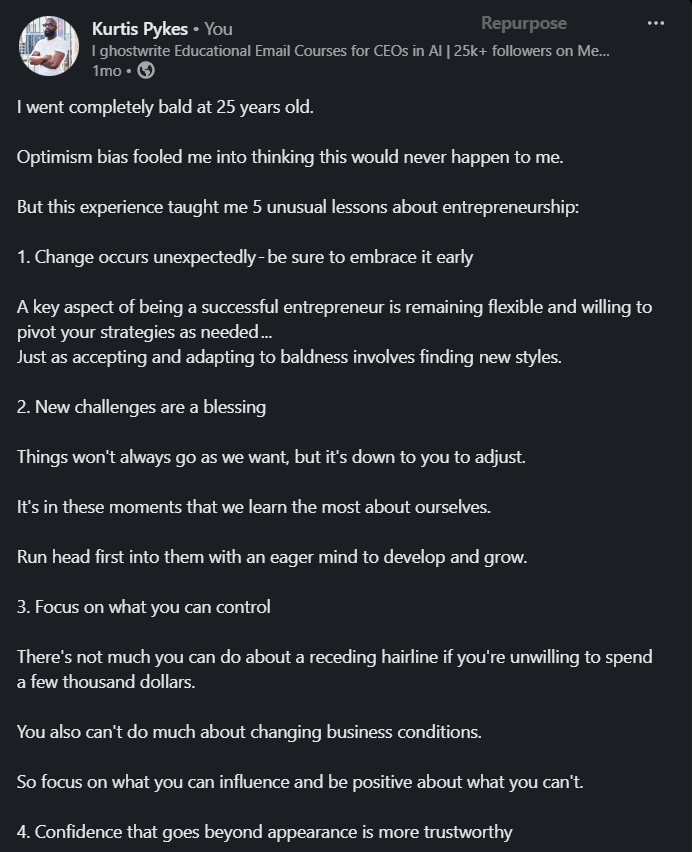
For example, I once shared a post about going bald at 25 and what it taught me about business.
Suddenly, a bunch of baldies started coming out and sharing their stories too.
We had a shared experience.
And shared experiences create connection.
Here are a few types of vulnerable content that tend to make a mark:
Mistakes you’ve made → especially ones your audience might be making too.
Costly lessons → things you wish you’d understood sooner.
Stories that scared you → moments where you failed, struggled, took a risk, or didn’t know what would happen next.
The key is to be genuine if you want that emotional connection to happen.
Don’t make stuff up.
And don’t force vulnerability because you think it’ll perform well.
Reflect on things that have genuinely happened to you.
Figure out what they taught you.
Then share the story in a way that helps someone else make sense of their own experience.
People might hire you for what you know.
But they connect with you because of who you are.
Final thoughts
When I first started posting on LinkedIn, I didn’t have a content strategy.
I found posts I liked, rewrote them using my own stories, published them, and hoped someone would reach out.
This is why nobody reached out.
Every post you publish should have a reason for existing.
That’s not to say you should become a LinkedIn influence, but you do need the right people to understand:
What you know.
How you think.
What you’ve done.
Who you are.
Why they should trust you with their content.
That’s what these 7 types of posts are designed to do.
You don’t even need to use all seven every week.
Just use them intentionally to build the perception you want prospective clients to have of you.
And remember….
Don’t create content just to attract an audience.
Create content that makes the right people want to work with you.
Thanks for reading!