

7 Types of Posts That Consistently Generate Leads On LinkedIn
And how you can recreate them...

I’ve been sharing and studying LinkedIn content daily for nearly 2 years.
Here’s my verdict:
Most people aren’t struggling to generate leads because they can’t write…
They’re struggling because they’re writing the wrong kind of content.
The content they share doesn’t prompt their target audience to take action.
So people read it…
And move on.
I’ve been stuck in this loop more times than I’d like to admit over the past 6 years.
And every time, I made the same mistakes:
Post more
Comment more
“Stay consistent”
You know… all the garbage the gurus preach to keep you engaged with their content.
All it did was burn me out.
It’s the reason my content journey had so many stop-starts.
But over the past 2 years, things changed.
I generated $10.1M+ in sales pipeline for clients
Scaled to a 6-figure business with just 3 customers
All obtained through founder-led content on LinkedIn.
How did I do it?
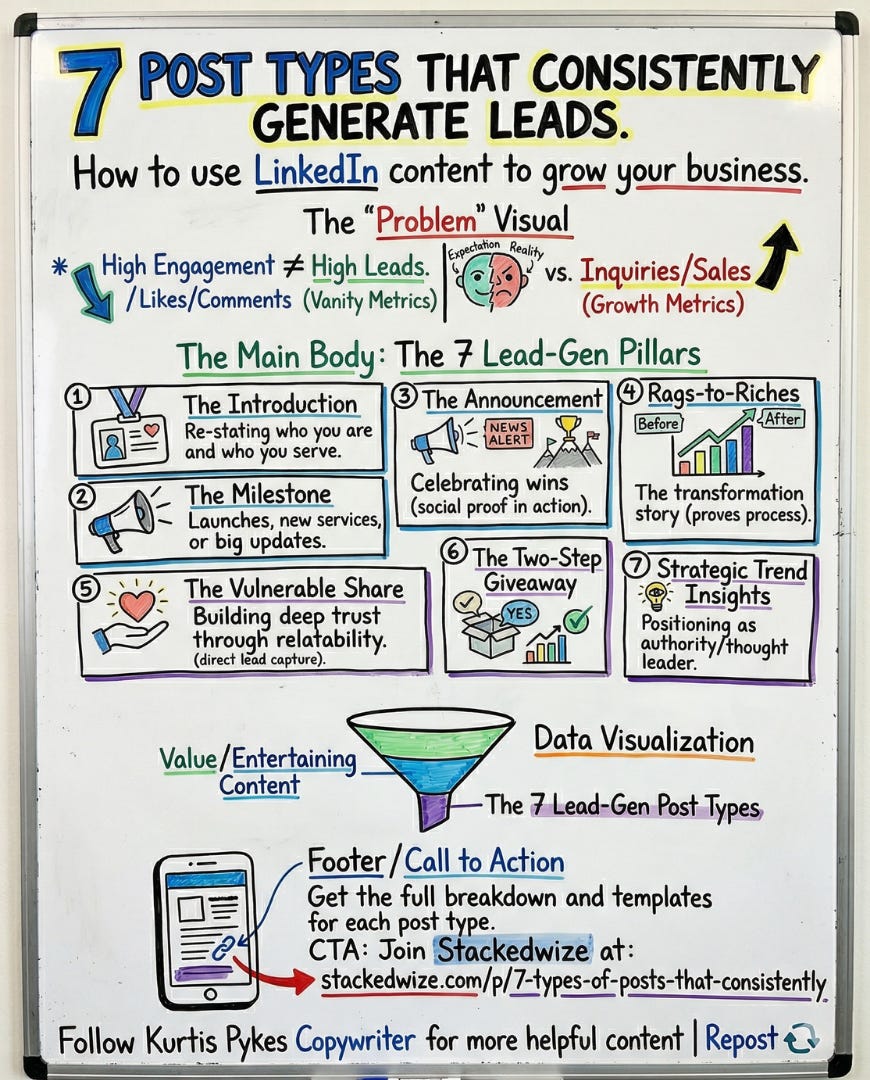
I’ve found 7 types of LinkedIn posts that consistently generate leads on the platform.
I’ve used them across my own content and my clients’.
Every time… they’ve been a hit.
So today, I’m breaking them down for you…
1. Introduction posts
If you’re constantly adding a new batch of people to your following, it’s likely you’re going to have several people in your audience who don’t know who you are.
This is bad.
Why?
Because context is what makes your content hold weight.
For example, would you rather go to a millionaire or a homeless person for financial advice?
Hopefully, you said the millionaire.
But what if the millionaire and the homeless person are dressed the same… how do you know who to listen to?
This is why context matters.
If people don’t know your context, your message will not land as hard.
So it’s your responsibility to constantly remind your audience about who you are.
Here’s an example:
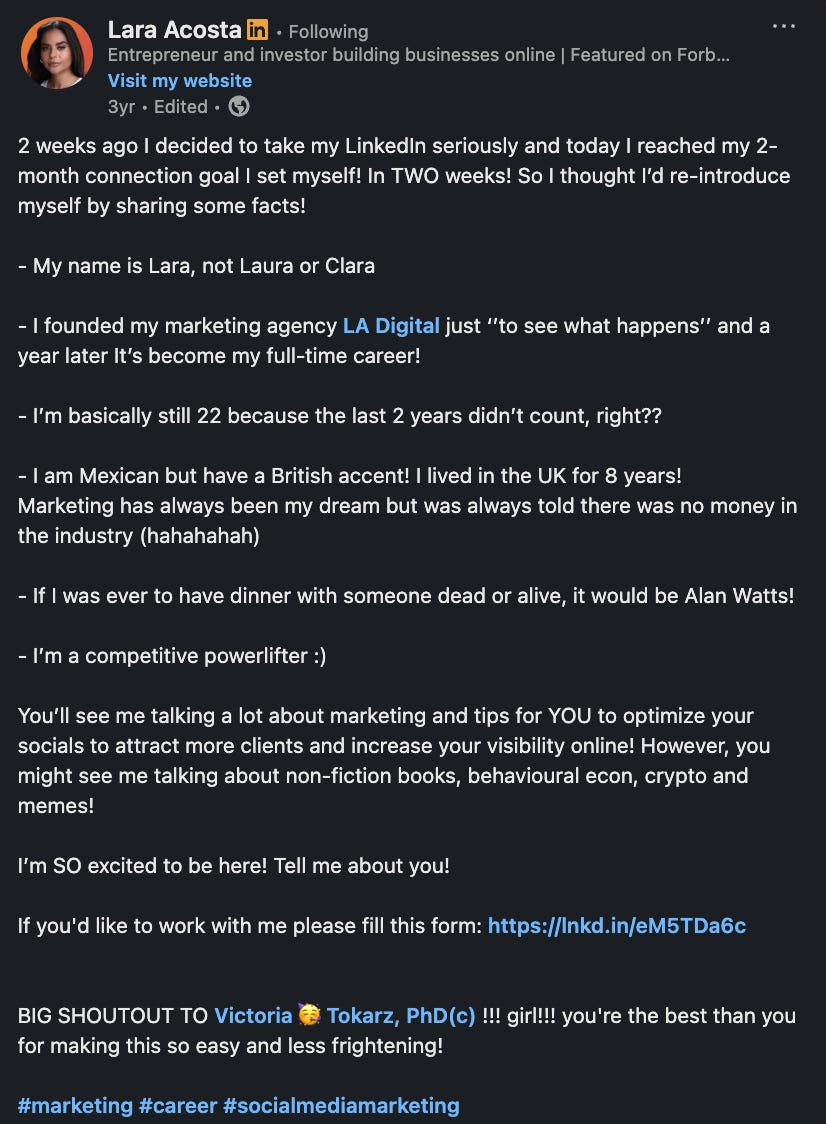
There are 4 steps to reproduce an introduction-style post:
1. Context (Why now?)
Start by explaining why you’re introducing yourself now.
This anchors the post in a moment.
Examples:
New followers
Milestone
Shift in direction
Formula:
“I’ve recently [event/milestone], so I wanted to reintroduce myself…”
👉 This makes the post feel timely.
2. Relatability (Who are you as a person?)
Share quirky and real details about yourself.
This is what makes people feel connected to you.
Mix:
Personal facts
Quirks
Background
Light humour
Formula:
“Here are a few things about me:
[Personal fact]
[Unexpected detail]
[Relatable trait]”
👉 This lowers resistance and builds familiarity.
3. Positioning (Why should they care?)
Now transition into:
What you do
Who you help
What you talk about
This is where you establish authority + relevance.
Formula:
“You’ll see me talking about [topic] to help [specific person] achieve [specific outcome]”
👉 This answers: “What’s in it for me?”
4. Call to Action (What should they do next?)
End with a low-friction CTA.
Options:
Invite engagement
Invite connection
Offer your service
Formula:
“If you’d like to [desired action], [CTA]”
“Or tell me about you below”
👉 This turns attention into action.
Why this works…
This structure hits 3 key points:
Clarity → People understand who you are
Connection → People feel like they know you
Conversion → People know how to engage or work with you
Here’s a simple template…
If you wants to copy this directly:
“I’ve recently [achievement], so I wanted to reintroduce myself.
Here are a few things about me:
[Personal fact]
[Relatable detail]
[Background]
I [what you do] and help [who] achieve [outcome].
You’ll see me talking about [topics].
If you’d like to [CTA], [action].
Also… tell me about you 👇”
2. Announcement posts
One thing I love about LinkedIn is that most people here want to see others win.
So when you share, you’re doing something new, people will usually get on board to show support.
So give the people what they want.
Use these posts to tell the world you’re:
Launching something
Changing direction
Starting or ending something
Here’s an example of an announcement post:
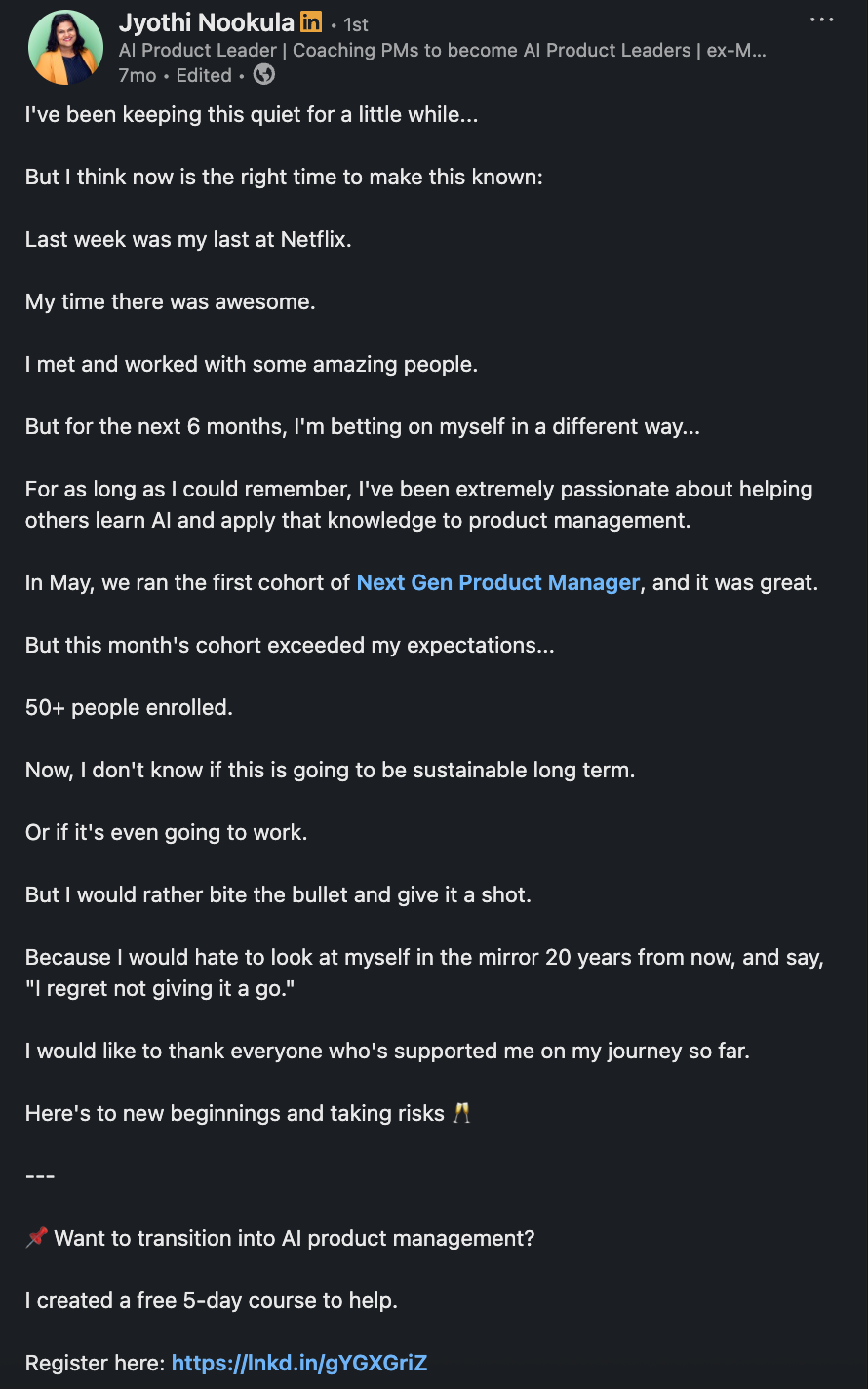
So here’s the generic structure of an announcement post:
1. Signal (What’s happening?)
Open with a pattern interrupt + clear announcement.
You want curiosity first.
It’s almost like you’re about to share a secret.
👉 This creates tension and pulls people in.
2. Understand (Acknowledge the past)
Briefly reflect on:
What’s happening
What it means to you
Expressing gratitude
👉 This builds credibility and emotional weight.
3. Risk (What are you doing now?)
Now introduce the shift:
What you’re doing next
Why you’re doing it
The uncertainty behind it
👉 This is makes people eager to root for you.
4. Extend (Invite action)
End with a natural bridge into your offer.
Make it feel like an extension of the story rather than a hard sell.
Formula:
“If you’re interested in [desired outcome], I created [resource]”
“You can check it out here: [link]”
👉 This converts attention into leads.
Why this works…
This structure taps into:
Narrative tension → Leaving something stable behind
Relatability → Fear + uncertainty
Aspiration → Betting on yourself
Opportunity → Clear next step for the reader
Here’s a simple template…
“I’ve been keeping this quiet…
But now feels like the right time to share:
[Announcement]
My time at [past situation] was [positive reflection].
But now I’m [new direction].
I don’t know if this will work.
But I’d regret not trying.
Appreciate everyone who’s supported me so far.
—
If you want to [result], I put together [resource].
[Link]”
3. Milestone posts
Piggybacking off the last point...
People love to see others win.
Tapping into this content type is a great way to anchor your credibility and signal progress.
These posts are similar to announcement posts but are more focused on your win:
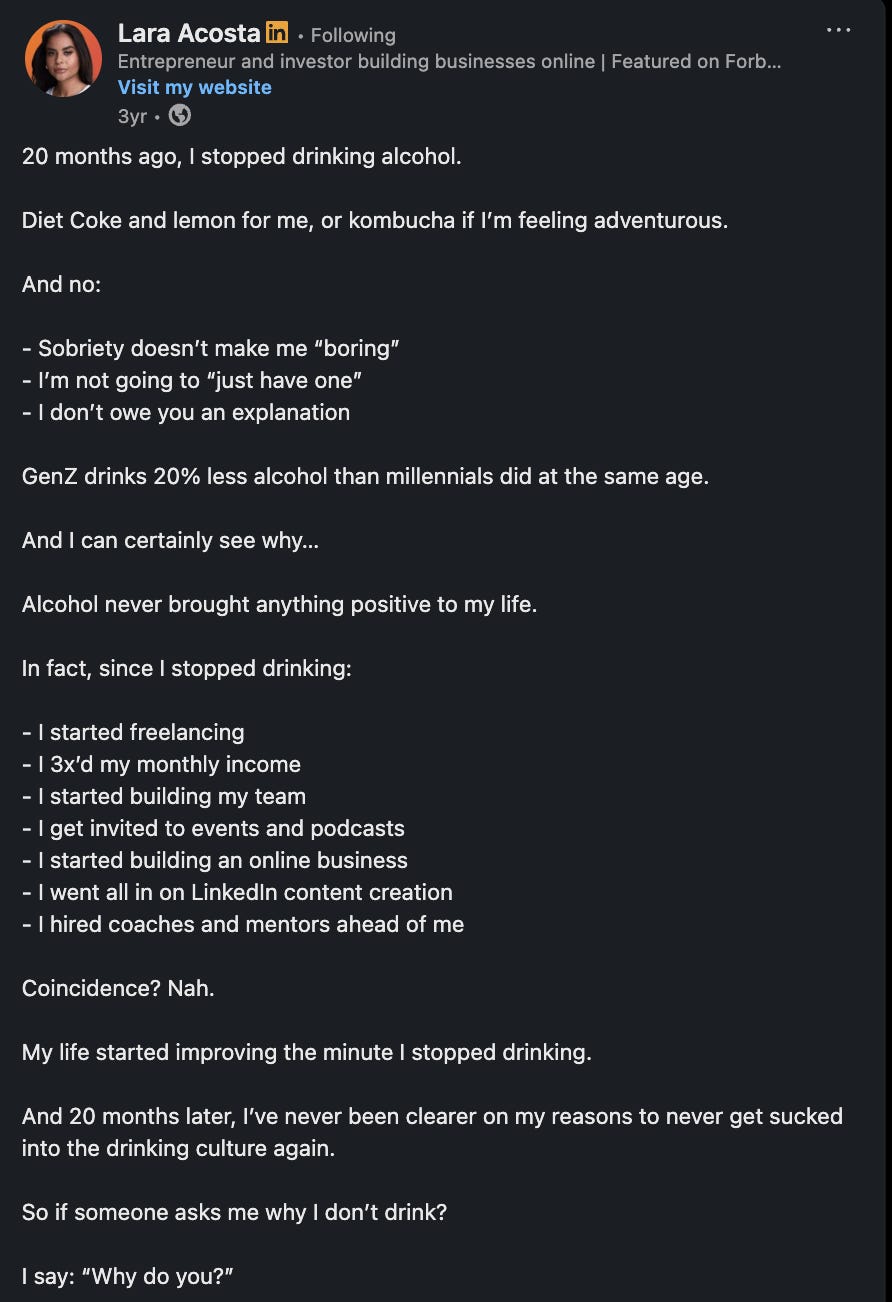
Milestone posts don’t necessarily generate leads directly.
… but they get people to say, “Me too,” which sparks conversations that typically lower people's guard and make them more welcoming to your approach.
This doesn’t mean you should hard sell straight after…
Social media is about building relationships and connections.
Most of my business has come from people I’ve built rapport with over time.
Anyways, here’s how to structure a milestone post:
1. Identity Shift (What changed?)
Start with a clear, time-based statement that signals transformation.
Formula:
“X months ago, I stopped/started [behavior]”
👉 This immediately anchors the reader in a before-and-after narrative.
2. Position (What you stand for now)
Address objections, misconceptions, or social pressure.
This is where you draw a line.
Formula:
“And no:”
[common objection]
[misconception]
[social pressure]
👉 This builds authority.
3. Reinforce (Proof of results)
List the tangible outcomes that followed the change.
Formula:
“Since I [change], here’s what happened:”
[result 1]
[result 2]
[result 3]
👉 This is where credibility is built.
4. Reframe (Challenge the reader)
Close with a perspective shift or question that flips the narrative.
Formula:
“So when people ask me [common question]…”
“I respond with [reframe]”
👉 This is what makes the post memorable and shareable.
Why this works…
This structure taps into:
Social proof → visible progress
Identity aspiration → “I want that version of me.”
Cognitive dissonance → challenges existing beliefs
Conversation triggers → invites “me too” responses
Here’s a simple template…
“X months ago, I [decision/change].
And no:
[objection]
[misconception]
[pushback]
Since then:
[result]
[result]
[result]
Coincidence? I don’t think so.
My life changed the moment I [core shift].
So when people ask me [common question]…
I ask them: [reframe].”
4. Rags-to-riches stories
Who doesn’t love a rags-to-riches story?
Transformation narratives work because people are wired for contrast.
The bigger the gap between “before” and “after,” the more compelling the story becomes.
And that’s exactly why these posts are so powerful for lead generation…
They show what’s possible for someone else.
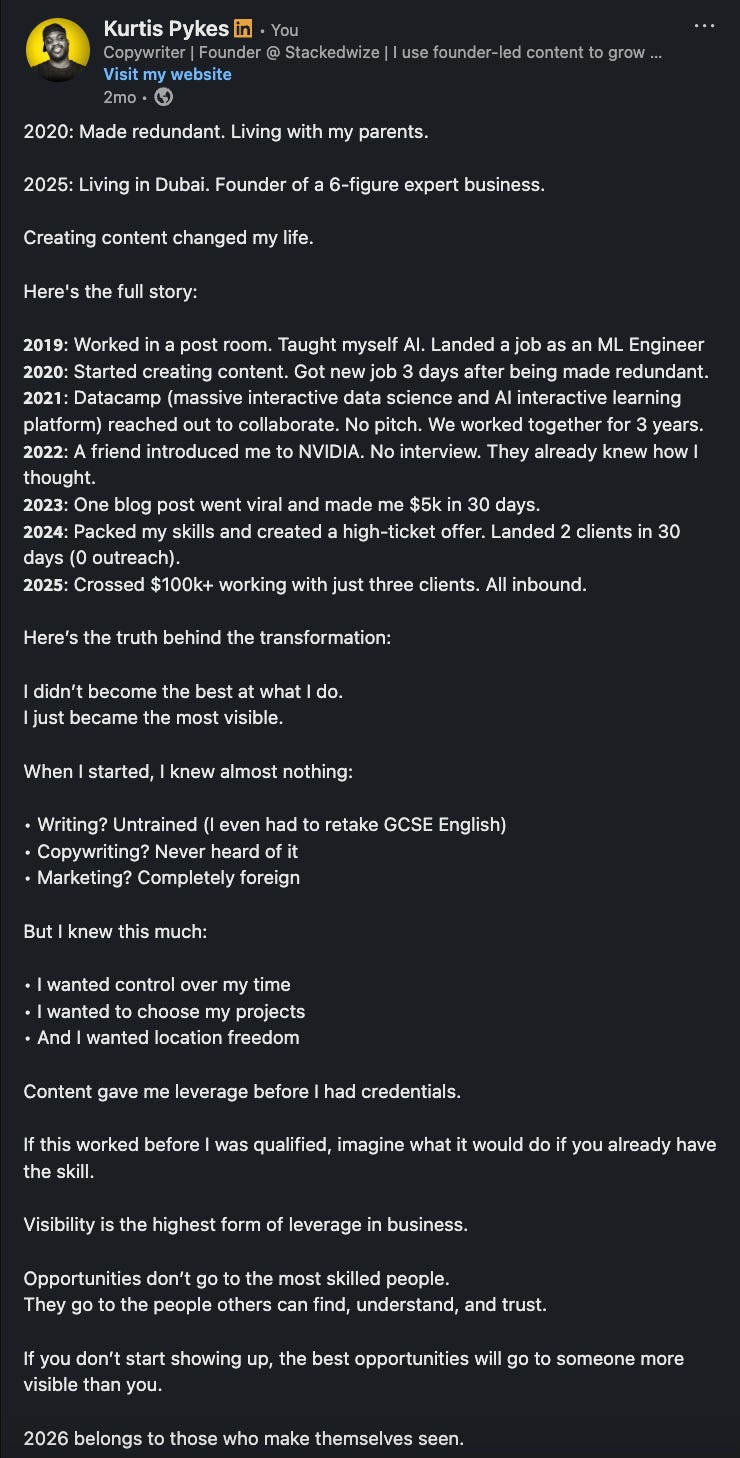
This is how you structure a post like this…
1. Contrast (Before vs After)
Open with a sharp, punchy contrast between your lowest point and current state.
Formula:
“Year X: [struggle]”
“Year Y: [result]”
👉 This creates immediate intrigue and stops the scroll.
2. Timeline (Bridge the gap)
Walk through the journey in compressed milestones.
Each step should show:
Progress
Momentum
Increasing leverage
Formula:
“Year X: [action → outcome]”
“Year X+1: [action → outcome]”
👉 This answers the unspoken question: “How did this happen?”
3. Leverage Point (The real reason it worked)
Reveal the non-obvious insight behind the transformation.
Formula:
“Here’s the truth:”
“It wasn’t [common belief]…”
“It was [actual driver]”
👉 This is what separates your story from generic motivation.
4. Validation (Make it relatable)
Break down:
What you lacked
What you wanted
Why you started
This pulls the reader into your story.
Formula:
“When I started, I didn’t have [X]…”
“But I knew I wanted [Y]”
👉 This is where identification happens for your audience.
5. Leverage Expansion (Generalize the lesson)
Turn your story into a universal principle.
But make it about THEM.
Formula:
“[Core insight] is the advantage”
“Opportunities go to people who [X]”
👉 This positions you as someone worth learning from.
6. Lead-In (Soft CTA)
Close by inviting the reader to step into the same path.
Keep it natural.
Formula:
“If you’re not doing this yet…”
“Now’s the time to start”
👉 This triggers the audiences next action
Why this works…
This structure hits:
Contrast bias → dramatic before/after
Narrative transportation → people follow the journey
Belief shift → “this could be me”
Authority → proven through lived experience
Curiosity gap → “how do I do this too?”
Here’s a simple template…
“Year X: [low point]
Year Y: [current result]
Here’s the full story:
Year X: [step]
Year X+1: [step]
Year X+2: [step]
Here’s the truth:
It wasn’t [what people think].
It was [what actually mattered].
When I started, I didn’t have:
[lack]
[lack]
But I knew I wanted:
[desire]
[desire]
That’s when everything changed.
[General principle]
If you’re not doing this yet…
You’re leaving opportunities on the table.”
5. Vulnerable shares
Vulnerability is a superpower.
But this isn’t about trauma dumping...
It’s strategic honesty that builds trust by reducing the perceived distance between you and others.
If all your content is polished wins and outcomes…
People will admire you, but they won’t relate to you.
And if they can’t relate, they won’t reach out.
Vulnerability makes you feel:
Approachable
Trustworthy
Authentic
This is also why it works so well for lead generation.
Here’s an example:
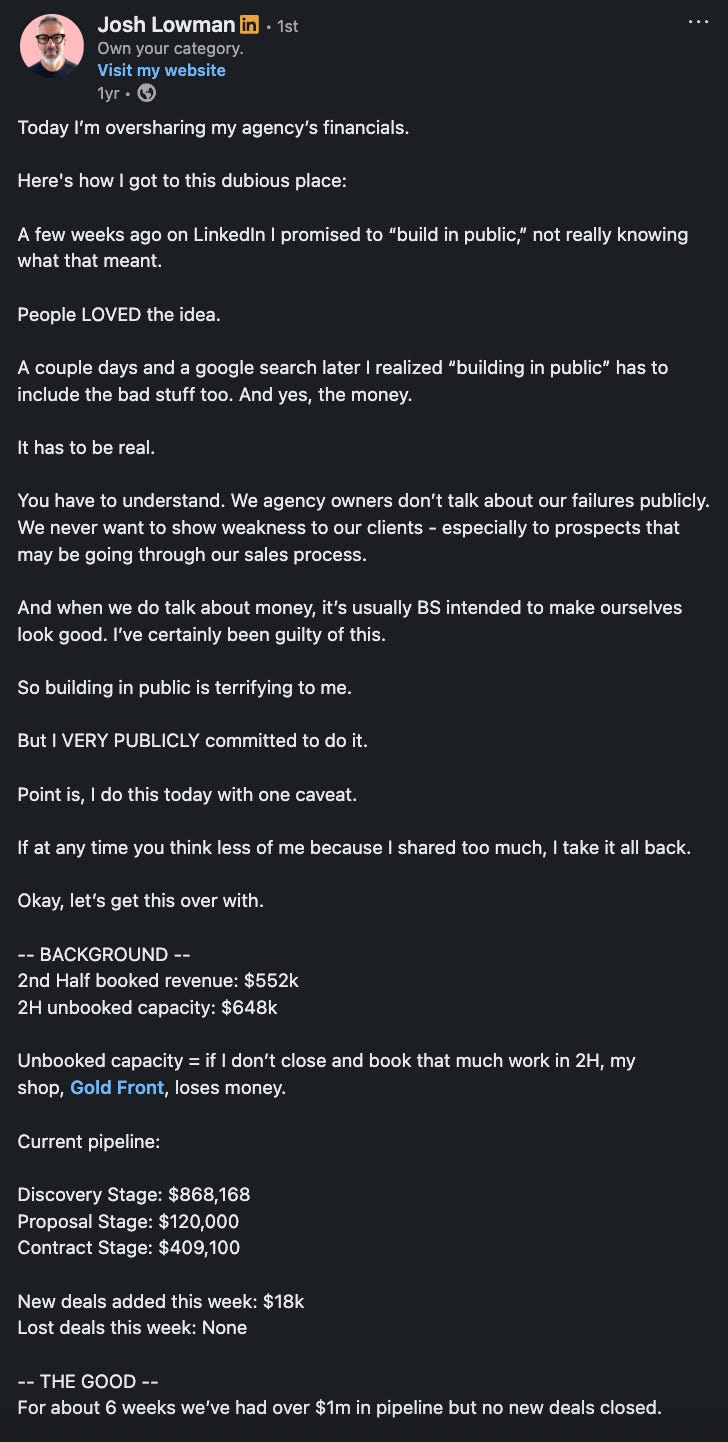
Here’s how to format a vulnerable post:
1. Risk (Say the thing most wouldn’t)
Open with something that feels slightly uncomfortable to admit.
This is your pattern interrupt.
Formula:
“Today I’m going to share [something most people hide]”
“This is uncomfortable, but…”
👉 This immediately signals honesty and pulls people in.
2. Tension (Why this matters)
Explain why this is difficult to share.
Highlight:
Social pressure
Fear of judgment
Industry norms
Formula:
“People in my position don’t usually talk about this…”
“This could make me look [negative outcome]”
👉 This builds credibility because there’s something at stake.
3. Audit (Show the reality)
Lay out the truth.
This can be:
Numbers
Mistakes
Failures
Internal thoughts
Make it structured and easy to follow.
Formula:
“Here’s where things stand:”
-- The good
-- The bad
-- The ugly
👉 This is where trust is built.
4. Accountability (Own the cause)
Don’t blame external factors.
Take responsibility.
Formula:
“The truth is…”
“This happened because I [mistake]”
👉 This is what separates vulnerability from victimhood.
5. Lesson (Turn it into value)
Close by extracting a clear takeaway.
Something the reader can apply.
Formula:
“What’s the takeaway?”
“[Simple, actionable insight]”
👉 This transforms the post from a confession into content.
Why this works…
This structure hits:
Trust → because you’re saying what others won’t
Authority → because you understand your own mistakes
Relatability → because people see their own struggles in yours
Engagement → because honesty invites honesty
Here’s a simple template…
“Today I’m sharing something I wouldn’t normally talk about:
[uncomfortable truth]
Here’s the reality:
[structured breakdown]
The truth?
This happened because I [mistake].
Not [external excuse].
That’s on me.
What’s the takeaway?
[lesson]
If you’re going through something similar…
You’re probably closer than you think.”
6. Two-step giveaway posts
These are posts that require a small action (e.g., like, comment, connect) before delivering value.
This works because it plays into how the algorithm is built…
If many people engage with it, it’s considered good content, so LinkedIn distributes it further.
A win for you, and a win for the algorithm.
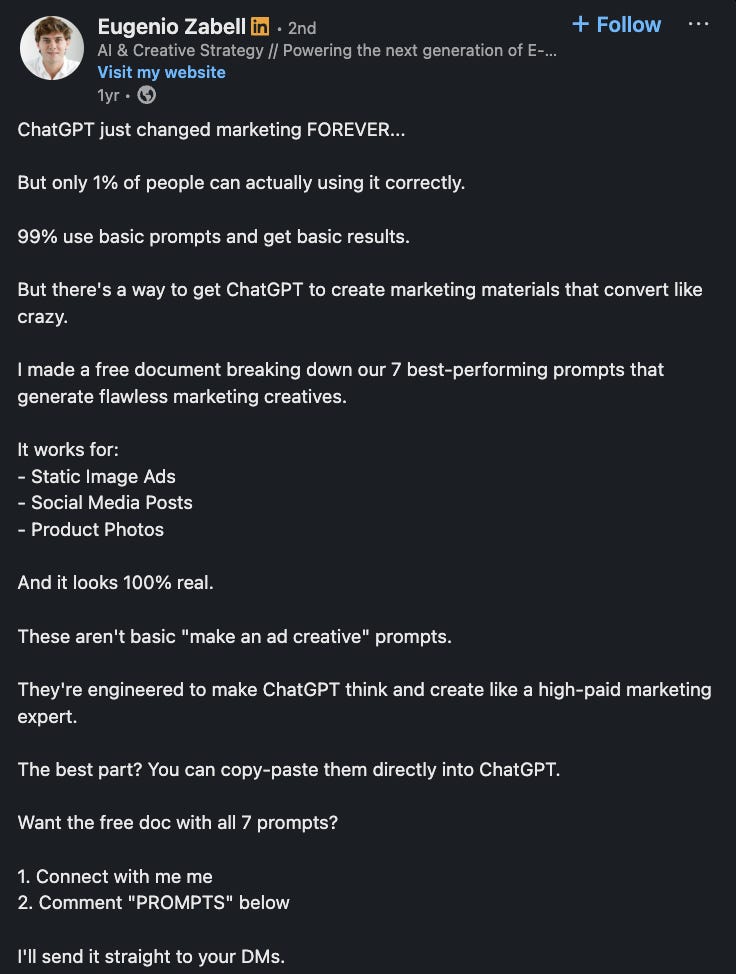
Here’s how to reproduce this:
1. Curiosity (Hook the outcome)
Open with a bold claim or shift that creates intrigue.
You want people thinking:
“Wait… what am I missing?”
Formula:
“[Tool/Trend] just changed [industry]…”
“But most people are doing it wrong…”
👉 This creates a gap between where the reader is and where they could be.
2. Expose (Call out the problem)
Highlight what people are currently doing wrong.
Make it feel familiar.
Formula:
“Most people do [basic thing] → get [basic result]”
“That’s why it’s not working”
👉 This builds tension and makes your solution more valuable.
3. Asset (Present the value)
Introduce the resource you’re giving away.
Be specific about:
What it is
What it does
Where it works
Formula:
“So I created [resource] that helps you [specific outcome]”
“It works for:”
[use case 1]
[use case 2]
👉 This is where desire is created.
4. Restrict (Increase perceived value)
Position it as:
Not basic
Not generic
Not widely known
Formula:
“These aren’t your typical [X]…”
“They’re designed to [advanced outcome]”
👉 This makes people feel like they’re getting an edge.
5. Request (Two-step CTA)
Now add friction.
This is key.
The action (comment, connect, etc.):
Signals interest to the algorithm
Qualifies the lead
Triggers distribution
Formula:
“Want it?”
“1. [action]”
“2. [comment keyword]”
“I’ll send it to you”
👉 This turns engagement into inbound leads.
Why this works…
This structure taps into:
Curiosity gap → “What am I missing?”
Social proof loop → comments → more reach
Reciprocity → free value in exchange for action
Micro-commitment → small action → higher intent
Most people either:
Give everything away (no conversion), or
Gate too hard (no engagement)
This balances both.
Here’s a simple template…
“[Tool/Trend] is changing [industry]…
But most people are doing this wrong.
They [common mistake] → get [poor result].
So I created [resource] that helps you [specific outcome].
It works for:
[use case]
[use case]
These aren’t basic [X].
They’re designed to [advanced benefit].
Want it?
[action]
Comment “[keyword]”
I’ll send it over.”
7. Strategic insight on new tools or trends
If everyone is already talking about something…
And you come in with a clear, actionable insight on how to use it…
Odds are quite high that your content will perform relatively well.
Why?
Because attention is already there.
All you’re doing is tapping into existing demand and redirecting it.
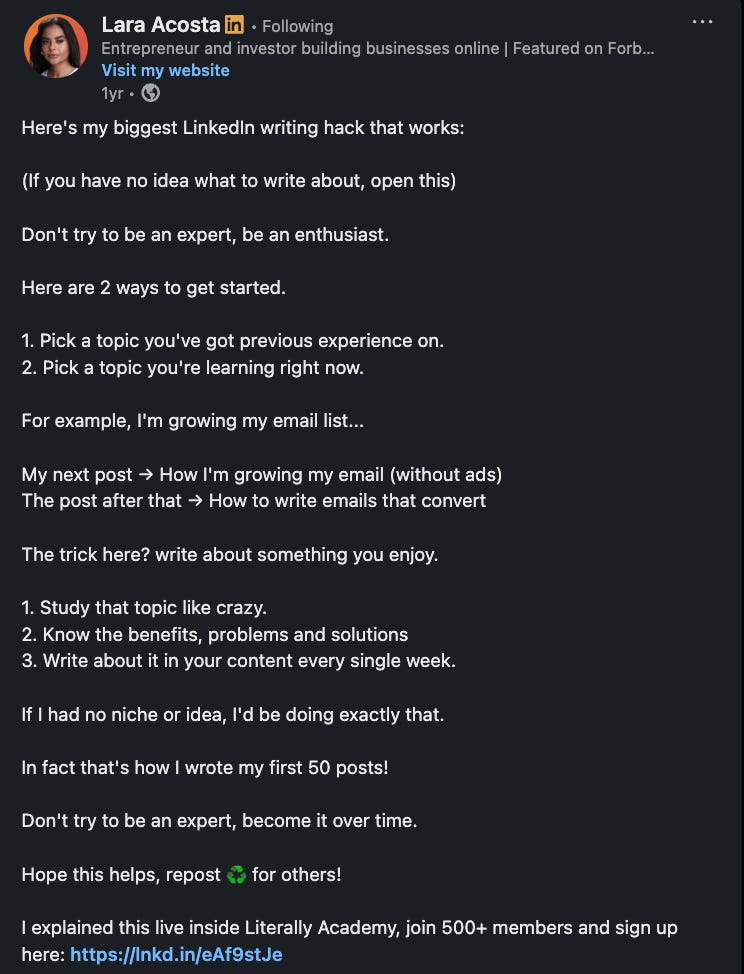
And here’s how to reproduce it…
1. Situation (Hook into a common struggle)
Open by calling out a problem your audience already has.
Make it feel immediate and relevant.
Formula:
“Here’s my biggest [result] hack…”
“(If you’re struggling with X, read this)”
👉 This taps into existing attention and stops the scroll.
2. Contrarian (Flip the default belief)
Challenge what people think they should be doing.
Formula:
“Don’t do [common approach]…”
“Do this instead…”
👉 This creates a shift in perspective.
3. Application (Show exactly how to use it)
Break the idea into simple, actionable steps.
Keep it practical and easy to follow.
Formula:
“Here’s how to do it:”
[step]
[step]
👉 This is what makes the post valuable.
4. Context (Make it real with examples)
Ground the idea in your own experience.
Show how it plays out in practice.
Formula:
“For example…”
“Here’s how I’m doing it…”
👉 This builds credibility and clarity.
5. Anchor (Reinforce the core idea)
Repeat the main insight in a punchy way.
Make it stick.
Formula:
“The trick is…”
“Don’t try to [X], do [Y]”
👉 This is what people remember and reshare.
6. Lead-in (Soft CTA or next step)
Close with a light action:
Share
Follow
Learn more
Formula:
“Hope this helps…”
“If you want more, [CTA]”
👉 This converts attention into distribution or leads.
Why this works…
This structure hits:
Relevance → solves a real, current problem
Clarity → simple steps reduce friction
Authority → backed by lived experience
Shareability → easy to pass on to others
Most people either:
Talk about trends with no application
Or give advice with no structure
This does both:
Insight + execution.
Here’s a simple template…
“Struggling with [problem]?
Here’s my biggest [result] hack:
Don’t [common approach].
Do this instead:
[step]
[step]
For example:
[real example]
The trick?
[core insight]
If you do this consistently, you’ll [outcome].
Hope this helps.”
Final thoughts
Most business owners fail to generate organic leads on LinkedIn because they don’t understand which content drives action.
I’ve been studying the platform for nearly 2 years.
And I’ve found the 7 content types that drive action include:
Introduction posts
Announcement posts
Milestone posts
Rags-to-riches stories
Vulnerable shares
Two-step giveaway posts
Strategic insights on trends
That’s the difference.
The people who generate leads are using proven formats that:
Build trust
Create relevance
Trigger action
And they repeat them consistently.
That’s it.
So if your content isn’t converting, try implementing one of these content types.
P.S. If you'd like help building a content engine like this inside your business, apply to work with Stackedwized.