

75 High-Converting LinkedIn Posts You Can Model to Generate Leads
A practical exercise to improve your LinkedIn writing

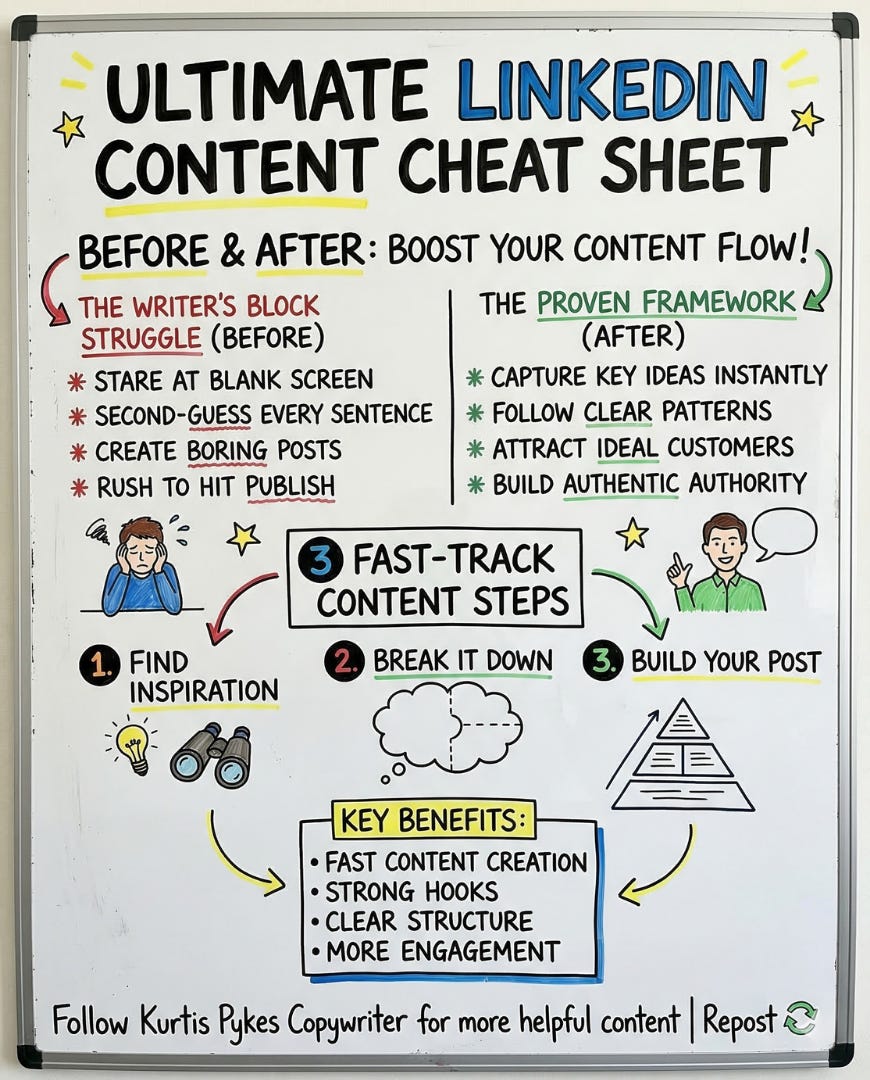
To build a high-converting LinkedIn personal brand, you must be able to do one thing well:
Break the scroll.
Every day, your prospects scroll past hundreds of posts.
Most of them are ignored.
And it’s not always because the ideas are bad…
Sometimes, it’s down to the simple fact that they fail to capture attention.
Capturing attention is a copywriting skill.
Most founders, solopreneurs, and coaches never intentionally learn copywriting.
And it makes sense…
You’re busy running a business.
Managing clients.
Delivering work.
Building.
So when it’s time to publish a LinkedIn post, you open the editor, write something quickly (or get AI to do it for you), and hit publish.
Sometimes it performs reasonably well.
But most of the time, it sucks.
This creates a frustrating experience.
Because when you look around the platform, you’ll often see other people attracting their ideal customers with posts that look similar to yours.
They talk about the same topics.
They share similar lessons.
Yet their posts gain traction while yours struggle to generate attention.
This is the part most people misunderstand…
LinkedIn success rarely comes down to what you say.
It usually comes down to how you say it.
Two people can share the exact same idea.
But the one who understands copywriting will almost always win the attention.
Unfortunately, learning copywriting from scratch can feel overwhelming.
There are books.
Courses.
Endless theories.
And you probably don’t have the time to go down that rabbit hole.
Which is why many people like you end up publishing posts that feel rushed, unclear, or forgettable.
The good news is there’s a much faster way to improve your writing.
A method that writers and copywriters have used for decades.
It’s called copywork.
Copywork is the practice of studying and modeling writing that already performs well.
Instead of trying to invent great writing from scratch, you analyze examples that have already proven to capture attention and persuade readers, and then use that as the basis for your writing.
Over time, you begin to internalize the patterns behind effective writing.
Your hooks become stronger.
Your structure becomes clearer.
Your posts start attracting more attention.
Let me show you how this works in practice…
A quick example of copywork in action
A few months ago, I came across a LinkedIn post structure that performed extremely well:
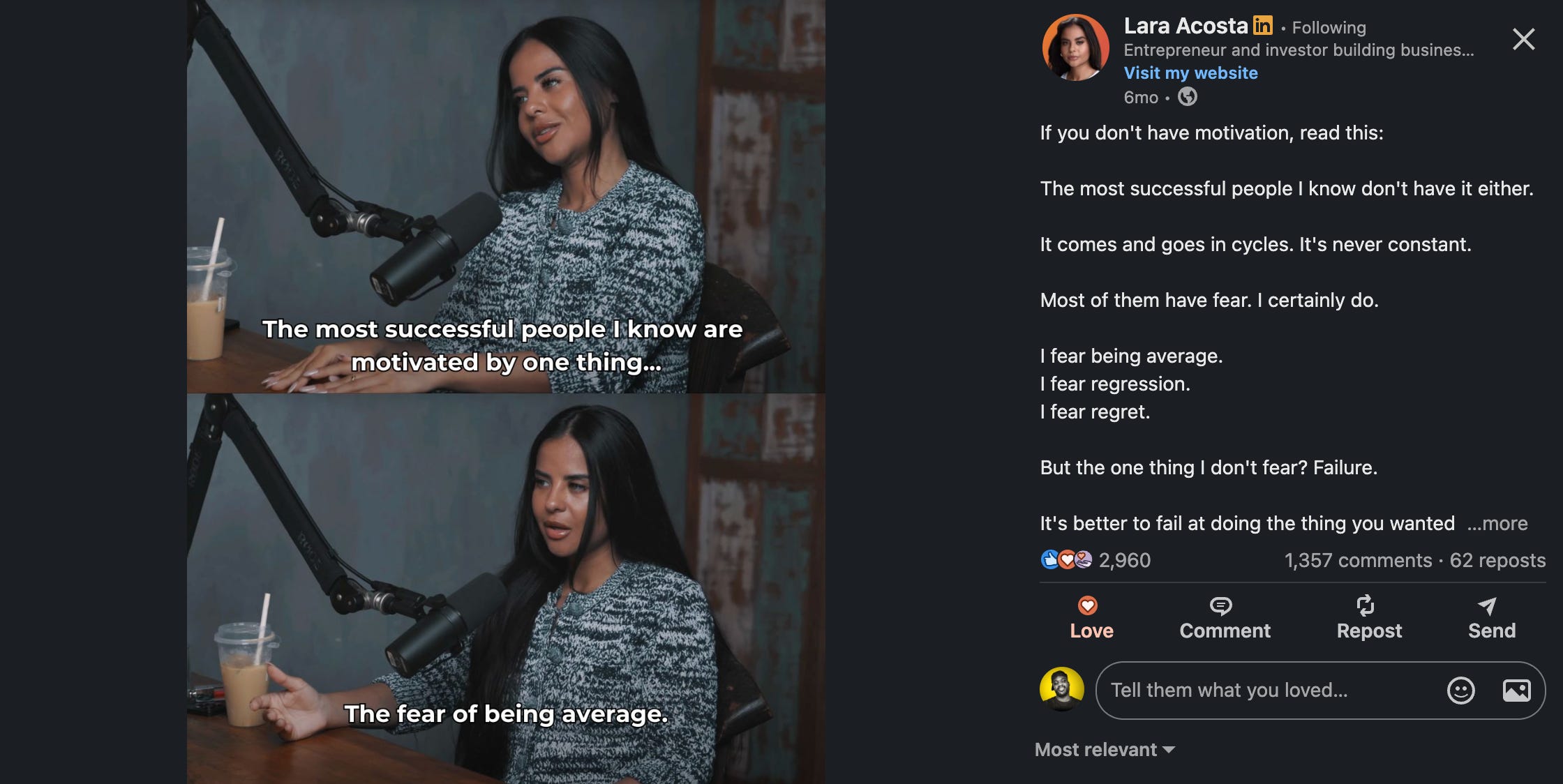
Instead of trying to invent a new structure from scratch, I decided to use copywork.
I studied the format.
Then I applied the same structure to one of my own experiences.
Here’s the post I wrote using that framework:
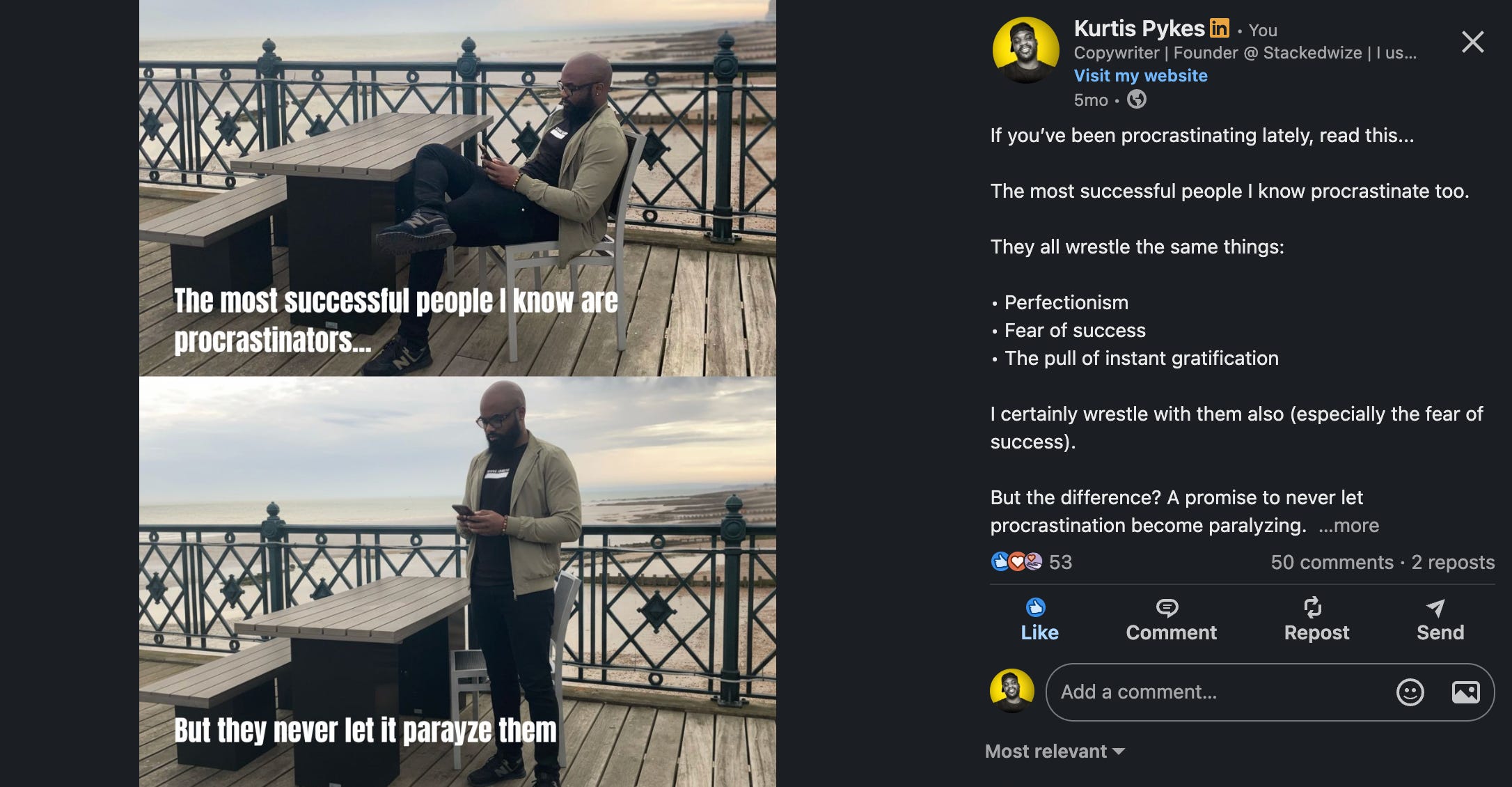
Of course, Lara’s post still performed significantly better than mine…
But mine still performed well relative to my average engagements.
And notice something important…
The idea itself isn’t particularly revolutionary.
What makes the post work is the structure.
It pulls the reader in with a relatable problem.
It tells a short story.
Then it leads the reader to a clear realization.
(I also use a similar visual hook that I generated with AI.
That’s the power of copywork.
You’re not copying someone else’s ideas.
You’re modeling proven writing structures and applying them to your own experiences.
Once you start recognizing these patterns, writing strong LinkedIn posts becomes significantly easier.
Instead of staring at a blank page, wondering what to write, you already have a framework to guide you.
Which is why I created the resource below…