


Recently, I spoke with a prospect who told me they’ve been struggling to find ghostwriting clients.
… And they were 100% convinced it was because they sucked at sales.
So I asked, “How many people have you spoken to this month?”
They didn’t know.
Okay...
“How many calls have you booked?”
They looked at me like I was speaking another language.
This is a problem I see with a lot of ghostwriters…
They’ll say:
“I suck at sales.”
“My outreach isn’t working.”
“I can’t get clients.”
But they don’t have clear insight into what part of the sales process is broken in their workflow.
And because they don't know where things are going wrong, they can't make the tweaks needed to improve.
So they feel hopeless.
Trust me, I know… I’ve been there.
For years, I barely tracked any of this stuff.
If I wasn’t getting clients, I’d assume I needed to:
Send more messages
Get better at sales
Change my offer
Find better prospects
And while one of those may have been right, I had no friggin’ idea because I didn’t have the numbers.
So now I track every stage of my client acquisition process to give me a holistic view of what’s working and what’s not.
It also allows me to forecast what future revenue could look like, which helps me set goals and targets.
But most importantly, I know where to look when I’m not getting clients.
If people aren’t accepting my connection requests, I know there’s a problem at the top of my funnel.
If I’m booking plenty of calls but nobody is buying, I know the problem is further down or potentially with my offer (depending on why they didn’t buy).
And that’s the whole point of tracking this stuff…
You can’t improve what you don’t understand.
So in this article, I’m going to break down the 8 metrics I think every ghostwriter should track to land more clients.
1. Connection acceptance rate
The first stage of your client acquisition process is connecting with prospects.
So it’s important to measure the percentage of people you send connection requests to who accept.
The formula is simple:
Accepted connections ÷ Connection requests sent × 100
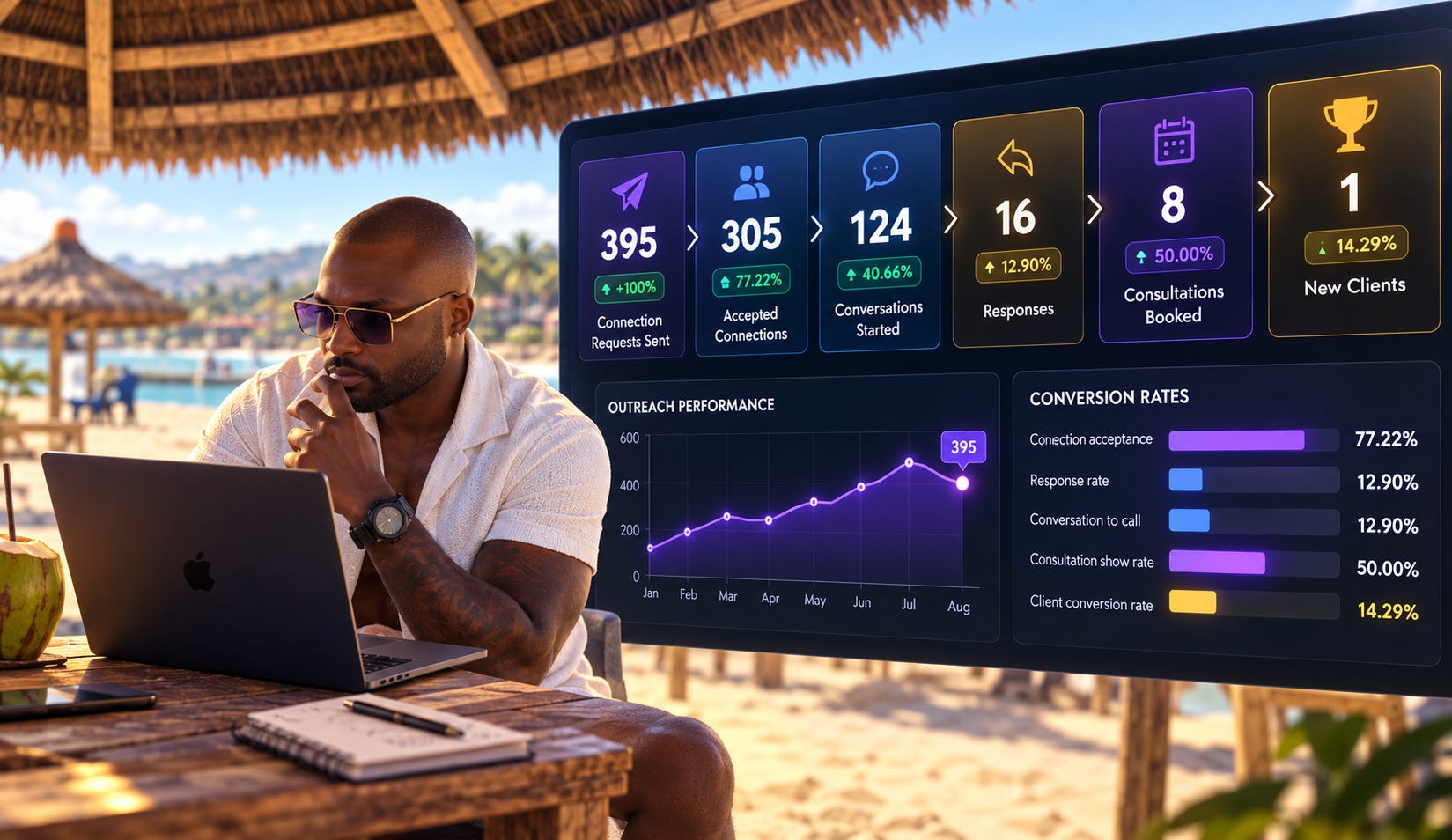
For example, if you send 395 connection requests in a month and 305 of them accept, your connection acceptance rate would be 77.22%.
305 ÷ 395 × 100 = 77.22%
Now, what’s considered a good connection acceptance rate on LinkedIn?
As a rough rule of thumb, I look at it like this:
Below 20% → Poor: Something probably needs investigating.
20–30% → Okay: There’s room for improvement.
30–50% → Good: Your targeting and approach are probably working.
50%+ → Excellent: You’re getting a very strong proportion of prospects to connect.
Several factors influence your connection acceptance rate.
For example:
Who you target
Whether they already know you
How active they are on LinkedIn
How strong your profile is
I once worked with a client whose connection acceptance rate was 10%.
After digging into the profiles of the people he connected with, I discovered most of them weren’t active on LinkedIn.
Once we realized this, he invested in Sales Navigator, turned on the filter to show only profiles active in the past few months, and his connection acceptance rate shot up to 40%.
This is why it’s important to know your connection acceptance rate…
If people aren’t accepting your requests, you won't have enough conversations to land clients.
And instead of assuming you need to do more outreach, the number tells you there’s something earlier in the process you need to fix.
2. Response rate
Getting someone to accept your connection request is great.
But it means nothing if you can’t get them to talk to you.
So the next metric I track is response rate.
It measures the percentage of conversations you start that receive a response.
The formula is:
Responses ÷ Conversations started × 100
So if you start 124 conversations and 16 people respond, your response rate would be 12.90%.
16 ÷ 124 × 100 = 12.90%
Now, what’s considered a good response rate?
As a rough rule of thumb, I look at it like this:
Below 10% → Poor: Your messaging or targeting probably needs work.
10–20% → Okay: You’re getting responses, but there’s room to improve.
20–30% → Good: A healthy percentage of prospects are engaging.
30%+ → Excellent: Your messages are consistently starting conversations.
Of course, these numbers will vary depending on whether your outreach is warm or cold, who you’re targeting, and what you say.
But if your response rate is consistently low, there are several things that could be at fault:
Your opener feels automated.
You’re pitching too quickly.
Your message is too long.
You’re asking generic questions.
There’s no obvious reason to respond.
You’re talking to the wrong people.
Personally, I’m a big believer in permission-based selling.
So my goal with the first message isn’t to convince someone to buy my ghostwriting service.
It’s simply to get a response.
📱 Example first message
Hey [NAME], thanks for accepting my connection request. I see you’re in the AI space, and I’m big on keeping up with developments in the field.
What’s been happening in your world?
Once they do, I can start asking leading questions to qualify whether they're a potential customer.
A low response rate isn’t a justification to start more conversations…
Investigate why the conversations you’re already starting aren’t going anywhere.
Test different opening messages.
Change who you’re targeting.
Compare warm outreach against cold.
Then track whether your response rate improves.
Remember, at this stage, you don’t need to make the sale…
You just want to begin an engagement.
3. Conversation-to-call rate
Now we’re getting deeper into your client acquisition funnel.
One of the most important parts of this process is getting the client on a call.
Hence why I track my conversation-to-call rate.
It measures the percentage of conversations that eventually result in a booked call.
The formula is:
Calls booked ÷ Conversations started × 100
So if you start 100 conversations and book 8 calls, your conversation-to-call rate would be 8%.
8 ÷ 100 × 100 = 8%
What’s considered a good conversation-to-call rate?
As a rough rule of thumb, I’d look at it like this:
Below 3% → Poor: Very few conversations are progressing into genuine opportunities.
3–5% → Okay: You’re booking calls, but there’s probably room to improve.
5–10% → Good: A healthy percentage of conversations are progressing.
10%+ → Excellent: Your targeting, conversations, and qualification are working extremely well.
A warm audience will probably convert to calls at a much higher rate than completely cold prospects.
How you talk to prospects in the DMs will heavily influence how many calls you book.
If a prospect feels like all you’re trying to do is make a sale, they’ll sniff it out and become more resistant to getting on a call.
But if they feel like you’re genuinely trying to help, they’ll be far more open to continuing the conversation.
This is why I’ll talk to the prospect until I uncover a problem I can help them solve.
Then I’ll ask permission to send them a Google Doc to help with the problem they told me they have.
The doc includes everything they need to do to solve their problem.
If they find it useful, have questions, or want to go deeper, then I’ll suggest jumping on a quick call.
So the call becomes the natural next step in the conversation rather than something I’m trying to force them into.
That said, if your conversation-to-call rate is low, there are several things I’d investigate:
You’re having conversations without uncovering problems.
You’re talking to people who don’t need what you sell.
You’re pitching before earning permission.
You’re missing buying signals.
You’re suggesting calls without first demonstrating any value.
You’re spending too much time talking to unqualified prospects.
So look at what happens inside the conversations you’re having.
Are you uncovering genuine problems?
Are you demonstrating enough value?
Are you recognizing when somebody wants more help?
Because if people are responding but nobody wants to get on a call, the problem is probably what happens after they respond.
4. Follow-up-to-call rate
As the popular sales maxim goes, “The fortune is in the follow-up.”
And that’s because not every prospect will book a call during your first conversation.
Sometimes, they’ll just disappear.
But this doesn’t necessarily mean they aren’t interested.
People:
Get busy.
Forget to respond.
Don’t consume the resource you sent them.
Read your message and tell themselves they’ll reply later.
…then life happens.
So you’ve got to follow up.
But I track this metric because I want to understand how effective my follow-up is.
It measures how many of my follow-ups eventually result in a booked call.
The formula is:
Calls booked from follow-ups ÷ Follow-ups sent × 100
So if you follow up with 50 prospects and 5 eventually book a call:
5 ÷ 50 × 100 = 10%
What’s considered a good follow-up-to-call rate?
As a rough rule of thumb, I’d look at it like this:
Below 3% → Poor: Your follow-ups probably aren’t recovering many opportunities.
3–5% → Okay: Some prospects are reengaging, but there’s room to improve.
5–10% → Good: Your follow-ups are consistently recovering opportunities.
10%+ → Excellent: A strong percentage of prospects are turning into calls after initially going quiet.
Following up with warm prospects who already expressed interest should naturally perform better than following up with completely cold leads.
But the most important point is you shouldn’t interpret silence as rejection.
I’ve had people apologize for not responding after I followed up, and it led to a call.
But if your follow-up-to-call rate is consistently low, I’d investigate:
Whether you’re following up with the right prospects.
How long you wait before following up.
Whether your message gives them a reason to respond.
How many times you follow up before moving on.
5. Discovery call show rate
I like to use a two-step sales process because it gives me another opportunity to build trust before presenting my services.
So my objective in this call isn’t to make a sale.
I just go deeper into showing the prospect:
What needs to be done.
What order I’d do it in.
Why I do it in this order.
But there’s a catch…
Prospects will only show up to this call if they believe they’ll get value from it.
Hence why I track my discovery call show rate.
It measures the percentage of people who book a discovery call and actually attend.
The formula is:
Discovery calls attended ÷ Discovery calls booked × 100
So if 10 prospects book a discovery call and 8 show up:
8 ÷ 10 × 100 = 80%
What’s considered a good discovery call show rate?
As a rough rule of thumb, I’d look at it like this:
Below 60% → Poor: Too many prospects are disappearing before the call.
60–70% → Okay: Most are showing up, but you’re still losing a significant number.
70–85% → Good: A healthy percentage of booked prospects are attending.
85%+ → Excellent: Very few prospects are dropping out before the call.
If you’re booking plenty of discovery calls and hardly anyone shows up, something is probably breaking down before the call.
Maybe:
You’re asking for calls too quickly.
You haven’t demonstrated enough value beforehand.
The prospect doesn’t understand why the call is worth their time.
You’re booking calls with poorly qualified prospects.
Too much time passes between booking and the call.
This is another reason I like sending the free resource before suggesting a call…
By the time I ask them to speak, I’ve already given them something useful, they’ve consumed it, and now they want to go deeper.
So the call is more of a continuation of the value.
If they feel like it’s a sales ploy, they’ll pull out.
So if your discovery call show rate is low, figure out why the people who already booked don’t think the call is worth showing up for.
Follow up!
6. Discovery-call-to-consultation rate
After adding value by telling the prospect what to do on the discovery call, I let them know I can help with that.
So I’ll say something along the lines of:
“By the way, this is something I can help you implement. I don’t have much time now to talk about it, but if you’re interested, we can jump on another call and I’ll explain how I’d help.”
And then they tell me whether they’re interested.
I deliberately separate the two calls…
By telling them the next conversation is about my service, they know I’m going to sell to them.
There’s no bait and switch.
If they agree to the consultation, they’ve given me permission to have that conversation.
And if I’ve added enough value throughout the process, they're highly likely to say “Yes.”
This is why the next metric I track is my discovery-call-to-consultation rate.
It measures the percentage of discovery calls that turn into consultations.
The formula is:
Consultations booked ÷ Discovery calls attended × 100
So if I have 10 discovery calls and 4 prospects agree to a consultation:
4 ÷ 10 × 100 = 40%
What’s considered a good discovery-call-to-consultation rate?
As a rough rule of thumb, I’d look at it like this:
Below 20% → Poor: Very few discovery calls are becoming genuine sales opportunities.
20–30% → Okay: Some prospects are progressing, but there’s room to investigate.
30–50% → Good: A healthy percentage of qualified prospects want to explore working together.
50%+ → Excellent: Your discovery process is consistently producing strong sales opportunities.
Again… your rate will depend heavily on how qualified your prospects are before they get on the first call.
So if plenty of prospects attend your discovery calls but hardly anyone wants a consultation afterward, they probably don’t believe you can help them.
And this may be because:
You’re getting the wrong people onto calls.
You aren’t diagnosing their problem properly.
They don’t see enough value in solving it.
There’s no urgency to act.
Your service isn’t positioned as the logical solution.
They simply aren’t a good fit.
7. Consultation show rate
The next metric I track is consultation show rate.
This measures the percentage of prospects who book a consultation and actually show up.
The formula is:
Consultations attended ÷ Consultations booked × 100
So if 8 prospects book a consultation and 7 attend:
7 ÷ 8 × 100 = 87.50%
What’s considered a good consultation show rate?
As a rough rule of thumb, I’d look at it like this:
Below 70% → Poor: You’re losing too many highly qualified prospects before the sales conversation.
70–80% → Okay: Most prospects are attending, but there’s room to improve.
80–90% → Good: The vast majority of prospects are showing up.
90%+ → Excellent: Almost everyone who books is making it to the consultation.
I pay particular attention to this metric because by this point, the prospect has:
Spoken to me in the DMs.
Received free consulting.
Attended a discovery call.
Learned what solving their problem involves.
Agreed to another call specifically to hear how I can help them.
So if someone willingly books that second call and shows up, I can safely assume they have serious buying intent.
This is a hot lead.
It’s also why a low consultation show rate would concern me much more than a low discovery call show rate.
Something has changed between the two calls…
Maybe:
Too much time has passed between them.
The prospect isn’t as committed to solving the problem as you thought.
You haven’t made it clear what the consultation is for.
You don’t create enough urgency to continue.
Something during the discovery call created doubt.
If plenty of prospects book consultations but don’t show up, the problem isn’t generating more leads.
Investigate why they didn’t show up.
This will tell you what’s breaking down in your pipeline.
8. Client conversion rate
Finally, we get to the metric everyone cares about…
How many consultations turn into paying clients?
This is your client conversion rate.
The formula is:
Clients won ÷ Consultations attended × 100
So if you hold 7 consultations and close 1 client:
1 ÷ 7 × 100 = 14.29%
What’s considered a good client conversion rate?
As a rough rule of thumb, I’d look at it like this:
Below 10% → Poor: Your sales process probably needs work.
10–20% → Okay: You’re closing clients, but there’s plenty of room to improve.
20–30% → Good: You’re converting a healthy percentage of qualified prospects.
30%+ → Excellent: Your sales process is converting strongly.
By this point, I’m less willing to blame lead generation if someone isn’t buying.
Think about everything that has happened before the consultation.
The prospect has:
Engaged in a conversation.
Told you about a problem.
Consumed your free consulting.
Booked and attended a discovery call.
Seen what solving their problem involves.
Agreed to another call specifically to hear about your service.
Actually showed up.
This person has buying intent.
And when people genuinely want something, they’ll usually find a way to get it.
I’ve seen people who are struggling financially take out financing to buy the latest iPhone.
Obviously, this doesn’t mean every qualified prospect can or should stretch themselves financially to buy your service.
But if qualified prospects consistently reach the end of your sales process and don’t buy, it’s a good time to look at your sales skills.
Something about your ability to make the sale needs work.
Maybe it’s how you communicate the value, present your offer, handle objections, or justify the investment.
But this is the beauty of tracking the entire process….
You can identify exactly which number needs to improve to get more clients.
Final thoughts
Remember the prospect I mentioned at the beginning?
They were convinced they sucked at sales.
But they didn’t know:
How many conversations they were starting.
How many people were responding.
How many calls they were booking.
How many prospects were showing up.
How many consultations were turning into clients.
So in reality, they had no idea whether sales was the problem.
They were just guessing based on how they felt.
This is the worst way to run a business because you can’t fix a problem if you don’t know where it is.
So before deciding you suck at sales, outreach, or getting clients…
Track the numbers and analyze them.
They’ll usually tell you where to look.
Thanks for reading!