


The hardest part of ghostwriting isn’t writing well…
You can write an objectively great piece of content and still completely fail at your job.
Why?
Because your client reads it and thinks, “I would never say this.”
I’ve been writing professionally for more than 6 years, ghostwriting for 2.
And one of the biggest lessons I’ve learned since becoming a ghostwriter is that good writing and good ghostwriting are two different skills.
Good writing requires you to develop your own:
Voice
Style
Opinions
Personality
Way of communicating ideas
Good ghostwriting requires you to temporarily put some of those things aside and learn somebody else’s.
Your job is to make your client sound like the best version of themselves.
This goes much deeper than learning whether somebody likes short sentences, uses profanity, or says certain phrases.
Those are simply expressions of their voice.
In May of this year, I had to drop a client because we fundamentally disagreed on this (and a few other things).
He was extremely particular about capturing these expressions of his voice.
And while they matter...
They’re only the surface level of what makes a voice yours.
Your actual voice starts with how you think.
Your:
Values
Beliefs
Opinions
Worldview
Personality
Experiences
These are the things that make you (and your client) unique.
So when I start working with someone, I’m not solely focused on understanding how they express their voice...
I’m trying to understand how they think.
What annoys them?
What do they believe?
What would they never say?
What makes them sound unmistakably like them?
What experiences shaped how they see the world?
The better you understand how your client thinks, the easier it becomes to write content that sounds like them.
And over the last two years of ghostwriting, I’ve gradually developed a process for doing exactly that.
In this article, I’m going to break it down.
What is a brand voice?
Before explaining how I capture a client’s brand voice, it’s probably worth defining what I mean by it.
The simplest definition I’ve come up with is this:
A brand voice is the recognizable way someone communicates their ideas.
And there are many things that contribute to it.
For example:
Humor
Rhythm
Profanity
Opinions
Analogies
Vocabulary
Punctuation
Sentence length
Storytelling tendencies
Phrases you repeatedly use
Things you would NEVER say
How directly you communicate
Put enough of these together consistently and people eventually start recognizing how you communicate.
But this is where ghostwriting gets complicated…
Capturing somebody’s voice and replicating every expression of their voice are NOT the same thing.
This was the disagreement I had with the client I mentioned earlier.
There were times when I’d send him a draft, and he’d respond, “I wouldn’t say that.”
So I’d go back to the transcript from our interview...
Find the exact sentence...
And copy and paste where he’d said it word for word.
But sounding like somebody isn't necessarily the same as copying how they speak.
The way people naturally communicate in conversation doesn’t always translate perfectly into written content.
When you’re talking, you:
Repeat yourself.
Go on tangents.
Use unnecessary filler words.
Start sentences without finishing them.
Take 100 words to communicate something that could’ve taken 20.
Those things are technically expressions of your natural voice.
But blindly preserving all of them doesn’t necessarily make the writing more authentic.
Sometimes, it just makes the writing worse.
And this was one of the tensions between this particular client and me.
He wanted me to preserve expressions of his voice that I believed made the content less effective for the platform we were writing on.
And more importantly, they sometimes worked against the goals he’d told me he wanted the content to achieve during our onboarding.
I believed part of my job as a ghostwriter was to make judgment calls about what to keep and what to remove.
Because I’m not a transcriptionist.
Note 💡
A transcriptionist reproduces what somebody said.
A ghostwriter communicates the same idea more effectively.
Your job as a ghostwriter is NOT to reproduce exactly how somebody speaks.
It’s to understand them well enough to communicate their ideas in a way that still feels unmistakably like them, while adapting those ideas to the medium you’re publishing on.
If somebody rambles for three minutes before making their point during an interview, you don’t need to preserve the rambling to preserve their voice.
If they use the same filler phrase seven times, you don’t need to include it seven times.
If they explain something in a way that works perfectly in conversation but makes a LinkedIn post unnecessarily difficult to read, you should be able to restructure it.
You’re supposed to preserve the person, not every imperfection in how they communicate.
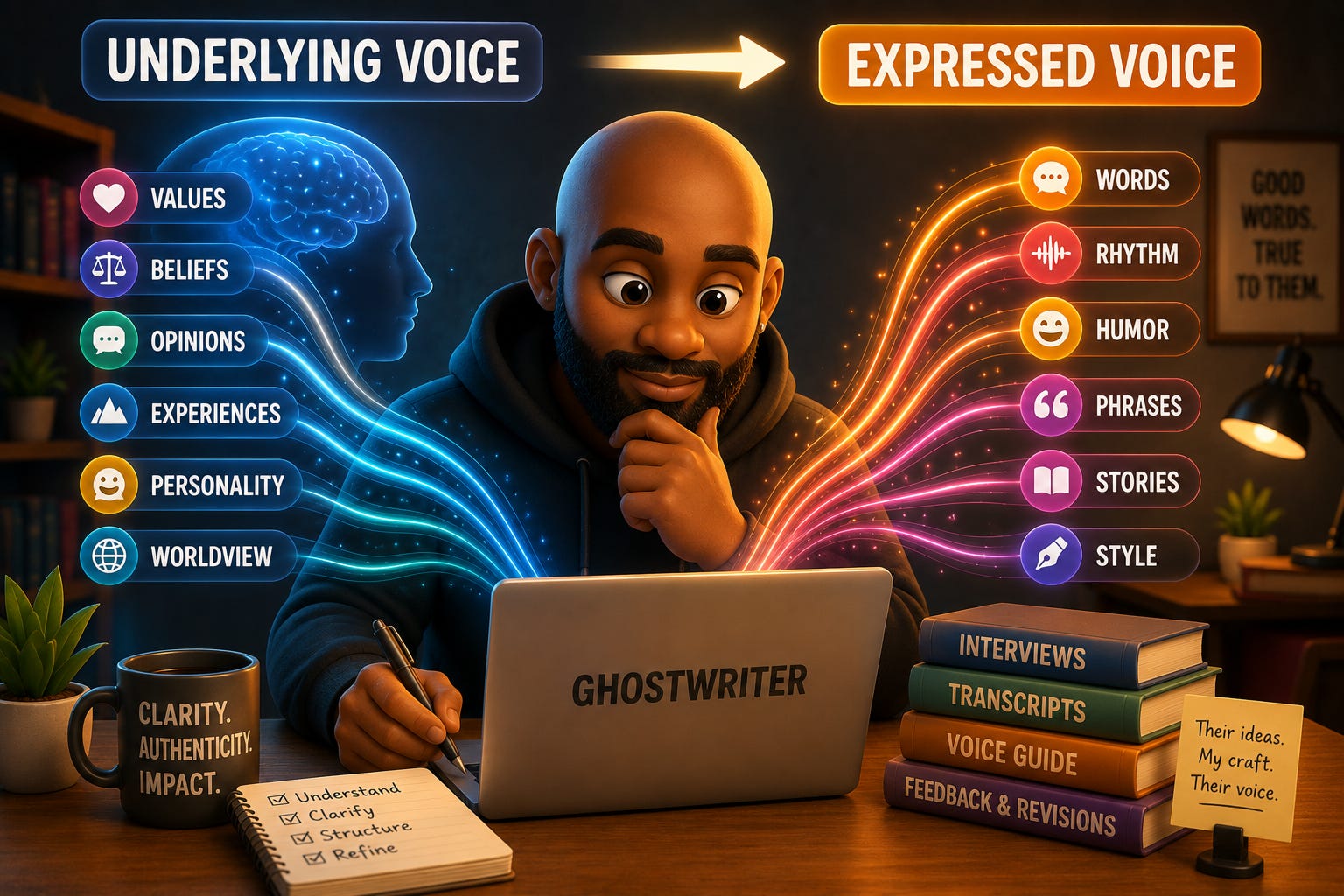
This is why I think brand voice exists on two levels.
On the first level, you have the underlying voice:
Values
Beliefs
Opinions
Worldview
Personality
Experiences
And on the second level, you have the expressions of that voice:
Words
Humor
Rhythm
Phrases
Profanity
Punctuation
Sentence structure
You must understand both.
But the second should serve the first, not constrain it.
Good ghostwriting is an effective expression of how somebody else thinks.
Why capturing your client’s voice matters
When someone hires you to ghostwrite for them, they’re trusting you with their reputation.
Ultimately, it’s their name attached to everything you publish.
So everything you create needs to feel like something they would genuinely say and be comfortable putting their name behind.
There are three reasons this matters:
1/ The content feels authentic
You’d probably notice if you’ve been following someone for years and their content suddenly starts sounding like a completely different person.
Your job isn’t to replace your client’s voice with your own.
It’s simply to improve how they communicate their ideas while preserving who they are so the content still feels authentic.
2/ Your client trusts you
Every draft you send is an opportunity to demonstrate how well you understand your client.
If they constantly have to rewrite sentences, correct your language, or tell you, “I’d never say this,” they’re eventually going to question whether you’re capable of doing the job.
The closer your drafts sound to them, the more comfortable they become giving you control.
Of course, some people are natural micromanagers, so they’re unlikely to relinquish full control.
And you could capture their voice perfectly and they’ll still want to make changes.
At that point, you have to decide whether that’s the type of working relationship you want.
3/ The relationship becomes easier to scale
The better you understand your client’s voice, the fewer voice-related revisions you should need.
And ideally, as you work together longer, you’ll start anticipating the changes they would make before they even make them.
Less back and forth for you.
Less work for your client.
And a much smoother relationship for both of you.
How I capture my ghostwriting client’s brand voice
You’re not going to nail a client’s voice after one onboarding call.
And that’s okay…
The more:
Material you consume
Conversations you have
Content you write
Feedback you receive
… the better understanding you’ll have of how that person thinks and communicates.
But there are several things you can do to speed up that process.
Here’s what that looks like:
1/ Study everything they’ve already created
Before I start writing, I consume as much of my client’s existing content as possible.
This could include:
LinkedIn posts
X posts
Newsletters
Podcasts
YouTube videos
Interviews
Emails
Presentations
Previous articles
If they’re comfortable sharing private material like Slack or WhatsApp messages, those can also be incredibly useful.
One of my clients even gave me access to their paid course.
This helped me understand their expertise and gave me hours of footage showing how they naturally explained concepts to other people.
But I’m not solely studying what they say…
I’m studying how they say it.
I’m looking for things like:
Words they repeatedly use
How long their sentences are
How they explain complicated ideas
Whether they use analogies
How direct they are
What makes them laugh
How they tell stories
What they have strong opinions about
How technical their language becomes
Phrases that repeatedly show up
The more material you have, the easier it becomes to separate genuine communication patterns from one-off expressions.
But existing content has limitations.
Especially when the client hasn’t created much of it themselves.
Which is why I also want to hear them speak.
2/ Record interviews with clients
I typically interview my ghostwriting clients twice a month.
But if they don’t have much existing content, I’ll increase this to four times a month for the first six weeks.
The primary purpose is to extract ideas and experiences I can turn into content.
But this also helps to identify client language.
The way somebody speaks naturally is often different from how they write when they know something is going to be published.
During a conversation, you get their:
Natural phrases
Cadence
Humor
Stories
Strong opinions
Analogies
Tangents
Emotional language
They’re not sitting there wondering whether a sentence has the perfect hook.
They’re simply… talking.
And sometimes, a throwaway sentence somebody says during an interview sounds more like them than anything you’ll find in their published content.
This is why I record my client interviews.
I currently use Fathom, which records my calls and gives me a transcript and summary afterward.
The transcript is particularly valuable.
I can search it.
Pull exact quotes from it.
Compare language across interviews.
And return to conversations months later when I need context.
Remember the client who would tell me, “I wouldn’t say that”?
The transcripts let me go back and show him the exact moment he said it.
So don’t just interview your clients for ideas.
Interview them for language.
