


I’ve struggled to get consistent reach on LinkedIn since returning in 2024.
And I think I know why…
I started posting on LinkedIn between 2020 and 2022.
And back then, I mostly wrote about AI and machine learning.
So naturally, that’s what a large portion of the audience I built knew me for.
Then I disappeared for 2 years...
When I returned in 2024, I wanted to set the foundations for my ghostwriting business.
So people who originally followed me because I wrote about AI and ML were now seeing posts about:
Ghostwriting.
Content strategy.
Writing for other people.
And whatever else I happened to be learning along the way.
You can probably see the problem.
I built an audience around one thing and returned expecting them to care about something completely different.
Unsurprisingly, many of them didn’t.
My reach suffered.
Most of my posts struggled to get anywhere near the distribution I’d experienced during my earlier years on LinkedIn.
And more importantly, my content wasn’t doing a particularly good job of attracting new ghostwriting clients.
The second part is what bothered me more.
I don’t particularly care about collecting impressions just to watch a number go up.
I run a ghostwriting business.
But if I’m going to spend hours every week creating content for myself, I want that content to help the right people discover me, understand what I do, and potentially become customers.
So in July of this year, I decided to do something about it…
I gave myself 31 days to deliberately increase my reach on LinkedIn.
I:
Experimented with how I created content.
Paid closer attention to distribution.
Looked at what was and wasn’t getting my posts in front of new people.
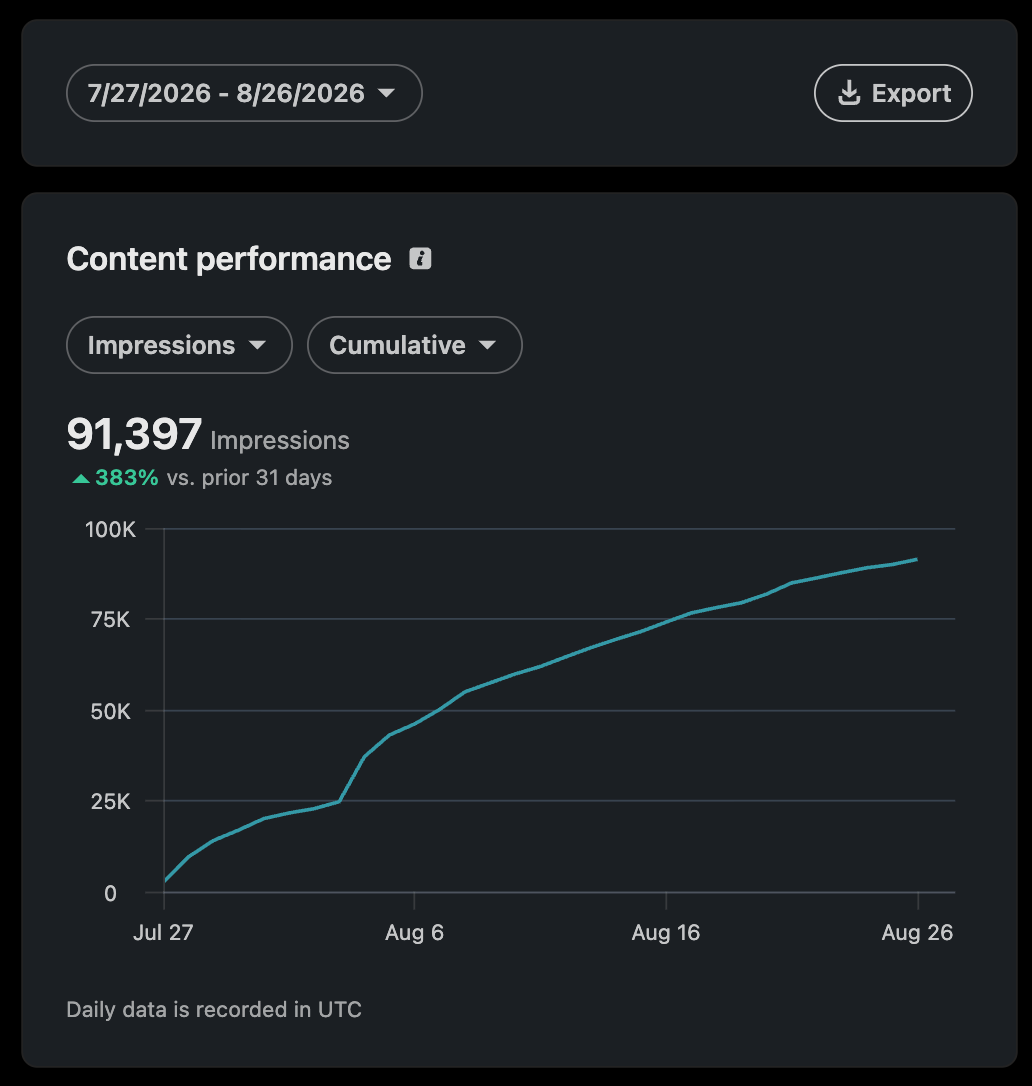
And by the end of those 31 days, my LinkedIn analytics spiked.
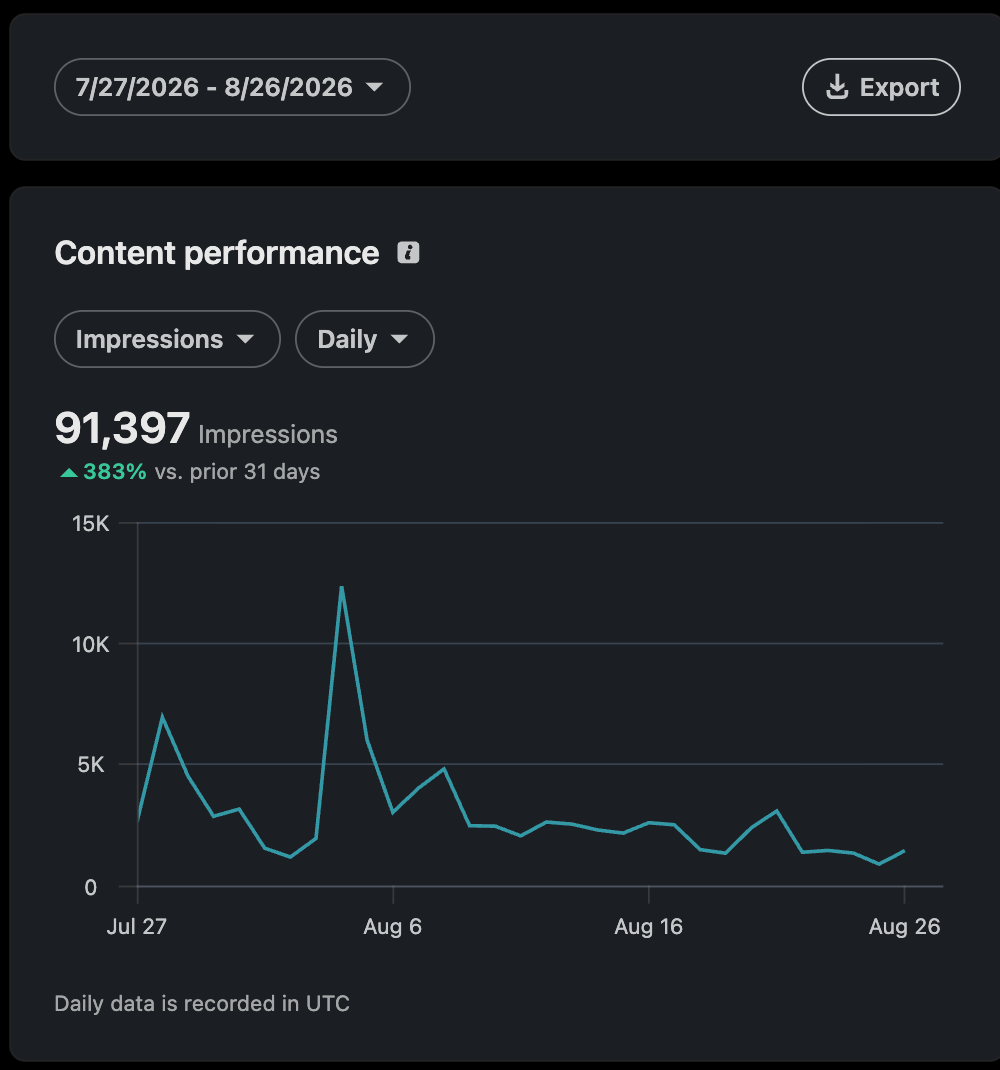
91,397 impressions.
Up 383% compared with the previous 31 days.
Now, 91,397 impressions isn’t a great achievement for most people.
Some creators generate that kind of reach from a single post.
But this is exactly why I think this experiment is worth breaking down…
I wasn’t starting with an account generating millions of impressions every month.
I was trying to revive an audience I’d built around a completely different subject and get more of the right people discovering what I do today.
This is a common problem.
In this article, I’m going to break down exactly what I changed over those 31 days, why I think my impressions increased by 383%, and, most importantly, whether that extram attention helped me generate new business.
Why I decided to focus on impressions
I know what you might be thinking…
“Aren’t impressions just a vanity metric?”
They can be.
Getting 100,000 impressions from people who will never buy from you isn’t necessarily better than getting 10,000 impressions from people who might.
But here’s the way I looked at it:
My business depends on people knowing I exist.
And content is one of the main ways I want that discovery to happen since that’s what I’ll be doing for my clients.
The journey looks something like this:
Content → impressions → profile visits → conversations → clients
Obviously, most impressions won’t become profile visits.
Most profile visitors won’t produce fruitful conversations.
And most conversations won’t turn into clients.
But increasing the number of relevant people at the top of that funnel gives me more opportunities for some of them to eventually make their way through it.
This was my hypothesis going into this experiment:
If I could substantially increase the number of relevant people seeing my ideas, I’d increase my chances of attracting potential ghostwriting clients.
The word relevant is important.
I wasn’t interested in increasing my impressions at any cost.
I could probably have easily:
Written about whatever controversial topic was trending that week.
Created engagement bait.
Started posting generic inspirational content designed to appeal to as many people as possible.
And maybe some of those things would’ve increased my reach.
But what would be the point?
I don’t need everybody on LinkedIn to know who I am.
So throughout the 31 days, I still wanted the content generating those impressions to strengthen the association between me and what I do.
Ghostwriting for Ed Tech Founders and my own school for ghostwriters.
More relevant impressions meant more opportunities for somebody in my target audience to discover a post.
More opportunities for them to visit my profile.
More opportunities to understand what I do.
And ultimately, more opportunities for some of those people to become clients.
That’s why I chose impressions as the metric to attack first.
The 31-day experiment
I consider pretty much everything I publish on social media an experiment.
Every post gives me another opportunity to test something.
So I didn’t suddenly wake up on July 27th and decide to completely change my LinkedIn strategy.
A lot of the experiments that eventually shaped this strategy started months earlier.
Gradually, I started noticing certain patterns in the posts that performed better than others.
By July, I had enough information to form a hypothesis about what might help me increase my reach.
Here are three of the biggest experiments that became part of that strategy.
Change #1: I shortened my posts to 1,000–1,200 characters
I used to write much longer LinkedIn posts.
There wasn’t necessarily anything wrong with the ideas.
The problem was getting people to read them.
LinkedIn is a feed.
People scroll quickly between posts, ads, comments, videos, and whatever else is competing for their attention.
And I started wondering whether I was simply asking too much of them.
So I experimented with shorter posts.
I settled on roughly 1,000–1,200 characters as a constraint.
It wasn’t some scientifically optimized number….
It was something I saw was working for another one of my clients.
So I tried it for myself.
My hypothesis was simple:
If people have limited attention, make the idea easier to consume.
And some of the results supported that hypothesis.
One of my highest-impression posts during this period was only 871 characters long.
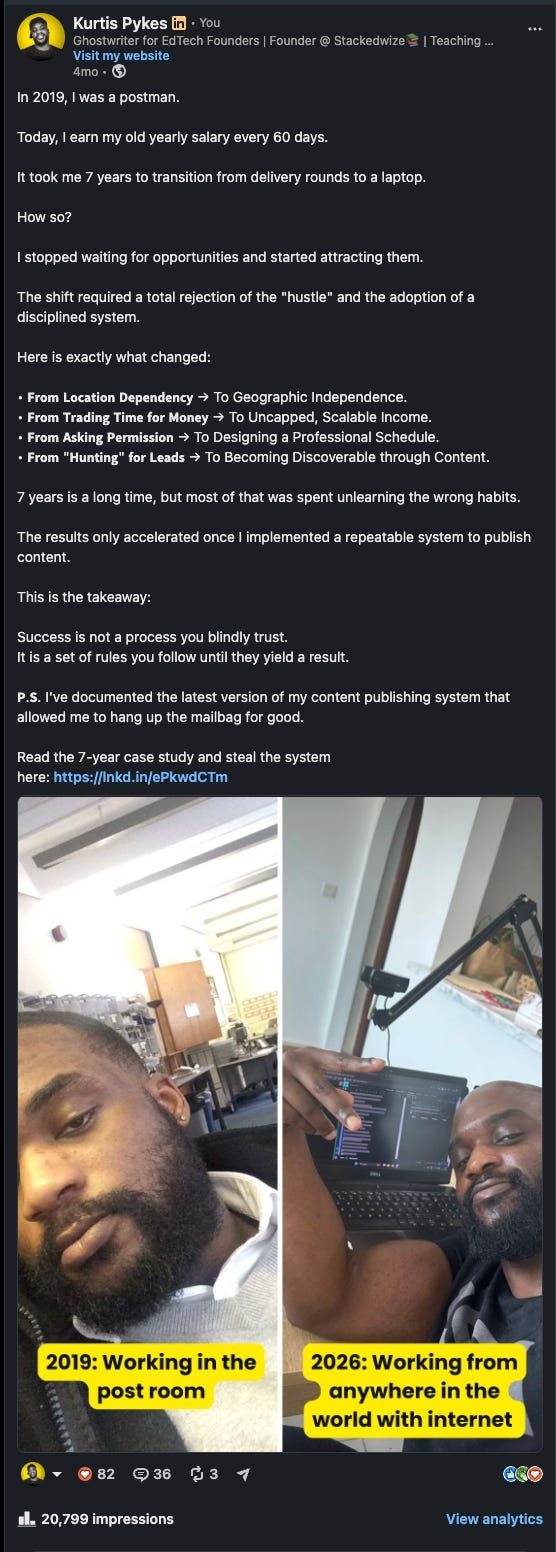
This post generated more than 20,000 impressions.
Now, I’m not going to pretend it performed well because it had 871 characters.
Too many variables are involved to make that claim.
But it gave me another useful data point…
And when shorter posts repeatedly started appearing among my stronger performers, I decided the constraint was worth keeping.
But then I noticed something else.
Writing short posts wasn’t enough.
Change #2: I started using before-and-after images
Once I started shortening my posts, I quickly realized people weren’t suddenly reading everything I published because I’d used fewer words.
Some short posts still flopped.
So I started looking for another pattern.
And one stood out like a sore thumb…
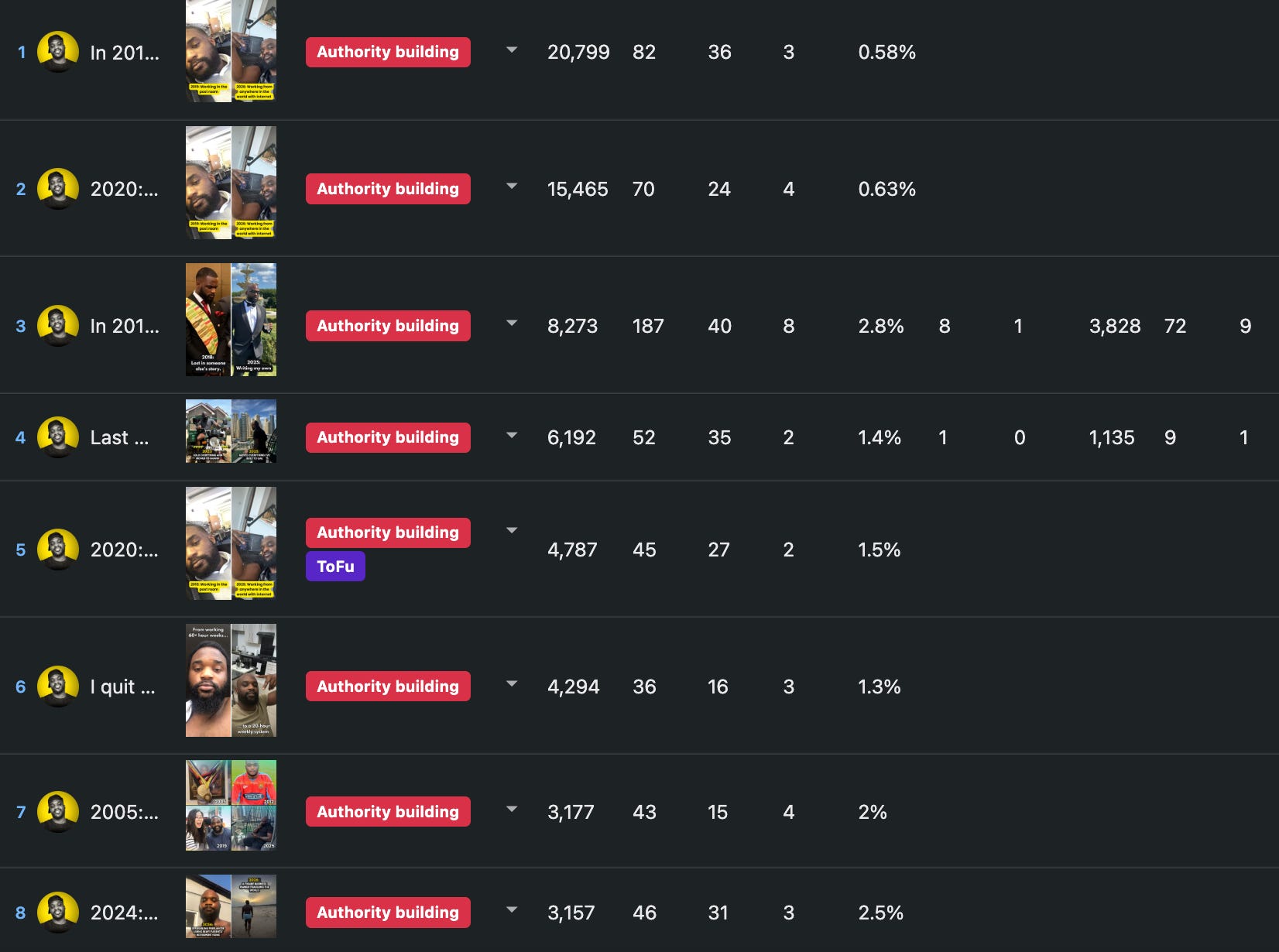
Posts I made with a before-and-after image consistently outperformed everything else.
These were posts where I would mention a bit about my past and then transition to where I am now.
I think these did well because my image became a hook.
It gave context for what the post was about before they even read it.
If the transformation in the image interested them, the writing explained how I’d got from one to the other.
When I looked back at my strongest content before July, the pattern was pretty ridiculous.
All eight of my top-performing posts (by impressions) used before-and-after images of me.
At that point, it would have been stupid not to investigate further.
So I started deliberately incorporating more of these images into my content.
And again, I saw a noticeable increase in impressions and profile views.
It also made sense when I thought about how people consume LinkedIn.
A before-and-after image creates an information gap almost instantly.
What happened between these two pictures?
The post underneath gives them the answer.
But even with shorter posts and stronger visuals, I still had another problem.
Despite having more than 18,000+ followers, I still wasn’t regularly breaking 1,000 impressions.
Something clearly wasn’t clicking with distribution.
That’s when I tried the experiment that produced the most interesting results.
Change #3: I started using LinkedIn’s celebration posts
For most of my time on LinkedIn, I published regular posts.
Nothing unusual.
Then I started paying more attention to LinkedIn’s built-in post formats.
One of them was the celebration post.
You’ve probably seen these before.
Instead of publishing a standard text post, LinkedIn allows you to select a celebration and attach a visual treatment to the post.
I had a theory…
LinkedIn built the feature.
So I wondered:
Would LinkedIn have some incentive to give posts using its native features more distribution?
I had absolutely no idea whether this was true.
And I still wouldn’t claim that LinkedIn deliberately boosts celebration posts without evidence.
But remember, I’m experimenting.
I didn’t need to know the answer beforehand.
I needed to test the hypothesis and see what happened.
So I started incorporating celebration posts into my content.
And they kept performing.
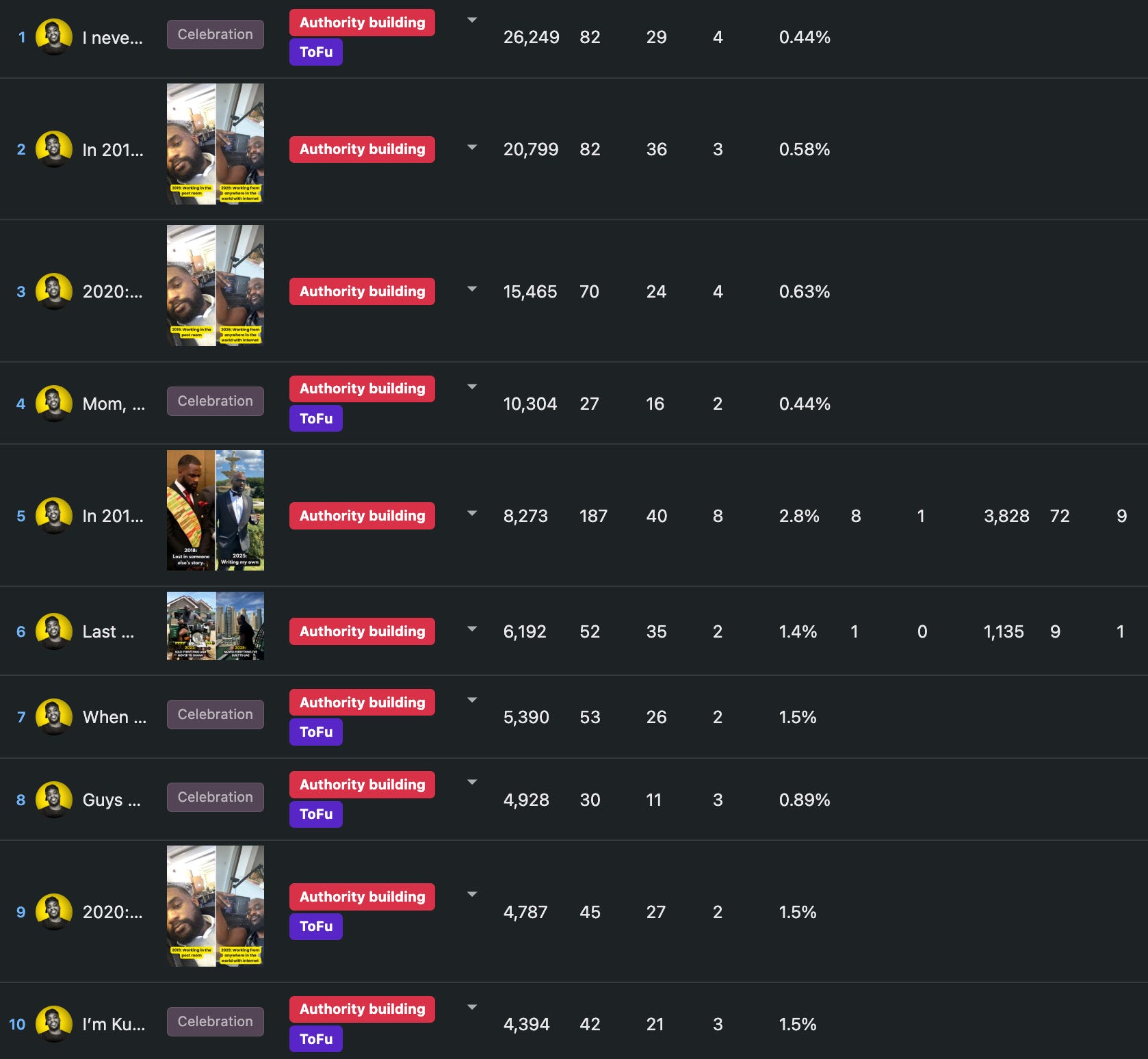
At the time of writing this article, five of my ten highest-performing posts are celebration posts.
And the post with the highest impressions is a celebration post.
Again, there could be several reasons for this.
Maybe LinkedIn gives the format additional distribution.
Maybe the celebration visual simply stands out more in the feed.
Maybe the types of stories I naturally tell through celebration posts are more interesting.
Maybe it’s some combination of all three.
I don’t know.
But it seems to be working well, so I will keep using it.
The results
Before getting into the results, there’s an important caveat…
This wasn’t a perfectly controlled experiment.
I wasn’t sitting there changing one variable at a time while keeping absolutely everything else identical.
For example, when I started experimenting with celebration posts, I didn’t always combine them with the before-and-after visuals that had already been working well for me.
Interestingly, the one time I did combine both...
It produced my highest-performing post of the entire period.
That’s something I’ll experiment with more going forward.
But despite the imperfect methodology, the overall change in my numbers was pretty significant.
My impressions increased by 383%
Over the 31 days, my content generated 91,397 impressions.
A 383% increase compared with the previous 31 days.
Only 34% came from people already inside my network.
The other 66% came from outside it.
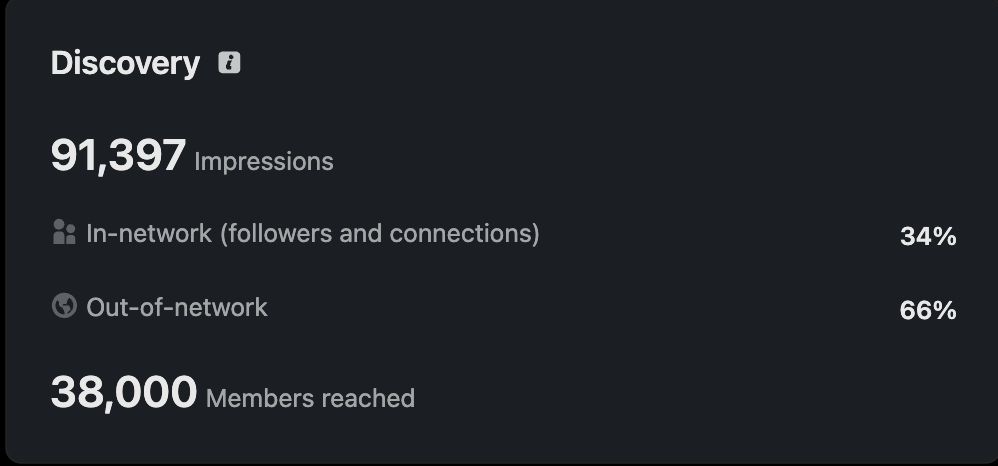
This matters because I started this experiment to get my content in front of more people who didn’t already know me.
And that’s exactly what happened.
In total, my content reached 38,000 LinkedIn members during the period.
The content also generated 1,781 social engagements, including:
1,250 reactions.
485 comments.
42 saves.
4 sends.
51 link engagements.
My three highest-performing posts generated approximately:
26,000 impressions: https://lnkd.in/p/dNQSEnmt
11,000 impressions: https://lnkd.in/p/d7rkwvJ4
5,000 impressions: https://lnkd.in/p/dekUAtF2
But was I reaching the right people?
This was far more important to me.
I wanted more people in my target market discovering me.
I work with founders in the education technology space, so I was particularly interested in seeing whether the additional distribution was pushing my content toward people in and around technology.
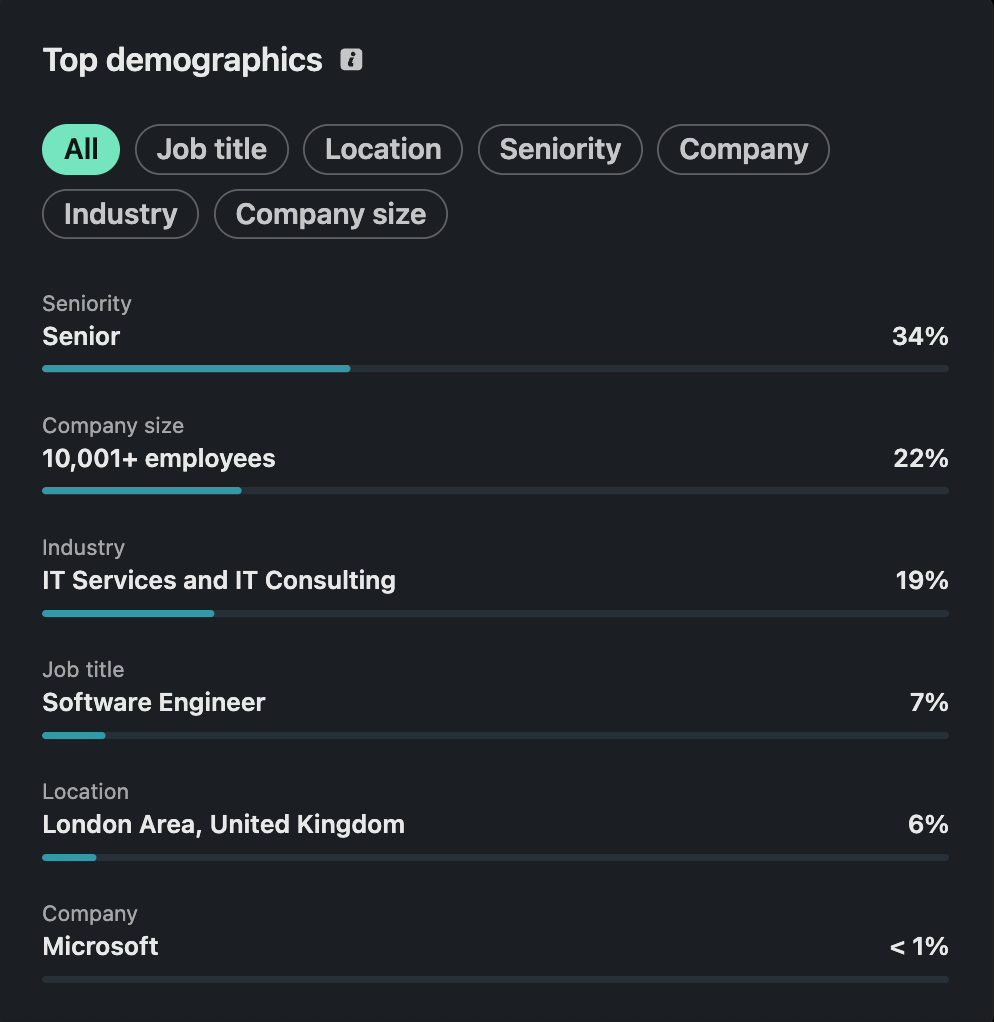
When I looked at LinkedIn’s audience demographics, there were some encouraging signs.
My largest seniority group was Senior at 34%.
And 19% of the audience came from IT Services and IT Consulting.
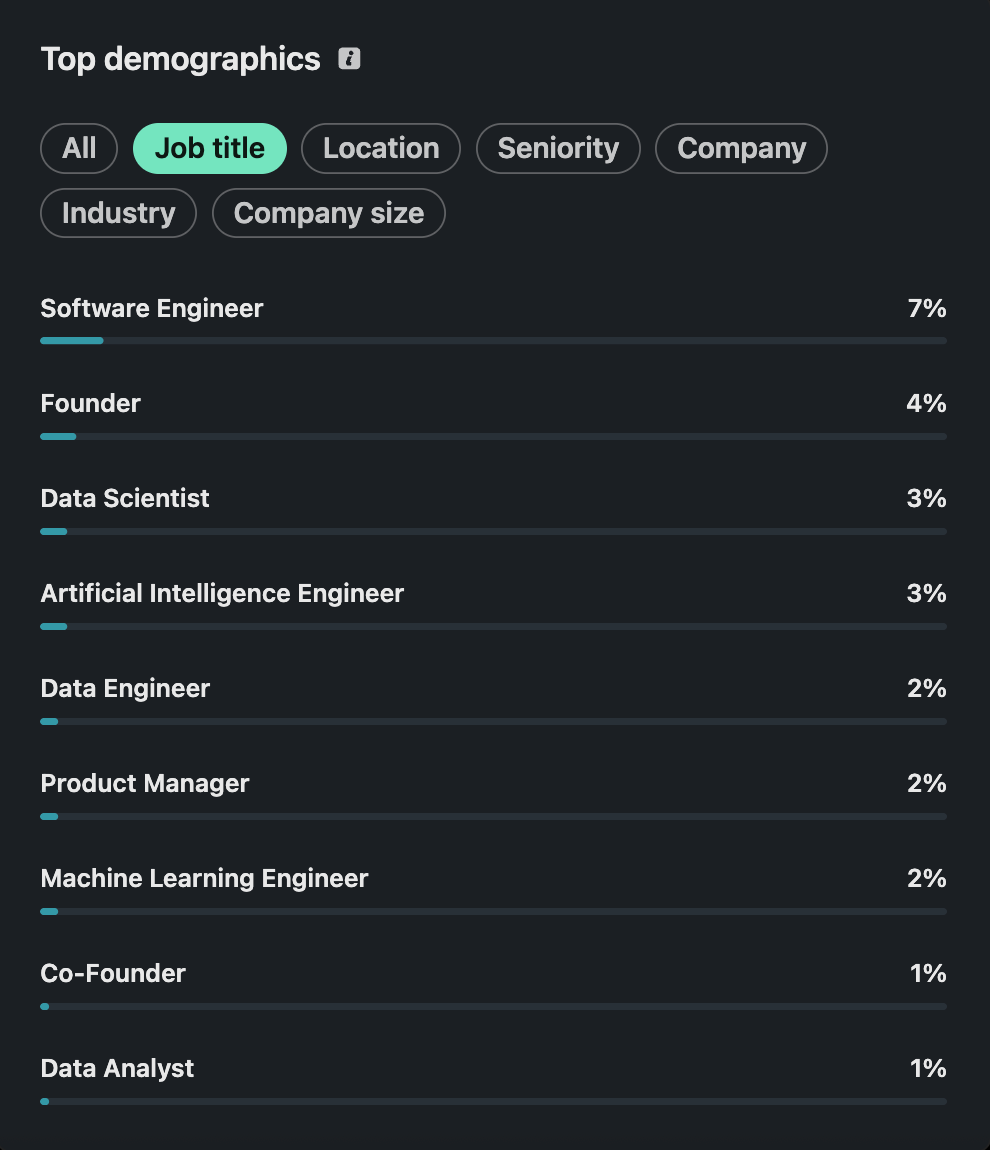
For job titles, the audience included:
Software Engineers: 7%
Founders: 4%
Data Scientists: 3%
Artificial Intelligence Engineers: 3%
Data Engineers: 2%
Product Managers: 2%
Machine Learning Engineers: 2%
Co-Founders: 1%
Now, these numbers don’t tell me that 34% of the people seeing my content were prospective customers.
And LinkedIn’s demographics don’t give me a neat category called “EdTech founders who need a ghostwriter.”
So I don’t want to pretend the data tells me more than it does.
But it does show me that a meaningful portion of my distribution was happening among senior professionals, founders, and people working in technology, which overlaps considerably more with the people I want entering my world than completely random viral reach would.
My follower count barely moved
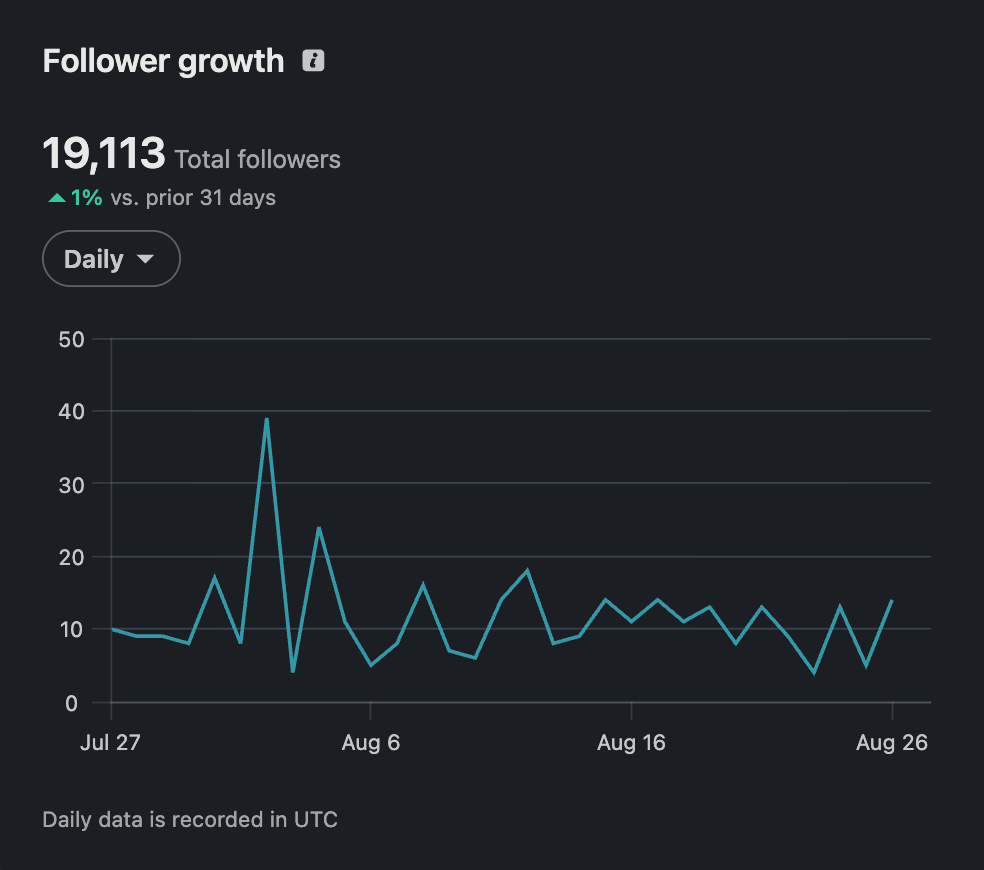
Despite increasing my impressions by 383%, I finished the period with:
19,113 followers.
That’s only a 1% increase compared with the previous 31 days.
So I dramatically increased how often my content was seen...
But this increase didn’t translate proportionally into audience growth.
And I think that’s an important reminder of something people often forget when looking at LinkedIn analytics:
Different metrics measure different things.
Impressions tell me I got significantly better at distributing my content.
Out-of-network impressions tell me I became better at reaching beyond the audience I already had.
Follower growth tells me relatively few of those people decided they wanted to keep hearing from me.
And none of those numbers, by themselves, tell me whether I generated more ghostwriting business.
That requires looking further down the funnel.
I’m launching a new ghostwriting offer soon, so time will tell.
Final thoughts
The objective of this experiment was to get more of the right people discovering my content and increase the number of opportunities I had to turn that attention into business.
And in that respect, the experiment worked.
My impressions increased by 383%.
I reached 38,000 people.
And 66% of my impressions came from outside my existing network.
So I became significantly better at getting my ideas in front of people who weren’t following or connected to me.
But I did learn an important lesson…
Getting attention and converting attention are two completely different problems.
I can increase my impressions.
I can get more people onto my profile.
I can even get more of my target audience consuming my content.
But none of that automatically puts money in my bank account.
I still need to give those people a reason to follow me.
I need to make it obvious what I do.
I need to create content that builds trust in my ability to do it.
Eventually, I need a mechanism to turn some of that attention into conversations with potential clients.
That’s the next part of the experiment.
I’ve figured out several things that appear to help me generate significantly more distribution on LinkedIn.
Now I need to get better at capitalizing on that distribution.
Because impressions aren’t the end goal.
Attention is useful.
But only if you know what you want to do with it.
Thanks for reading!
When Kurtis speaks, I listen. Yo, when are we doing that live?