


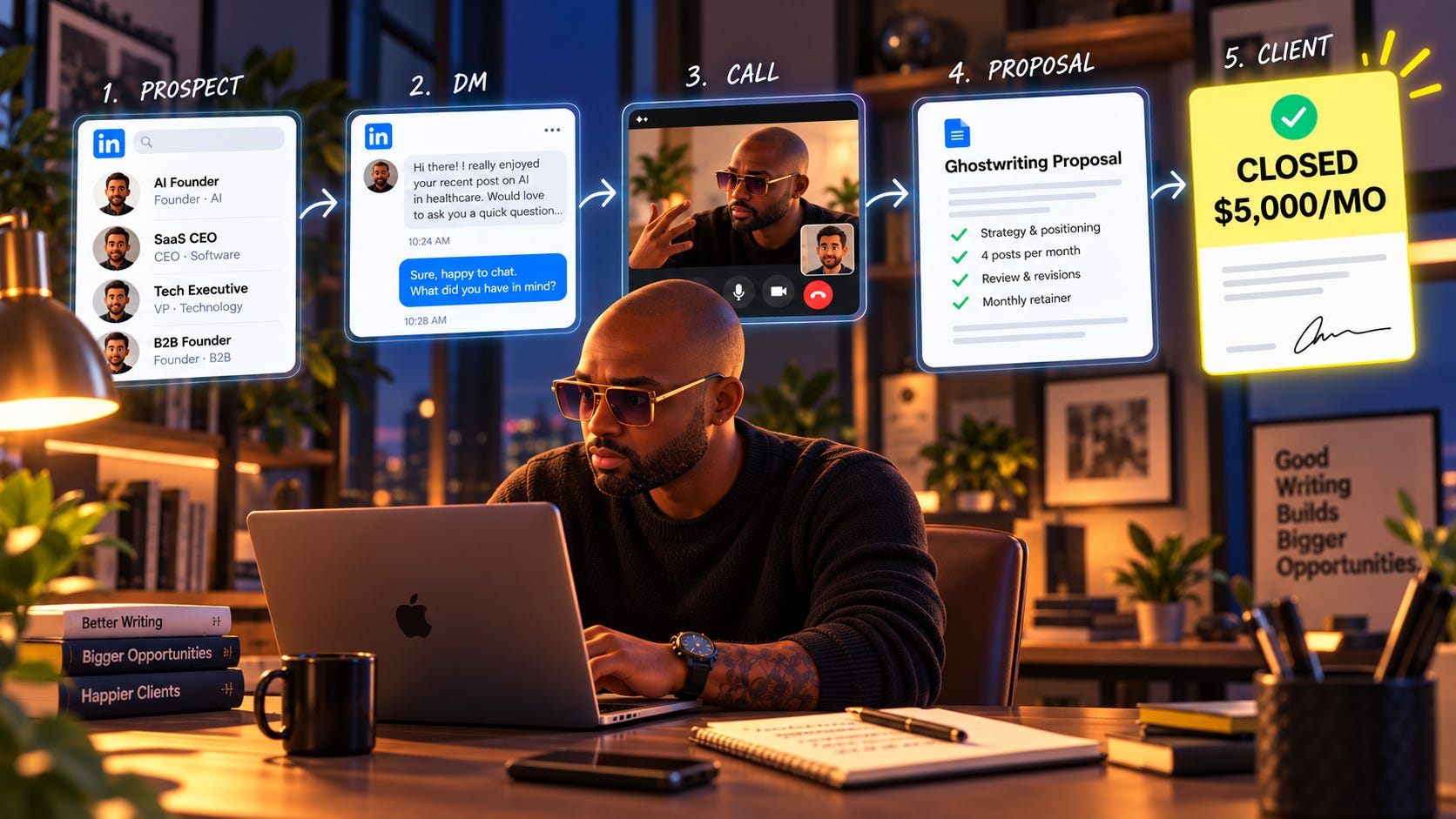
I recently spoke with a ghostwriter who told me they’d been working on projects here and there, but struggled to lock down retainers.
This puzzled me because retainer projects are pretty much all I’ve ever done.
So I asked to see his process, and it immediately made sense…
He was trying to get prospects, who were complete strangers, to commit to 3–6 months of ghostwriting on a monthly retainer.
You might be thinking, “Yeah, what’s wrong with that?”
Well…
Contrary to popular belief, you don’t land high-ticket retainers by pitching the retainer off the bat.
Asking someone who has no idea:
What it’s like to work with you
Whether you can deliver on the promise you’ve made
Whether what you’re proposing will work for them
…to commit thousands of dollars every month is a huge ask.
And understandably, most people will say “No.”
I mean, would you get into a long-term relationship with someone you bumped into at the cafe that same day?
Probably not.
Things are no different online.
So if you want to land more retainer clients, start by reducing the commitment.
Sell them an initial offer designed to solve an immediate problem.
Give them a quick win and a taste of what’s possible if you keep working together.
I call this a progressive offer.
And it’s become one of the most important parts of how I turn new clients into $3,000–$5,000/month ghostwriting retainers.
Let me show you how it works…
Trust is not given…
In September, I paid a business consultant $6,000 to help me grow my business.
I had been connected with this guy on LinkedIn since September 2024.
We had interacted for 2 years before I ever pulled the trigger and bought his services.
Now, I want you to think about the last time you handed someone a significant sum of money…
Did you wake up one morning, find a complete stranger on the internet, and immediately throw thousands of dollars at them?
Of course you didn’t.
You probably did your homework first.
You looked at what they’d done.
Asked questions…
Maybe spoke to them a few times.
And even after all of that, there was probably still a tiny voice in your head wondering, “Is this going to be worth it?”
Given you went ahead with the transaction, you obviously believed the answer was “Yes.”
Prospects you reach out to on LinkedIn go through the exact same process.
Except… they haven’t had 2 years to build trust with you.
Asking them to commit $3,000–$5,000 every month for the next 3-6 months is a huge commitment if they never initiated the interaction.
They don’t know whether:
You’ll understand their voice.
You’ll understand their business.
You’ll be able to deliver what you promised.
Heck, they don’t even know if they’ll enjoy working with you.
So the odds of them agreeing to chuck you $5,000 every month are pretty slim.
What do you do when the prospect hesitates?
This is what I asked the ghostwriting prospect who had been struggling with landing retainer clients.
He told me, “They usually say they need to think about it, so I assume it means I haven’t done a good job of selling them. So I try to convince them by showing them more of my work.”
In other words, he tries to explain the value again.
He talks through everything they’d get if they just trusted him and handed over the cash.
He’d show them examples of his work.
And continue handling objections like we’re told to do on sales calls.
Do they end up buying?
No.
Sales folks would boil this down to poor closing skills, but the real flaw lay further up the chain.
Point being…
There’s only so much proof can do when someone has never worked with you.
Your portfolio can prove you’re a good writer.
Your testimonials can prove other people enjoyed working with you.
Your case studies can prove you’ve generated results before.
But none of them can prove what their experience working with you will be like.
And that’s ultimately what they’re being asked to bet thousands of dollars on.
When a prospect says, “I need to think about it,” they’re telling you there’s still some uncertainty around the decision.
And if you’re trying to sell a multi-month retainer to someone you’ve only recently met, some of that uncertainty may simply come from the size of the commitment.
Throwing more proof at them doesn’t necessarily solve that.
Neither does getting better at handling objections.
Because maybe the objection isn’t something you need to overcome in the first place…
Maybe you’re simply asking them to make too big a commitment, too soon.
The progressive offers framework
Solving this problem is easier than it may seem…
Instead of asking a stranger prospect for a big commitment right off the bat when they don’t know you, ask for a smaller commitment and increase it as you earn their trust.
I call this the Progressive Offers Framework.
