

How to ACTUALLY Grow a Business With Content
(Even if you’re not super creative)

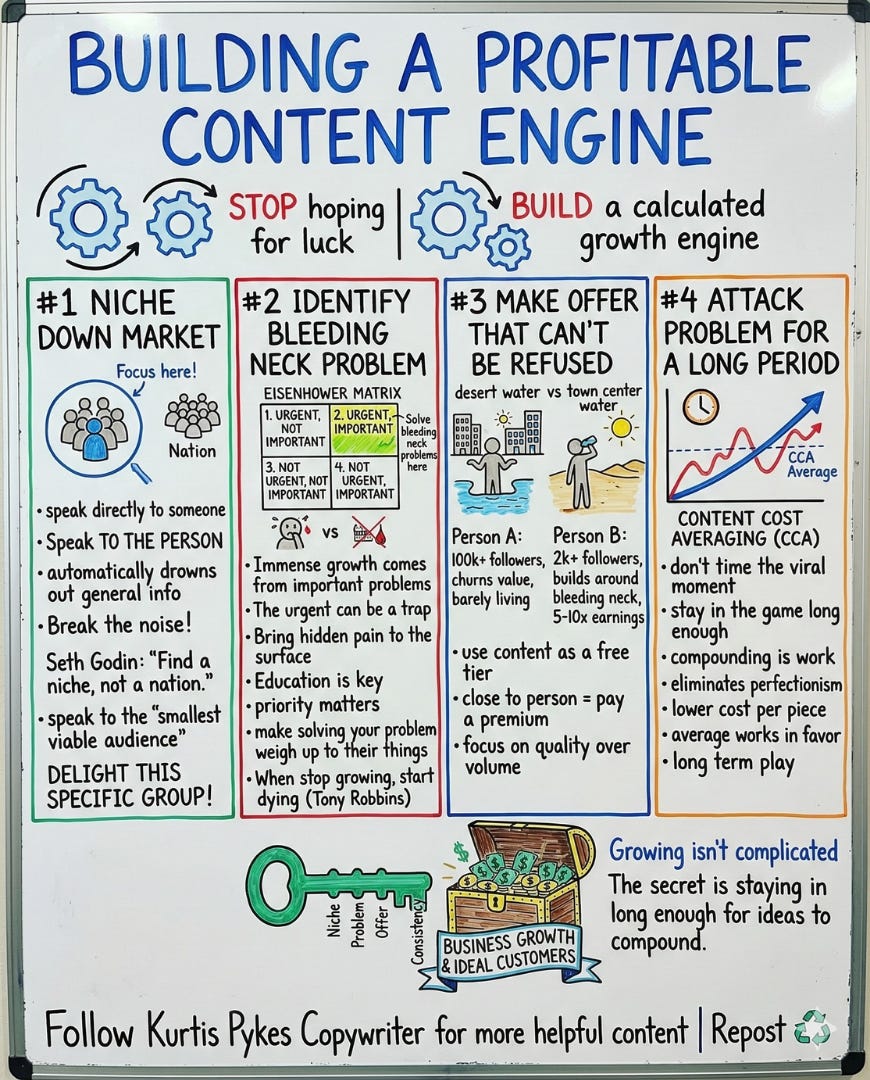
Content is one of the cheapest levers for growth you have in your business.
But more and more people are becoming aware of this.
The problem? Many think it’s a magic pill.
They dive straight in without understanding the mechanics that pull people into their ecosystem.
They start enthusiastically.
Sharing daily.
The response isn’t great, but they convince themselves, “It will pick up over time.”
It doesn’t.
3 months go by…
Still, nobody is listening.
No leads are pouring into their inbox.
Eventually, they stop posting.
Their mates ask, “Why did you stop?”
“Ahh, I’m just rebranding,” they reply.
I know this story so well because that was me for the first 4 years of business.
I’ve had more stop-starts than Nick Cannon has children.
I even quit posting on LinkedIn for 2 whole years.
But in 2025, I returned.
That year, I made over $100,000 from just 3 customers because of my content.
0 outreach.
Here’s how I did it…
Step 1: Niche down a market
Last week, I got a text from one of the best young chefs in all of South Africa.
Her employer went bust 2 months ago.
She was made redundant as a result.
Since then, she’s been unable to find work.
They say she’s over-qualified for junior roles and lacks experience for more senior opportunities.
Now, she’s found herself working in a call center.
Pain.
Something must’ve snapped in her because the message she sent me was of a flyer that read, “Premium meal prep services,” with her contact details on it.
She followed up with, “Does this look good?”
I was conflicted.
Because if I told her the truth - that it sucked - we’d end up in a long conversation about why.
I wasn’t prepared for that.
I had just set up my shisha and put my feet up in preparation for the Chelsea game.
But I felt bad.
I called her.
The first thing I said was, “Who is this for?”
She replied, “I don’t know. Anyone who wants meal prep services… I’m just fed up. This is the third time I’m posting something like this. I just want this one to work. Do you think it looks good?”
“Well, yeah... The designs are great,” I replied.
And it truly was great.
But content like this rarely extends beyond the cheers and applause from people you already know.
Heck, they may even buy from you in the beginning.
But this won’t be enough to sustainably grow your business.
Eventually, they’ll get tired of doing you a favor.
Or you’ll get frustrated about doing more work than you’ve signed up for to make up for the “premium” you claimed your offer to be.
It’s a lose-lose situation.
The most valuable thing you could do at the beginning of your content creation journey is to decide who you are going to help.
If you’re already running a profitable business, you’re in luck because you’ve already got your answer.
But if you’re just starting out with both (business + content), you must take your time on this step.
Or as Seth Godin, the Godfather of marketing, put it, “Find a niche, not a nation."
Why?
Because we live in a world of infinite choice.
To keep us functioning effectively, our brains automatically drown out any information that doesn’t apply to us.
And that’s like 99% of what’s on social media.
The only way to break the automatic system is to speak to the person directly.
The narrower you go, the better… to an extent.
You don’t want to narrow it to a point where there aren’t enough people in your pool to sustain your business.
But you also don’t want to broaden it so much that people are confused whether you’re talking to them.
This is known as your “smallest viable audience.”
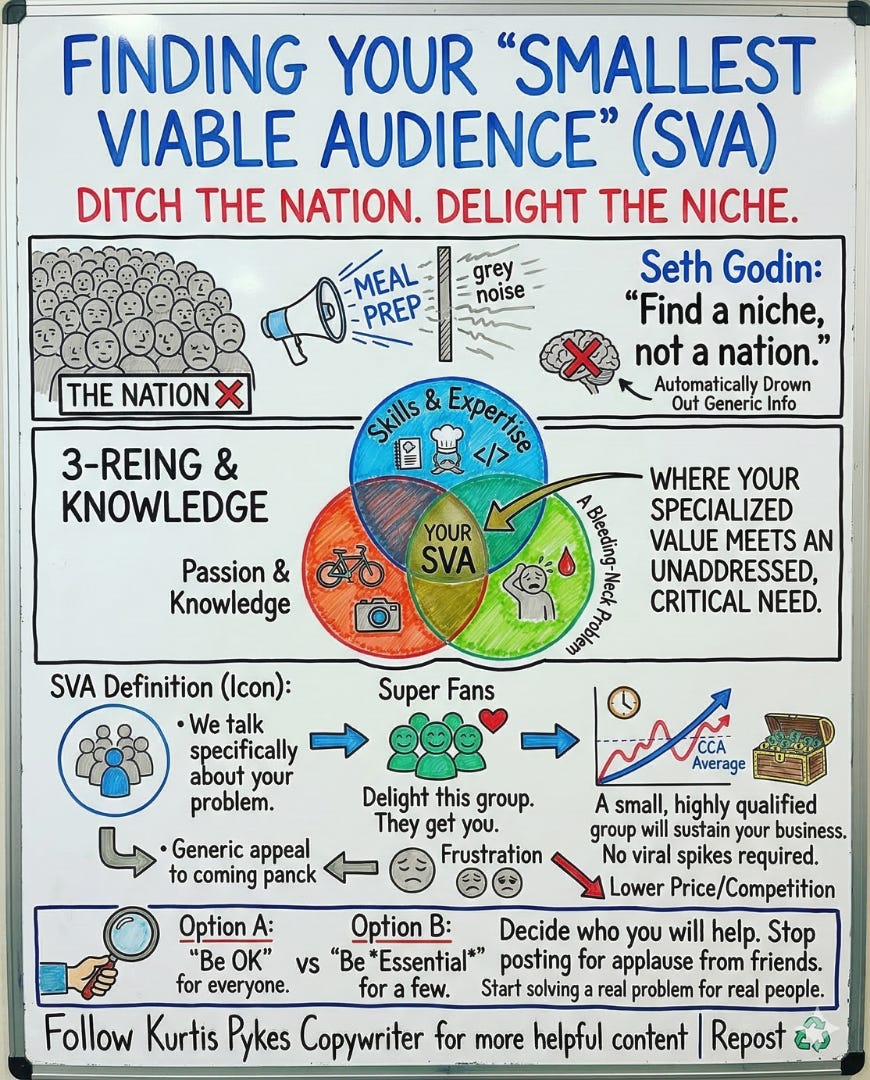
And by focusing on it, you can truly delight a specific group of people who will become your loyal fans and customers.
The alternative is to be just “okay” and compete on price, which is an everlasting race to the bottom.
Step 2: Identify their bleeding neck problem
Look, we all have problems…
But would you agree some are more pressing than others?
The 34th President of the United States, Dwight D. Eisenhower, certainly did.
In 1954, he took the podium to address the Second Assembly of the World Council of Churches…
During his speech, he said, “I have two sorts of problems: the urgent and the important. The urgent are not important, and the important are never urgent.”
This conundrum later became known as the Eisenhower matrix.
… and it’s the story of each of our lives (even if you don’t know it).
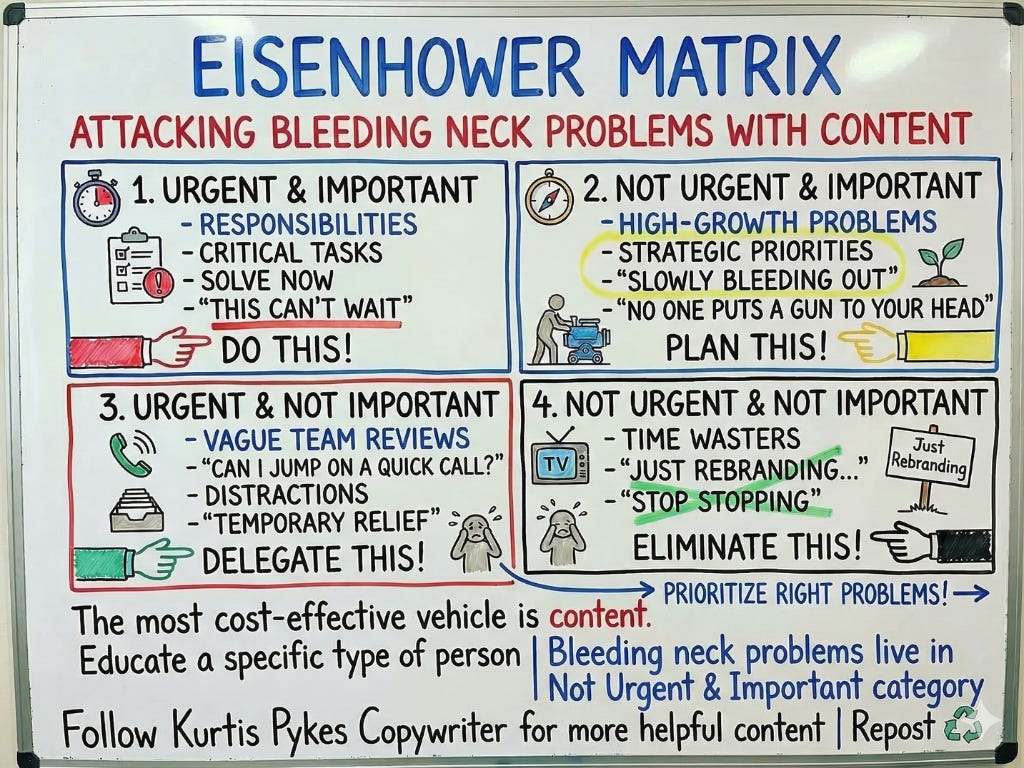
Urgent problems don’t move you closer to your desired objectives, but they must be fulfilled.
Think:
Paying bills
Admin tasks
Anything that’s time-sensitive and needs to be dealt with immediately
The problem? Most people invest the majority of their resources in this category.
Only because doing so provides a temporary sensation of relief - “I’ve done it.”
But after that, there’s not much else…
Important problems aren’t urgent, but this is where immense growth lives.
Think:
Getting in shape
Learning a new skill
Speaking to loved ones
We all know we’re supposed to do them, but nobody puts a gun to our heads and tells us to get to work.
And there’s no immediate consequence for not doing them.
But unbeknownst to you, you’re slowly bleeding out until you’re drained of life.
If you want to use content to grow your business exponentially, these are the types of problems you have to find in the ideal customer you selected above.
Why?
It all stems back to what I said earlier…
We live in a world of infinite choice.
… but we’re constrained by resources (e.g., time, money, etc.).
Because of these constraints, we must prioritize.
Most people prioritize tasks that don’t contribute to their growth.
And in the words of Tony Robbins, "When you stop growing, you start dying."
By that logic, there are people out there slowly draining themselves of life.
And the majority of them don’t even know they’re doing it.
Your job is to bring it to their attention and help them solve it.
The most cost-effective vehicle to do so is content.
The job of content in the equation of business growth is to educate a specific type of person on a bleeding neck problem and then help them solve it.
It’s extremely difficult to grow a business with content when you’re not attacking a bleeding neck problem.
People have infinite choice, and they’re constrained.
Their energy must be preserved for the most pressing matters in their life.
So the cost of NOT solving the problem you’re attacking must weigh up to (or be greater than) the things they’re already dealing with.
Otherwise, they’re extremely unlikely to ask you for help (even if they cheer you on when you post).
Step 3: Make an offer that can’t be refused
If you were stranded in the middle of the desert for 24 hours, and a stranger suddenly appeared with a bottle of water and offered you some, would you take it?
What about if you were on a 25-hour flight from London to Melbourne, and a stranger offered you a bottle of water because the flight crew ran out?
You probably said yes in both of these scenarios.
What about this one…
You’re in the town centre, and I approached you with a bottle of water. Would you accept it?
Probably not.
Better yet, would you approach me for my water?
Again, probably not.
The most you might ask me for is a hand opening a door so you can carry your shopping out, which doesn’t cost much (if anything at all).
This is a common problem we see on social media…
On one side, we have person A with 100,000+ followers.
They’re churning out a ton of valuable content.
The problem? They’re barely making a living (or they’re earning far less than they’re capable of, given their audience).
On the other side, we have person B with 2,000+ followers
They’re also churning out valuable content.
But they earn 5-10x+ more than person A.
And the only difference is in what they’re offering.
Person A builds their business around abundantly available skills.
They make a living through regular low-ticket gigs, sponsorships, and/or ad revenue.
The more volume they do, the more they get paid.
They’re incentivized to work hard.
Suddenly, views and engagement become their main focus.
The number of hours they work becomes their medal of honour.
It’s high effort, low reward.
Person B builds their business around a bleeding neck problem for a specific type of person.
They use content as a free tier of their offer.
But you can also pay a premium to work with them.
The closer you are in proximity to them, the more you pay.
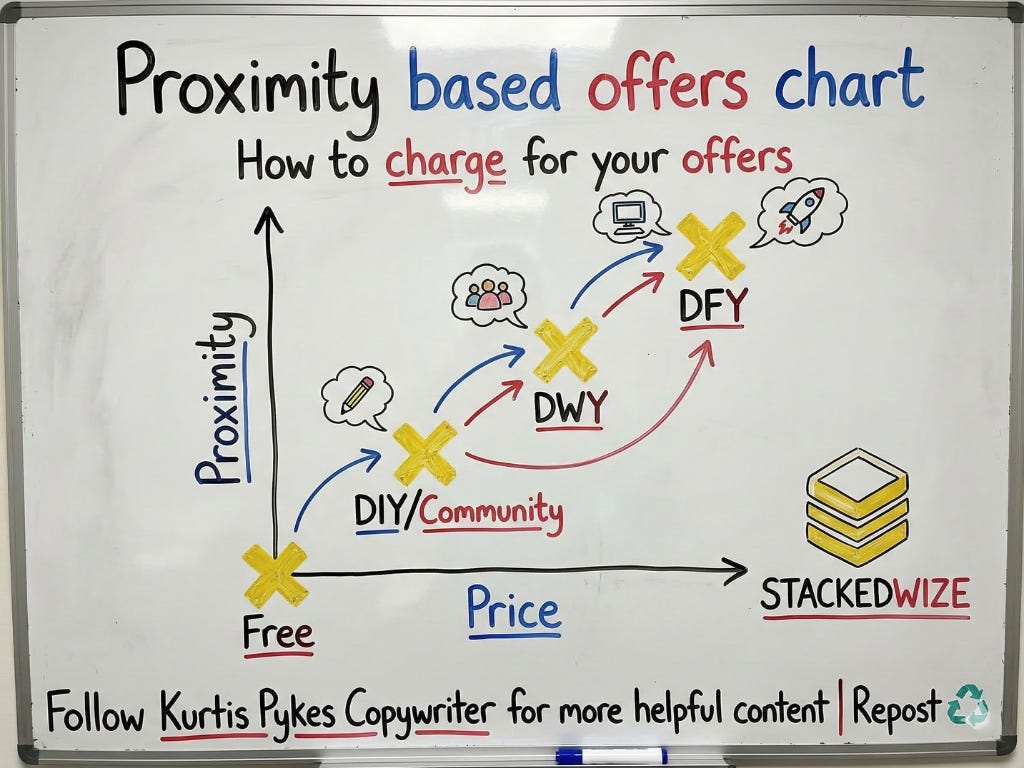
Person B is incentivized to bring people closer to them.
This means focusing on producing higher-quality content rather than volume.
It’s lower effort, much higher reward.
It’s also how I grew my business from making $2,000 to $15,000+ p/m.
From 2020 to 2024 (and stints of 2025), I wrote on Medium.
I regularly got 100,000+ views each month, but made around $1,500 p/m.
I also worked with companies like NVIDIA and Datacamp to create blog posts.
They would create the brief, and I would just do the work they gave me.
Naturally, this capped my asking price.
Because if I charged too much, they’d just find someone else cheaper.
So I worked 70+ hours a week, but still couldn’t afford to rent an apartment in London.
It got so bad that I had to move from the UK to Ghana to live in the retirement home my parents built.
Now, I work 30-40 hours a week max.
I have 2 clients paying me 6-figures p/y.
I also recently left Ghana and moved to Dubai (I know, bad timing).
All of this is only possible because my offer can’t be refused.
It’s a natural progression to my content.
So if you love my content but can’t implement it yourself for whatever reason, just pay my premiums and I’ll do it for you.
Step 4: Attack the problem for a long period of time
In 1949, Benjamin Graham published the first edition of The Intelligent Investor.
This book went on to shape Warren Buffett's (one of the wealthiest investors to ever live) investment philosophy.
Buffett even called it, "Best book on investing ever written."
In the book, Graham spoke of an investment strategy called “Dollar cost averaging (DCA).”
The idea is simple…
Instead of trying to time the market, you invest a fixed amount of money at regular intervals regardless of what the market is doing.

Sometimes you buy when prices are high.
Sometimes you buy when prices are low.
But over time, the average works in your favour.
The biggest benefit?
It removes emotion from the equation.
You stop trying to predict the perfect moment and simply stay in the game long enough for compounding to do its work.
Content works the exact same way.
I call this principle Content Cost Averaging (CCA).
Instead of investing money at regular intervals…
You publish content at regular intervals.
Regardless of:
What’s trending
Whether the algorithm likes you today
Whether your last post performed well
You simply keep investing.
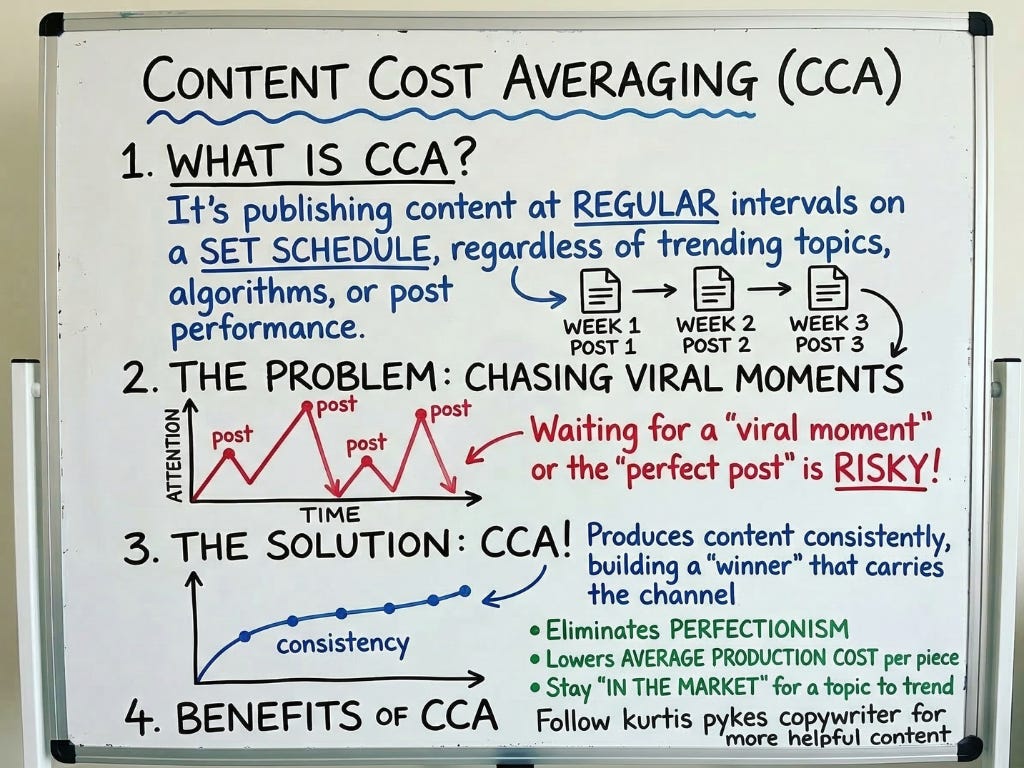
Here’s why this works:
Eliminates perfectionism: Just as DCA removes the need to “time the market,” CCA suggests you shouldn’t wait for a “viral moment” or the “perfect post.” You publish on a set schedule regardless of immediate trends.
Lowering “cost per piece”: Consistently producing and repurposing content (e.g., turning one webinar into 10 social posts) lowers your average production cost and effort per asset.
The “winning” average: Not every post will be a hit. However, staying consistent will ensure you are “in the market” when a topic suddenly trends, allowing your “winners” to carry the average performance of your entire channel.
CCA is the reason I’m even in business…
In 2024, I wrote an article about ghostwriting that barely made a splash when I first published it.
A year later, someone found it and reached out to me on LinkedIn.
I quickly onboarded them, and we’ve now been working together for 9 months and counting.
Without CCA, I wouldn’t have any clients because I’ve never successfully converted anyone through outbound.
And that’s something I want to point out here…
If the survival of your business depends on landing clients in the short term (e.g., 1-3 months), relying solely on content isn’t a good idea.
Yes, you should still publish now to reap the benefits of CCA later.
But most of your focus should be on outreach.
Leveraging content to grow your business is a long-term play.
While a few people have reaped massive rewards in short time frames, the majority of us will not experience that, so it’s better to optimize our strategy for the long haul.
If it happens before then, so be it.
Final thoughts
Growing a business with content isn’t complicated.
But it is misunderstood.
Most people treat content like a lottery ticket.
They post for a few months, hope something goes viral, and quit when nothing happens.
But content doesn’t work like that.
It works when four things are true:
You focus on a specific market
You solve a bleeding-neck problem
You build an offer around that problem
You consistently attack it for a long time
When these four pieces align, content becomes the engine to pull the right people into your business ecosystem.
But it doesn’t happen overnight.
The secret is staying in the game long enough for your ideas to compound.
P.S. If you'd like help building a content engine like this inside your business, apply to work with Stackedwized.