

How to Find Your Brand Voice (Without Overthinking It)
The psychology behind finding your authentic voice


You set aside 3 hours to draft a piece of content…
And you end up using up the whole day because you spent most of your time second-guessing every sentence.
Or it’s time to start drafting…
But you can’t begin without pulling up the creations of popular creators in your niche because you want to copy their style.
Or you’ve written your first draft…
And all your strong opinions are absent because you’re afraid people might disagree.
Or you’ve published your content…
And nobody, apart from the people using virtual assistants to write blatant AI comments, engages with what you’ve shared.
These are all signs you're disconnected from your brand voice.
You’re unable to express your ideas in a way that’s authentic to you.
Why does it happen?
Because of societal influence.
Most people underestimate how much their environment shapes the way they think.
So they tell themselves things like:
“Maybe I'm just not good enough.”
"I'm just not that creative."
"I don't have anything interesting to say."
But none of those beliefs attack the actual problem.
You’ve simply lost touch with your natural way of expressing yourself.
So in this article, I’m going to show you:
How you lost your voice
The mindset of a creator
How to rediscover your voice
Let’s get into it…
How you lost your voice
There is a switch everyone goes through in their content career.
It’s when you transition from:
Creating content because you enjoy it → Creating content to produce a specific result.
Or…
Not creating content → having to create content to produce a specific result.
Few people are able to navigate this transition seamlessly.
But for many, the transition creates so much pressure that they stop enjoying the act of creating.
This has happened to me many times.
In 2022, I quit writing blog posts for 6 months because I dreaded it so much.
The spark I used to feel when I was just sharing things I was learning was gone.
Because I felt like I had to write in a way that would help me find customers.
So the majority of the content I created was stuff I thought would go viral.
The logic seemed sound…
The more impressions I got, the more people would discover me.
The more people who discovered me, the more clients I’d attract.
But this approach was exhausting.
So I quit for 6 months.
I wasn't chasing impressions anymore.
I started following my curiosity again.
… and that curiosity led me back to writing again.
When I returned, I wrote one of the most viral articles on Medium that year.
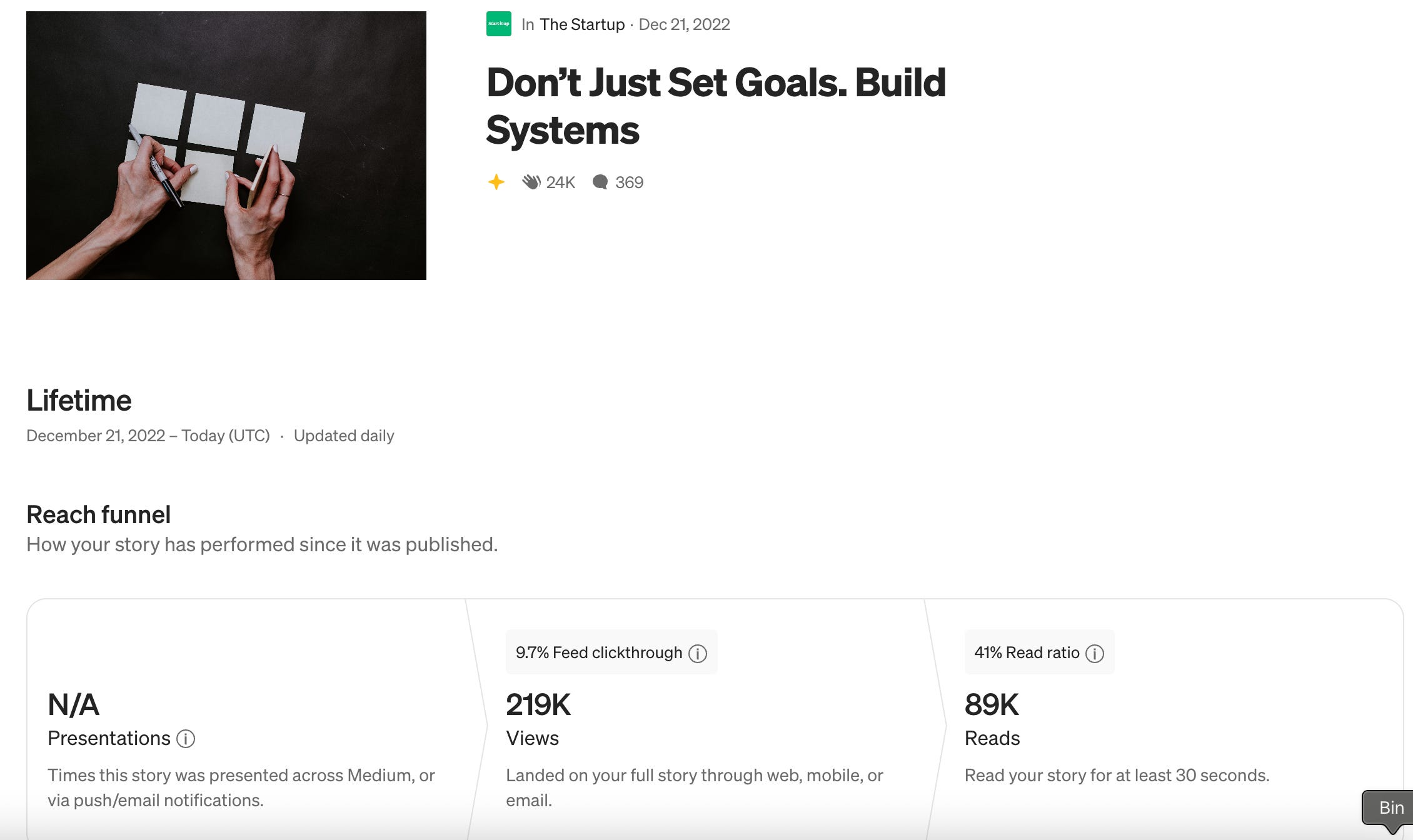
And this article wasn’t even in the typical niche I’d been writing in up until this point - I typically wrote about AI.
So what happened?
For a lack of better words…
I stopped giving a fuck.
The mindset of a creator
Content creation is a blend of natural intuition and learned strategy.
What do I mean?
Creative spark, such as what to say or how to say it, requires natural intuition.
The process of packaging, distributing, and optimizing content to stand out requires a learned strategy.
But the moment there’s pressure to produce an outcome, your creative spark disappears.
You stop acting intuitively and start trying to engineer the “right” answer.
In other words, you end up using logic to perform intuitive tasks.
When this was happening to me, I could literally feel the anxiety in my body while I was creating because I was worried about things not playing out the way I wanted.
As a result, I always played it safe.
So my content NEVER stood out.
A similar thing happened to me back when I used to play football…
Whenever I played matches for my contracted team, who were in the 4th tier of English football, I never made much of an impact.
In fact, over my 2 years as a scholar, I never scored a goal for the youth team.
But when I went to play with my friends, who were earning $30,000+ a week as 18-year-olds, I was a beast.
Many of them were shocked I played so low in the divisions.
But what they failed to understand was the difference between the two environments…
When I was playing for my contracted club, there was pressure to perform because I wanted a professional contract.
When I was playing with my friends, the goal was simply to have fun.
This allowed my instincts to take over.
I was in flow.
The first thing that came to mind was what I’d do.
And oftentimes, it worked.
But even when it didn’t, I never became a shell of myself because I was just having fun.
Content creation isn’t any different.
The moment you stop trying to impress people and start enjoying the process, your natural voice shines through.
This is the secret to finding your brand voice.
It isn’t something you invent…
It’s what naturally comes out when pressure stops getting in the way.
How to rediscover your voice
You’ve got to be having fun.
And the only way to have fun is to enjoy what you’re making.
If you’re creating a piece of content for any other reason besides the fact that you enjoy creating it, don’t do it.
It’s probably going to flop anyway.
That’s the first step.
Here are 4 more steps to help you rediscover your voice.
1/ Master the fundamentals
Creative spark is an art.
But there are principles that make art beautiful.
In the case of content, these are things such as:
Ideas
Hooks (including visual)
Opinions
Formatting
Flow
Language
etc
The key is to master the mechanics so you no longer have to think about them.
The less mental energy you spend worrying about where to break a paragraph or how to write a hook, the more energy you have available for expressing what you actually think.
It’s like learning to drive…
At first you’re consciously thinking about the mirrors, gears, pedals, and steering wheel.
Eventually all of that becomes automatic.
Content creation works the same way.
The fundamentals should become second nature so your intuition has room to play.
2/ Create with no goal
Imagine nobody is going to see what you’re creating.
Because that’s the version of yourself you’re trying to access.
The moment you attach an outcome to your work, you stop expressing yourself intuitively and start performing.
So if you catch yourself thinking, “Is this going to go viral?” or “Is anyone going to like this?” stop writing.
Take a break.
Come back once you’ve let go of the outcome.
You’ve got to train your brain to create without an agenda.
Every time you catch yourself performing instead of creating, you’re reinforcing the habit of separating creativity from validation.
Eventually, creating for the sake of creating becomes your default.
3/ Identify your patterns
Once you begin creating without the burden of societal pressure, you will quickly notice patterns.
These are patterns that are noticeable to other people.
This is what you call your sound.
A pattern of elements that are repeated in your content.
You’re not even trying to do it…
It’s just something you do off your intuition.
Maybe you naturally tell stories before making your point.
Maybe you’re always challenging conventional wisdom.
Maybe your writing is blunt, humorous, philosophical, or full of analogies.
Whatever it is, don’t try to force it.
Just pay attention.
For example, my voice is pretty relaxed, but also blunt.
People come to me when they want the non-sugarcoated truth.
I’m also known among friends for explaining complicated ideas in ways that make people feel silly for not realizing it before.
So naturally, those same patterns show up in my writing.
4/ Edit like a maniac (Optional)
After you’ve created your content, you can tweak it to increase its chances of performing well.
This could mean:
Strengthening your hook
Tightening sentences
Removing repetition
Improving the flow
Replacing vague language with something more concrete
Etc.
Anything you feel can improve the content using learned strategy.
But this part is optional.
I personally refrain from making too many edits because I’ve found that every additional round pulls me further away from the version that felt most natural when I first wrote it.
I want my writing to sound like a conversation between me and a friend.
So I simply read everything out loud to make sure it still does.
But the main gist is that you’re supposed to create with intuition and then edit with strategy.
Don’t reverse the order.
Final thoughts
Your brand voice isn’t something you build.
It’s something you uncover.
And the way to uncover it is to create for yourself before you create for anyone else.
This means creating things you’re genuinely interested in.
Not what you think the algorithm wants.
Not what you think your audience expects.
Not what you’re hoping will go viral.
Because the moment your attention shifts from expressing yourself to chasing an outcome, your voice begins to disappear.
This doesn’t mean you shouldn’t have goals.
It means you trust that everything you’ve practiced will carry you there without forcing it.
This is why my old football coach used to say, “Train as you play.”
Because if you've trained the fundamentals enough, you don't have to think about them when the pressure is on.
Here’s the gist:
Your voice has been there all along.
It’s the way you naturally explain ideas to a friend.
The stories you instinctively tell.
The opinions you can’t help but have.
The analogies you always reach for.
The phrases you repeat without even realizing it.
Your job isn’t to manufacture a personality.
It’s to remove everything that’s stopping your real one from coming through.
Strategy gets attention.
Your voice earns trust.
Thanks for reading!