



Did you know a cook in the US Coast Guard once became a Pulitzer Prize-winning author?
His name is Alex Haley.
He won the award for his book, Roots, which tells the story of a Gambian man, Kunta Kinte, during the transatlantic slave trade.
But that’s not even where we’re going…
Haley never had ANY formal training as a writer before he dropped this banger.
As I said, he was a cook.
So how was he able to pull off this feat?
One night, he stumbled upon an exercise that changed how he understood good writing.
He picked up a book he’d been reading, propped it against his typewriter, and began typing out one of its chapters word for word.
For the first time in his life, he could FEEL what good writing was like.
He noticed how deliberately the sentences were constructed, how clearly the ideas were communicated, and how no words went to waste.
The funny thing is he’d read the book before…
But he never truly appreciated the craftsmanship behind it until he reproduced it for himself.
From then on, he made it his goal to make his own writing feel the same way.
And years later, that self-taught writer would go on to win a Pulitzer Prize.
There’s an important lesson in this…
You can become a better writer by reproducing great writing.
This exercise is known as copywork.
Copywriters have been doing it for years!
Traditionally, it involves reproducing another writer’s work word for word to internalize their writing techniques.
I encourage you to save top performing content (especially from small creators) for this purpose.
Let me show you how this works in practice...
2 ways to practice copywork
I’ve been doing copywork for years.
But these past 30 days, I’ve been more consistent than ever.
90 minutes every morning, first thing when I wake up.
Anyway, that’s irrelevant...
There are two core ways I use it to help me improve my writing:
1/ Structural modeling
I recommend this approach to anyone who’s just getting started with writing.
Instead of reproducing what a writer has said, you reproduce HOW they’ve said it.
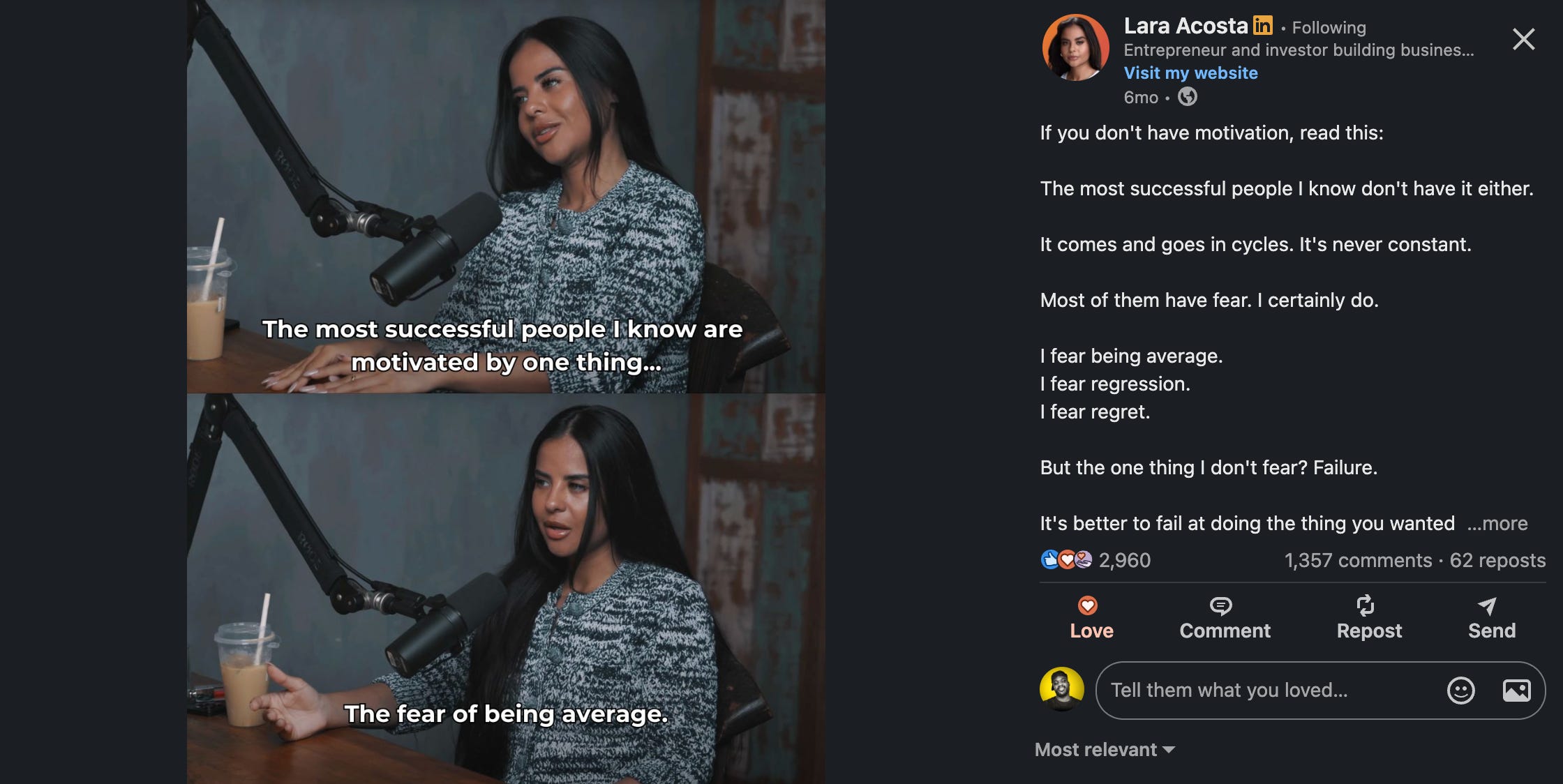
For example, here’s a popular post I saw from Lara Acosta:
And here’s my whack at structural modeling:
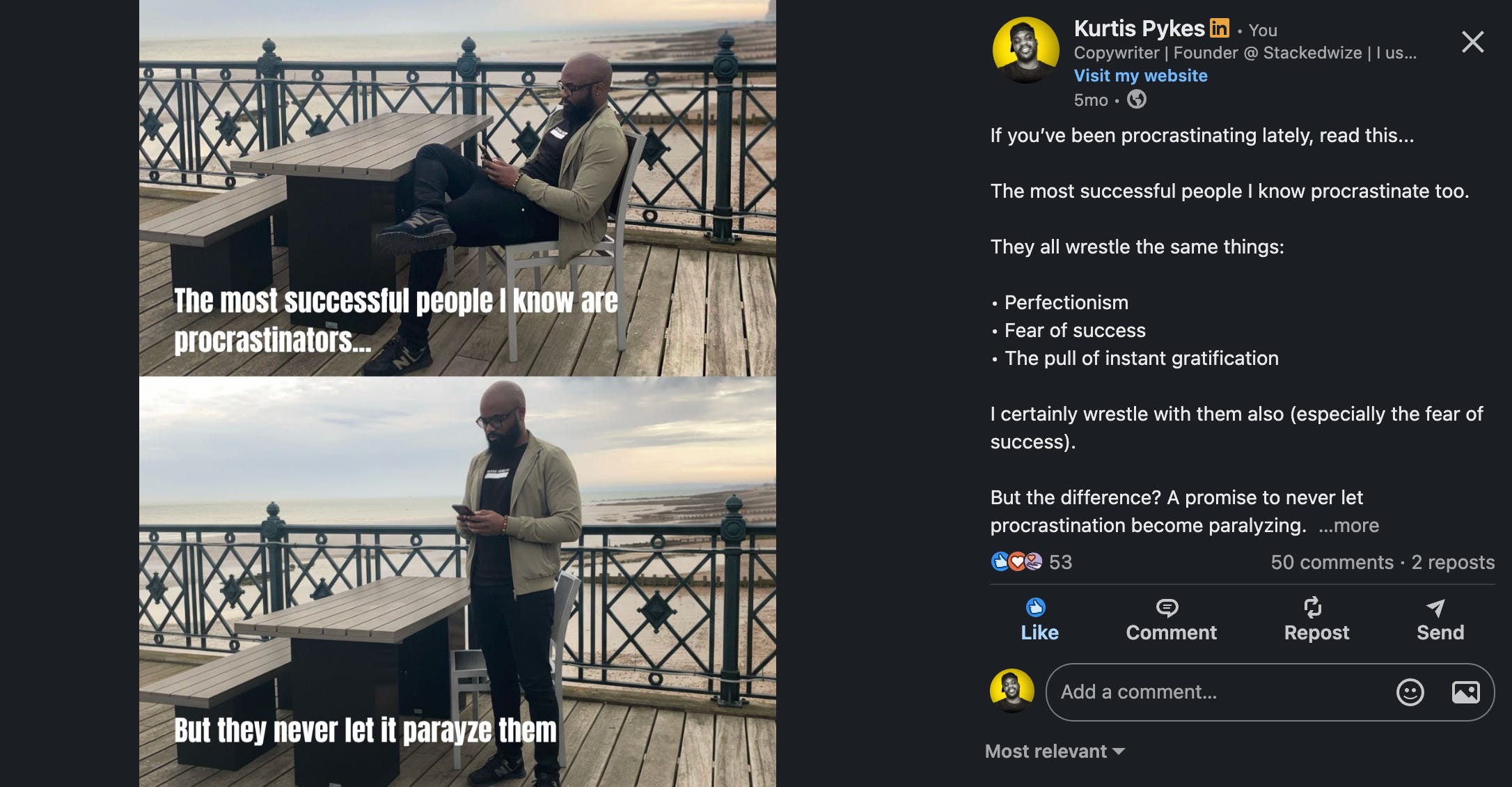
Lara’s post still performed significantly better than mine, but compared to my average engagement, this is pretty good.
But back to why I recommend this to beginner writers…
One of the hardest things about writing (especially when you’re just getting started) is figuring out how to communicate your ideas in a way that keeps people engaged.
Structural modeling removes some of that friction because you’re working with a structure that’s already proven to capture attention.
The objective of this exercise is to understand WHY those structures work so you can eventually construct your own.
And that’s why you shouldn’t become dependent on this approach…
If you constantly borrow structures from other writers without understanding why they work, you’ll depend on their creativity instead of developing your own.
There’s nothing wrong with borrowing from other writers (I still do it occasionally).
But you want it to be a choice, not a necessity.
2/ Word-for-word reproduction
This is the traditional approach to copywork.
You find a piece of writing you admire and reproduce it word for word.
I always tell writers to start with Gary Halbert’s Boron Letters when they want to get into this type of writing.
He’s one of the most successful direct-response copywriters ever, and you’ll quickly see why once you start reproducing his work.
The objective of this task is to slow yourself down enough to notice things you’d typically overlook when reading.
The more you do it, the more you develop an instinct for good writing.
75 high-converting LinkedIn posts for copywork
To save you the trouble of finding great LinkedIn posts to model, I’ve compiled 75 of them for you.
They are broken into 3 different types:
Storytelling
Education
Lead magnet
And 3 different types of reach:
Broad: Content designed to drive growth by covering topics that appeal to a wider audience, bringing new people into your funnel.
Narrow: Content designed to build trust with your audience by demonstrating your skills and expertise.
Niche: Content designed to convert readers by speaking directly to your ideal customer (e.g., addressing a specific problem, desire, or objective).
I’ve categorized them by content type and intended outcome, so you can be intentional about the posts you model.
Anyways, here’s the resource…