

My Content Publishing System For LinkedIn, X, And Substack
How I distribute content to maximize my reach

3 years ago, I published my first content publishing strategy.
But a lot has changed since then…
Twitter is now called X.
And I haven’t posted there in almost 2 years.
I’ve also moved from ConvertKit to Substack to make use of their paid newsletter infrastructure.
So my old publishing system is obsolete.
But that’s about to change…
Clients have been asking me to expand my services to X and Substack.
And I’m a big believer in being my own first case study.
So I spent the last 4 weeks studying publishing patterns across:
X
Substack
And I have put together a strategy to help me maximize the reach of my organic content.
This is the exact same strategy I’ll be deploying for my clients.
But you’re getting it completely for free.
Let’s get into it…
The content schedule
“Do I need to post daily? And if so, how many times per day?”
This is one of the first crossroads creators get stuck at.
Gurus online would swear by a certain number of posts per day or week.
But after studying a range of creators across industries, I quickly learned the answer is not so clear-cut.
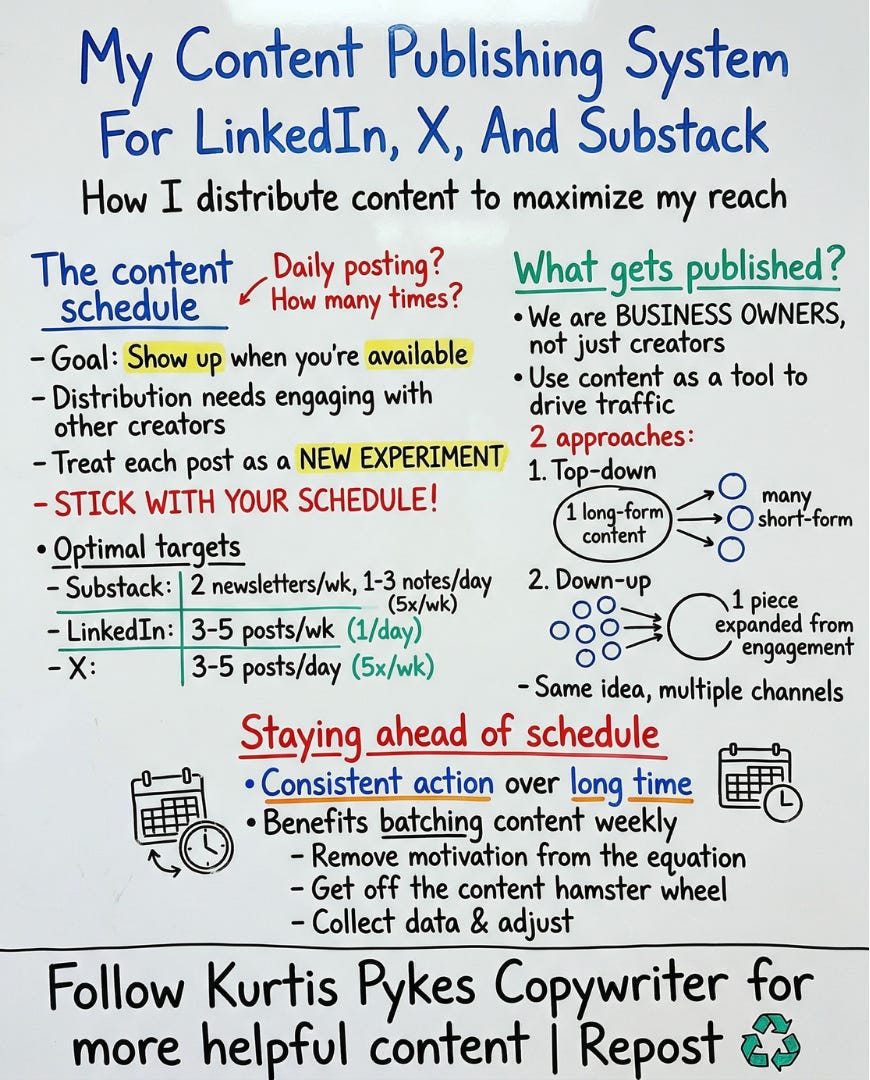
The goal is to show up when you’re available.
Why?
Because what’s going to help your content distribution most is engaging with other creators.
It’s simply not enough to just make a great post and ghost.
You must spend time replying to comments made on your posts.
More importantly, you must spend time engaging with others’ content to divert eyes to your content.
This is how you become seen by prospects.
But that’s not all…
Social media is extremely competitive these days.
To give you the best chance of reaching your target customers, you want to take as many swings as possible without coming across as spam.
The goal is to treat each post as a new experiment. Do things to see what works and do more of what works.
Here are the ranges I’ve found optimal for hitting those targets:
Substack: 2 email newsletters per week, 1-3 notes per day (5x per week)
LinkedIn: 3-5 posts per week (once per day)
X: 3-5 posts per day (5x per week)
Of course, you can do more.
But this is what I’ve found to be most effective after my research.
The most important thing is that you pick a schedule and stick with it no matter what.
Your audience should know what to expect from you.
And you should know what to expect from yourself.
When you have a dedicated time, you remove the need for inspiration.
Which is extremely important for consistency.
But what gets published?
Yes, we create content…
But we’re not content creators.
We’re business owners.
Content is only a tool to drive traffic to our business.
So we must minimize the time we spend creating content to allow us more time to focus on what we do best.
And how do we do this?
By stealing from ourselves.
Fun fact: The people you’ll find on one social media is not the same you’ll find on another.
Some people swear by X.
Some think LinkedIn is everything.
Others believe Substack is the next big thing.
You’re going to meet people with different belief systems on different platforms.
And they may all still fit your target audience.
The point I’m making is…
Just because you share something on one platform doesn’t mean you can’t share it again on another.
You can maximize the distribution of one idea by spreading it across channels.
And there are 2 ways you can play this:
Top-down: Create one piece of long-form content and then strip ideas from there to create multiple pieces of short-form content.
Down-up: Create multiple pieces of short-form content and expand the piece that gets the highest engagement into a long-form piece of content.
Of course, they both have their pros and cons.
Top-down content distribution is high investment.
You’re essentially making a bet about what your audience wants to know.
The good thing about it is you can batch your content well in advance.
Down-up content distribution is low investment.
But it’s reactive.
You’re waiting to see what the market says before you invest.
Some would swear by the down-up approach. But in reality, it’s down to preference.
I used to use the down-up approach, but I switched because my content wasn’t getting the best engagement overall.
Now I take a more hybrid approach.
Staying ahead of schedule
I’ve been fortunate enough to join communities with successful entrepreneurs like Matt Gray, Nicholas Cole, and Darren Lee, to name a few…
I always use it as an opportunity to pick their brain.
One of my most favorite questions to ask them in the Q&A sessions is: “What ingredient do you feel like has been the important to your success?”
And they all answer with a variation of the same thing…
“Taking consistent action over a long period of time.”
The way to do this is to remove motivation from the equation.
I do this by batching content weekly.
This helps you achieve 2 goals:
Takes you off the content hamster wheel so you can focus on high ROI tasks
Gives you enough time and flexibility to collect data about what’s working and what’s not, then adjust.
Anything longer than a week is too rigid. Anything less than a week can demand too much time.
We want to minimize friction wherever possible.
I used to publish daily on LinkedIn…
I ended up quitting the platform for 2 years - don’t be like me.
At the time of writing, I use AuthoredUp to schedule my LinkedIn content and native Substack to schedule Substack notes and newsletters.
I’m experimenting with different tools for scheduling X posts, but only because I want something that tracks stats automatically and gives me insights into popular posts in my niche.
But the native X scheduler is fully capable.
Final thoughts
Content is just another tool to help with lead generation.
This means creating it shouldn’t take up most of your time.
The entrepreneurs who maximize the value of their content succeed by building systems to help them distribute the same idea across multiple platforms.
But always remember this:
It’s not about how much you communicate with them in a day…
It’s more about how consistently you show up over a long period of time.
This will allow your audience to develop expectations of you, which constantly keeps them anticipating your next move.
Thanks for reading!
P.S. If you’d like help writing LinkedIn content, apply to work with Stackedwized.