


I publish a lot of content every week.
This includes:
Emails.
LinkedIn posts.
Substack Notes.
Substack articles.
Content for all of my clients.
But I don’t remember the last time I ran out of ideas for what to post.
To caveat that…
I’d be lying if I said that was always the case.
When I first started writing in 2020, I practically had no system.
This is probably why I ended up losing my hair a year later…
I’d wake up, see what was trending, spend some time researching it, then write something about it.
It worked sometimes…
Quite a few of my articles went viral.
But other times, I’d spend hours scrolling around looking for something that inspired me.
And when nothing did?
I had the perfect excuse not to publish that day.
This process was draining.
Mainly because my ability to stay consistent depended on me feeling creative every single day.
I knew this approach would never scale.
Especially as I started publishing more content and eventually started creating content for clients too.
So I created a system…
It tells me:
Exactly what is being published.
Where it’s being published.
When it’s going live.
What I need to work on next.
And in this article, I’m going to share it with you.
This is the exact system I use to stay consistent on LinkedIn and Substack while managing content for multiple ghostwriting clients.
My publishing targets
As Stephen Covey famously said, “All things are created twice. There's a mental or first creation, and a physical or second creation to all things."
This principle applies to your content.
Before you build a content publishing system, you need to know what it's supposed to produce (a.k.a. the mental/first creation).
For me, the minimum is:
3 emails per week
7 LinkedIn posts per week
28 Substack Notes per week
2 Substack articles per week (1 free + 1 paid)
That’s 40 pieces of content every week.
… and this is just for me.
It doesn’t include any of the content I create and manage for my ghostwriting clients.
So now you see why I need a content publishing system…
There’s no way I could manage that volume if I woke up every morning wondering what to post.
The other reason you need to know what your outputs are is that you can’t build a publishing system if you haven’t defined what “consistent” means for YOU.
For me, that means 40 pieces per week.
For you, it might mean 5.
The number itself isn’t so important.
What matters more is that you know it.
So get clear on how much content you need to create each week.
Once you have a number, you can work backward to figure out how you’ll manage the load.
TL;DR: Your publishing target gives the rest of your system something to work toward.
Defining the category & content pillars
If you’re going to create a lot of content, you need to know what you’re going to talk about.
This is where you need a category and content pillars…
A category is simply a broad subject you want to become known for talking about.
The central topic of my content is ghostwriting.
But “ghostwriting” is far too broad to guide everything I publish, so I break the category into four content pillars:
Business scaling: How to build a ghostwriting business that can grow beyond you.
Case studies: Breakdowns of things I’ve done, results I’ve generated, mistakes I’ve made, and lessons from working with clients.
Offer & positioning: How to package your skills, choose who you serve, position yourself, price your services, and attract better clients.
Writing development: How to become a better writer and create better content for yourself and your clients.
My pillars have different names across LinkedIn and Substack because I created my LinkedIn strategy first and never bothered updating them.
But pretty much everything I create falls into one of these four buckets.
This gives me boundaries for what I create.
My idea capture system
Now we know HOW MUCH content I need to publish and WHAT I’m going to talk about.
The next question is, “Where the hell do I get all the ideas from?”
My answer depends on the platform.
LinkedIn
My idea capture system for LinkedIn is pretty weird…
I save other people’s posts.
That’s it.
Whenever I see a post that:
Says something I want to weigh in on.
Makes an argument I agree or disagree with.
Covers a topic I could approach differently.
Uses a format I want to recreate with my own ideas.
…I save it.
Then when it’s time to write my LinkedIn content, I open my saved posts and start working through them.
I guess you can say I use other people’s posts as a prompt for what I want to say.
This is pretty effective because it lets other people validate formats and ideas before I post.
Substack
Most of my articles come from two places:
Conversations I’m having with prospects.
Wins I’ve generated for myself or my clients.
Prospect conversations tell me what people in my target market are struggling with.
If I keep hearing the same question or problem, there’s probably an article in it.
Content on wins gives me proof.
Whenever I spot one of these ideas, I add it to my Notion database.
The harder part of this process is deciding whether an article should be paid or free.
At the moment, I’m using this simple rule of thumb:
WHAT to do = free content
HOW to do it = paid content
And that’s pretty much it.
I’m not coming up with 40 completely new ideas every week.
Most of the other content I publish is derived from these core ideas.
This is important because creating 40 pieces of content per week is insane if you assume every piece needs an original idea.
And this brings me to the next part of my publishing system…
The content publishing strategy
Now we get to the part where everything starts working together…
I started publishing consistently on LinkedIn before Substack, so my LinkedIn system is much more developed.
I publish 7 LinkedIn posts per week, but I don’t decide what goes out each day randomly.
Every day has a job:
Monday → Education / MoFu: Teach something related to the previous Sunday’s free Substack article.
Tuesday → Education / BoFu: Teach something related to Wednesday’s upcoming paid Substack article and promote it in the P.S.
Wednesday → Story / ToFu
Thursday → Education / ToFu or MoFu
Friday → Story / ToFu
Saturday → Education / MoFu: Teach something from a random Substack article.
Sunday → Story / ToFu
This does two things…
First, it makes sure I’m creating content for people at different stages of my funnel.
My stories reach and connect with a broader audience.
My educational content demonstrates my expertise and helps nurture people who already know me.
And my bottom-of-funnel content gives people an opportunity to go deeper with my paid content.
Second, I never have to decide what type of LinkedIn post I should publish that day.
If it’s Wednesday, I know I need a story.
If it’s Monday, I know I’m educating people using something from the Substack article I published the day before.
This removes another decision from my content operation.
How LinkedIn feeds Substack
Remember earlier when I said I publish 28 Substack Notes per week?
I’m not coming up with 28 completely new ideas.
For every LinkedIn post I write, I create three additional Notes based on the same idea.
Then I publish the original LinkedIn post as a Substack Note too.
So:
1 LinkedIn post → 4 Substack Notes
Do that seven times:
7 LinkedIn posts → 28 Substack Notes
But this relationship also works in the opposite direction.
How Substack feeds LinkedIn
I publish two long-form Substack articles every week:
Wednesday → Paid article
Sunday → Free article
Those articles become source material for my LinkedIn content.
My Monday LinkedIn post is based on the free article that went live the previous day.
This gives me another chance to promote the article after it's published.
Then on Tuesday, I publish educational content related to the paid article coming out on Wednesday.
The post gives people something valuable on its own, then I’ll casually mention the upcoming paid article in the P.S.
Essentially, the article is simply where readers can go deeper.
And LinkedIn feeds my emails
There’s one final loop…
Remember the three emails I publish every week?
I don’t create those from scratch either.
I look at my LinkedIn content from the previous week and identify the three posts that performed best.
Those become the basis for the following week’s emails.
Put all of that together, and my publishing system looks like this:
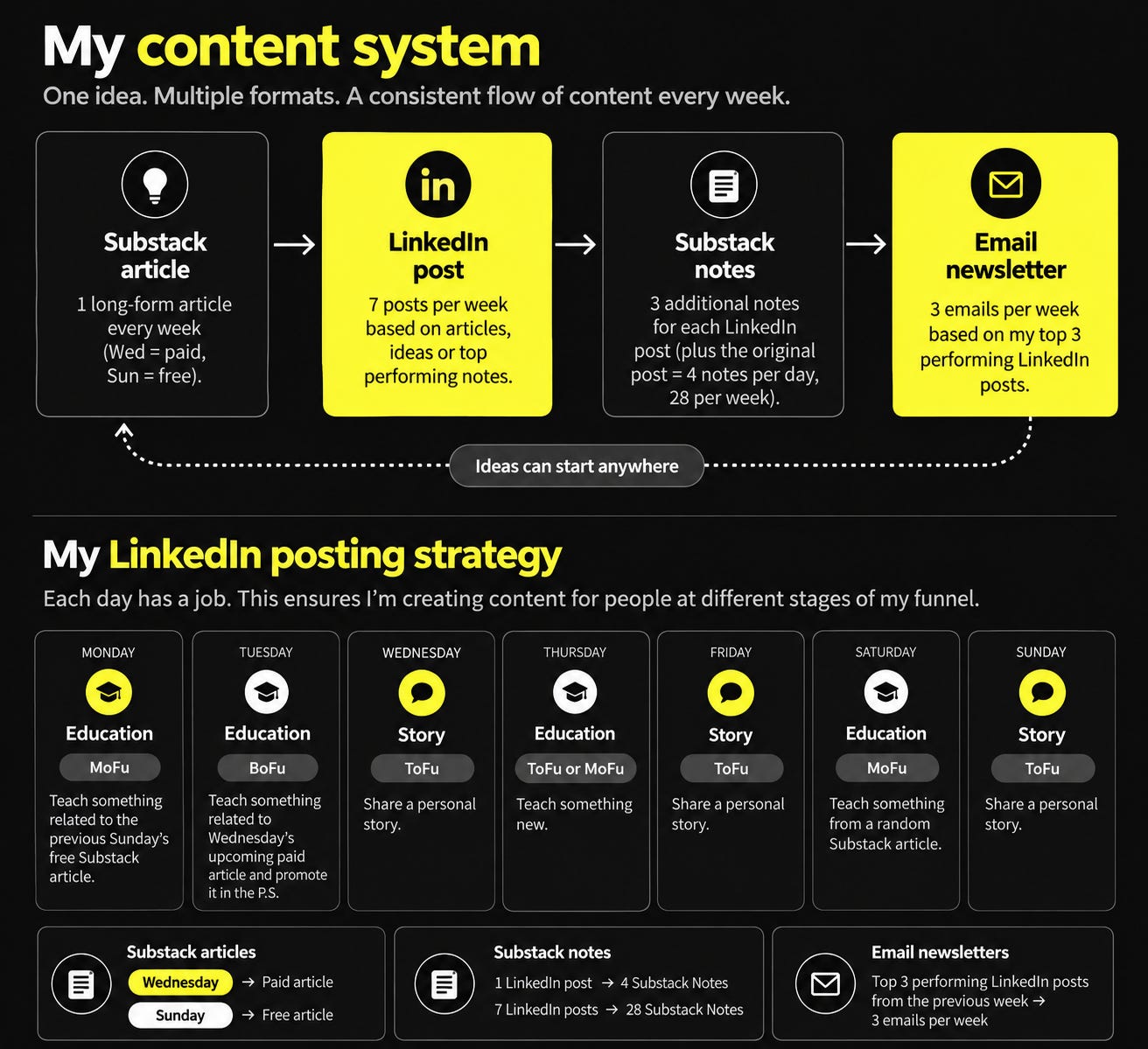
Here’s how the system feeds itself:
Substack article → LinkedIn post → Substack Notes → Email
But this isn’t rigid.
Sometimes an idea can start in the middle or at the end.
For example, let’s say a Substack Note gets more attention than anticipated…
I would create a LinkedIn post that dives deeper into the idea, or an article that expands on it.
The point is, every piece of content has the potential to create another piece of content.
This is how I publish 40 pieces every week without needing 40 completely different ideas.
I just take a smaller number of ideas and distribute them across different formats and platforms.
And since every format has a predefined role in the system, I don’t have to figure out what to publish from scratch every day.
I just keep the system fed with good ideas.
Tip: Batch work one week in advance
One final thing makes this entire system much easier to manage…
I batch everything.
I don’t write a LinkedIn post, switch to a Substack article, jump into client work, then come back to another LinkedIn post.
This would drive me insane (and it did when I used to do it).
Instead, I group similar tasks together and work on them in dedicated blocks.
My current writing schedule looks like this:
Monday + Tuesday (9 am–12 pm): Write my Substack articles.
Wednesday–Friday (9 am–12 pm): Write LinkedIn posts for myself and all of my clients.
… and I’m always working one week ahead.
This gives me breathing room if something unexpected happens.
It also gives me enough time to spot patterns in how my content performs and adapt my strategy before the next batch goes out.
I’m rarely scrambling to finish something hours before it needs to go live.
But the biggest benefit of batching is focus…
Every time you switch between different types of work, you have to mentally reload the context required to do that task.
Writing a long-form Substack article requires a different headspace from writing a short LinkedIn post.
And writing for myself requires a different voice and context from writing for a client.
So instead of constantly switching gears, I stay in one mode for several hours at a time.
This also makes my workload predictable.
TL;DR: Batch similar work together
And work far enough ahead that one bad day doesn’t derail your entire publishing schedule.
But not so far ahead that you can’t adapt quickly to changes on various platforms.
Final thoughts
Consistency isn’t always a discipline problem.
… and working harder isn’t always a solution to being more consistent.
Sometimes, you just need a system.
It doesn’t need to be complicated, as long as it informs you of:
WHAT you need to create.
WHERE your ideas come from.
WHEN everything needs to be created and published.
HOW your content moves through the system.
And most importantly… it allows you to achieve a desired outcome.
For me, this outcome is publishing at least 40 pieces of content every week while managing content for multiple ghostwriting clients.
For you, it might only be five pieces.
The number doesn’t matter.
What matters is you have a system that can produce your desired outcome consistently, without relying on you waking up inspired every morning.
… because there will be many days when you don’t.
Thanks for reading!
Thanks for sharing this! The method is too systematic and overall, there's plenty of air space.
Good topic. Will go through it👍