I bootstrapped my online service business to $100,000 in 8 months.
And a big reason I was able to grow so quickly was because I got better at creating offers people wanted to buy.
So naturally, as I started pushing toward my next milestone of $1M/year, I kept thinking about the same thing…
How can I make my offer better?
I added DM management and outreach to my LinkedIn ghostwriting package.
A few people bit.
Then I experimented with additional services I could sell to existing clients.
I introduced email ghostwriting.
Clients bought that too.
On paper, everything was working.
I was finding more ways to generate revenue from each client.
But one pretty massive problem remained...
Every improvement to my offer created more work for me.
I had virtually no time left to take on additional work.
I was increasing how much each client could pay me while simultaneously reducing my capacity to serve more clients.
Not exactly a brilliant scaling strategy.
But this is where I’ve found myself over the past six months…
Revenue has continued growing.
But I’ve also become increasingly trapped inside the business required to generate it.
If I want my ghostwriting business to keep growing, I need to offload the work that depends on me.
I need other people to produce outcomes without constantly asking me what to do.
I need recurring tasks to happen the same way every time.
I need processes that don’t live exclusively inside my head.
In other words...
I need systems.
More specifically, I need Standard Operating Procedures (SOPs).
Over the past several months, I’ve been building a framework to identify the things I repeatedly do, document how they’re done, hand them off to somebody else, and gradually remove myself from the process.
I’m not going to pretend this framework has already built me a $1M/year ghostwriting business.
But I am using it to build one.
In this article, I’ll break down the SOP framework I’m using to make that transition, how I’m implementing it in my ghostwriting business, and what I’m learning as I make myself less necessary to its day-to-day operation.
Why I started taking SOPs seriously
A few months back, my dad gave me a surprise early morning call.
This was strange because everybody in my family knows I take my working hours seriously, so unless something is important, they usually leave me alone.
I answered the phone.
His voice was staggered.
“Kurt, your grandmother has passed away.”
I had a feeling something was wrong that morning.
Around 7 AM, I’d heard my mom, who was on vacation at my home in Ghana, rushing out of the house.
But I didn’t even bat an eyelid.
I was working.
My dad continued, “You’re the only one from the family in Ghana at the moment. Are you able to pause what you’re doing and go and be with your mom at the hospital?”
That question hurt me.
“Whaaatt? Of course I can be there. Where is she? I’m going right now.”
I ordered an Uber.
Then I sat on the edge of my bed trying to process the fact that my grandmother had just died.
But something else was bothering me too.
Why did my dad feel like he had to ask whether I could make time to be there for my mom?
My mind immediately went back to all the times my parents had asked me for favors during working hours.
My response was usually some variation of, “I’m working. If I don’t work, I don’t get paid.”
I’d always considered that a reasonable boundary.
And to some extent, it was.
I run my own business.
Nobody pays me a salary at the end of the month regardless of what I produce.
But sitting on my bed that morning made me realize I’d taken that reality much further than I wanted…
My business had become so dependent on me that the people closest to me felt like asking for my time meant asking me to stop earning money.
If I’d fixed that earlier, maybe my dad wouldn’t have felt like he was inconveniencing me during one of the worst moments our family had experienced.
Hopefully, you never need something like this to happen before realizing something needs to change.
But there are usually warning signs long before you reach that point.
You might have become the bottleneck in your business if:
Every problem lands back on your desk.
Every task requires your approval before it moves forward.
Your team constantly asks you the same questions.
You repeatedly explain the same processes to different people.
You context-switch between ten different responsibilities every hour.
Your business slows down, or completely stops, the moment you take a day off.
You just never seem to have enough time.
This is where I found myself.
I felt less like a business owner and more like an air traffic controller trying to stop everything from crashing.
When I started bringing other people into the business, I was still involved because they needed me to explain how things worked.
This may be manageable when you only have a handful of clients.
But growth increases complexity.
My lack of systems was costing me time.
And, more importantly, it was beginning to affect how available I felt I could be outside the business.
So I started looking at everything I repeatedly did inside my ghostwriting business and asking a different question:
How can I make this happen without me?
That question eventually became the foundation of the SOP framework I’m using today.
My SOP framework
Once I realized I was the bottleneck, my first instinct was to start documenting everything.
But this created another problem…
I didn’t want to spend hours creating documents nobody uses for processes that didn’t need an SOP.
I needed to be deliberate about what I systemize to make the most of this session.
So I created this framework:
Identify → Do → Document → Delegate → Remove
Let me break each step down…
Step #1: Identify what keeps repeating
Start by identifying repetitive tasks.
To make this easier, I separated my business into 6 departments:
Prospecting/Sales
Onboarding
Marketing
Fulfilment/Operations
Offboarding/Upsell
Admin/HR
Then, within each department, I identify all the sub-tasks.
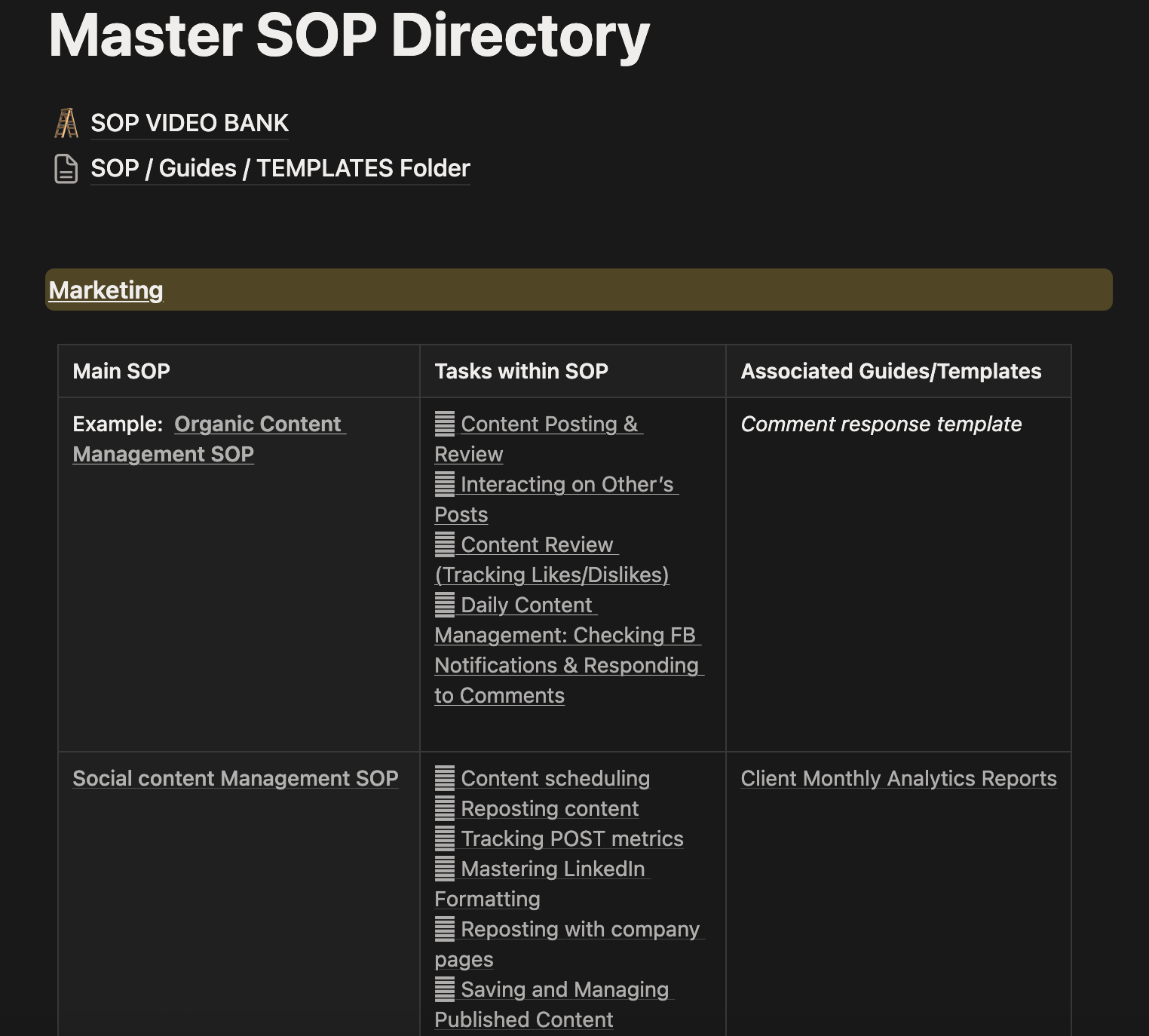
For example, in marketing I have:
Social content management
Email content management
Tracking growth metrics
And then I detail the tasks within each SOP.
So let’s take social content management in this instance…
Individual tasks within this include:
Content scheduling
Formatting LinkedIn posts
Saving & managing published content