

5 Mindsets Behind Every Successful Personal Brand
The psychology that shapes how the world's best creators think, create, and grow


If you’ve been sharing content to grow your personal brand for the past 6+ months, but you’re struggling to get traction…
Then it’s highly likely there are some underlying problems that you’re not aware of.
If you plant a seed, water it consistently, and give it enough sunlight, it grows.
Personal brands work the same way.
If your personal brand isn’t growing, there’s something wrong with your process.
This is difficult to accept because most people feel they're already doing everything they're supposed to.
For example, I remember watching a video from Gary Vee where he talks about “Put out more content.”
So when my blog content went stale in 2022, I started publishing 5-7x times a week.
But all this did was create more work for me.
The results barely changed.
There were people pulling more impressions from 1 post than I had in 5.
So volume clearly wasn’t the solution.
Nor was imitating viral hacks.
Again, I tried…
When I returned to LinkedIn in 2024, I saw a massive trend of small accounts getting massive engagement.
And one of the ways they were doing it was by asking people to comment a specific word in exchange for a valuable asset.
I tried to replicate this approach.
Crickets.
Of course, I blamed the algorithm.
But maturing means realizing that the more accountability you take for a situation, the more authority you have to change the outcome going forward.
So I’ve accepted I was the problem all along.
But it’s not enough to just accept you’re the problem.
You’ve also got to understand WHY you were the problem to prevent it from happening again.
And after studying 100+ highly successful brands, I found the thing holding me back wasn’t what I thought.
I expected to find better strategies.
Better hooks.
Better posting schedules.
Better content calendars.
Instead, I found something much deeper…
The biggest difference wasn’t their tactics.
It was simply their mentality.
To build a successful personal brand, you must adopt certain mindsets.
Because every strategy is filtered through the way you think.
If you change your mindset, your content changes with it.
People with forgettable personal brands tend to adopt mindsets that narrow their creative scope until nothing they create stands out.
The only fix is to change your mind.
And I’ve identified 5 mindsets you must adopt to build a highly successful personal brand.
But before we get into them…
There's one thing you need to understand.
You already have a personal brand - whether you realize it or not.
Because a personal brand is simply the perception people form about you through repeated interactions with you.
For example, it’s well known among my friends that alcohol, clubbing, and last-minute plans are a hard “No” for me.
They don't even bother asking me to join anymore.
Why must you remember this?
So you don’t fall into the trap of thinking you need to “create” a personal brand.
You don’t because you already have one.
The difference between the one you have and a successful personal brand is the intentionality behind it.
In other words, to build a successful personal brand, you must be intentional about cultivating a reputation that helps you produce the outcomes you want.
What that outcome looks like depends on your goals.
For some, that’s becoming a thought leader.
For others, it’s:
Becoming a trusted consultant.
Attracting premium clients.
Becoming the recognized face of a business.
This is the essence of a successful personal brand…
Reinforcing an intentional reputation until people instinctively know what to expect from you.
But you’re doing it so you can get something you want in exchange.
That said, we can formulate a successful personal brand as follows:
Successful Personal Brand = Intentional Reputation x Consistent Actions x Time
Now, let’s get into the mindsets…
Mindset #1: I’m also a consumer
The most successful personal brands are built by people who are completely aware of what people want to consume.
And the reason they’re so aware is that they understand they’re consumers too.
They observe their consumption habits and try to reproduce this for their audiences.
Most people disregard the fact they’re also consumers.
This is what allows bias to creep in.
Notably, most people who publish content to build their personal brand believe what they’re sharing is the shit.
They’re delusional.
Which isn’t a bad trait to have if you’re able to be honest with yourself about reality.
But people with forgettable brands can’t pair the two.
They believe their content is amazing and they’re genuinely confused when it doesn’t perform.
So they blame everything but the content.
“The algorithm.”
“I’ve been shadow-banned.”
"LinkedIn only rewards clickbait."
But there are only two reasons why your content doesn’t perform well:
The platform you’ve shared it on doesn’t like it.
People don’t like it.
To fix the first issue, you’ve just got to become aware of what the platform you’re sharing on likes and dislikes.
For example, the other day I came across a LinkedIn post by an author complaining that their post had been shadowbanned.
She was adamant that LinkedIn was hindering her post's reach because she’d posted it 3 months ago and it had gone viral.
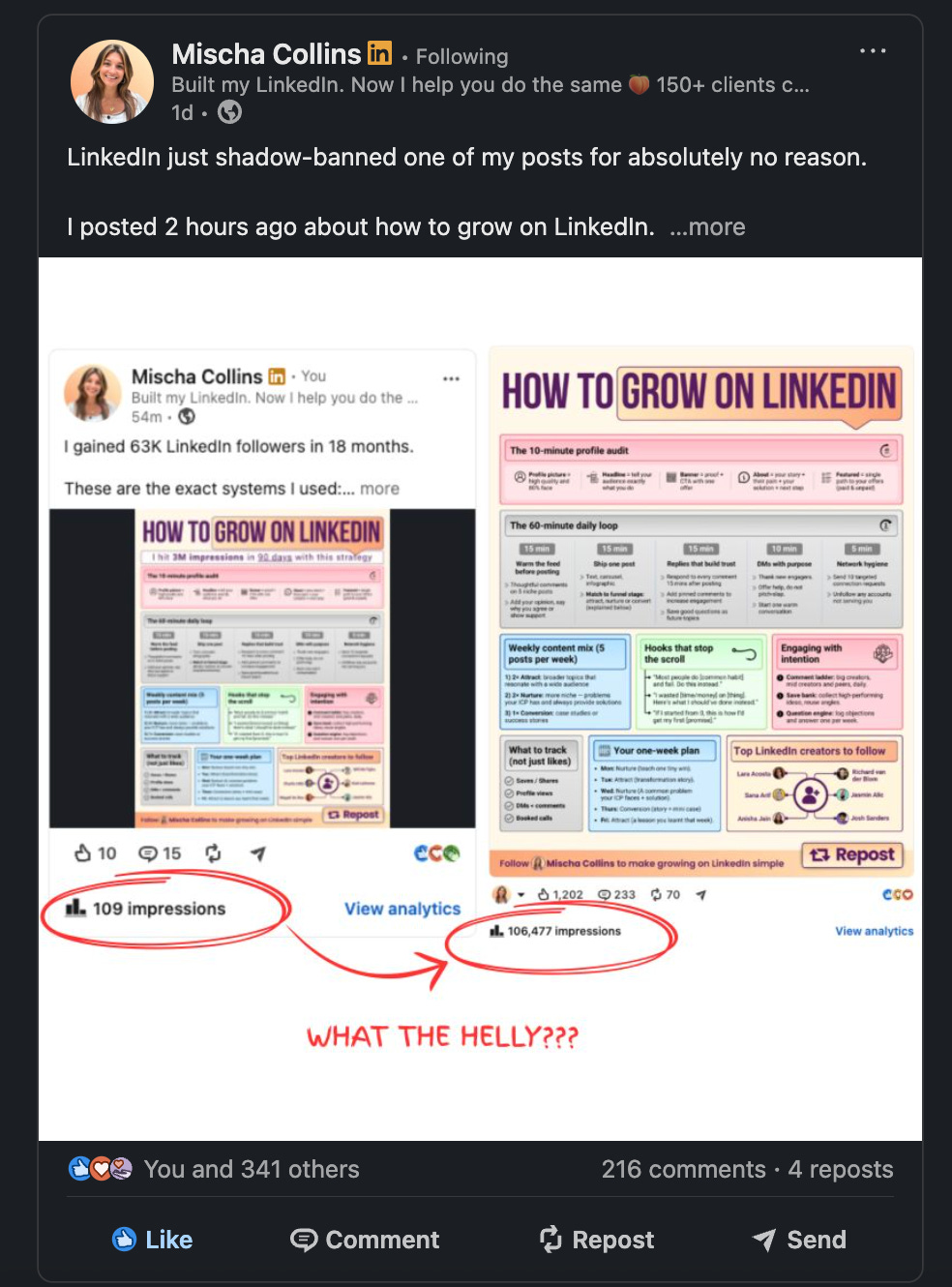
But then a well-known LinkedIn creator chimed in and said, “That is exactly why it was suppressed.”
Basically, LinkedIn updated its algorithm and now suppresses duplicated content.
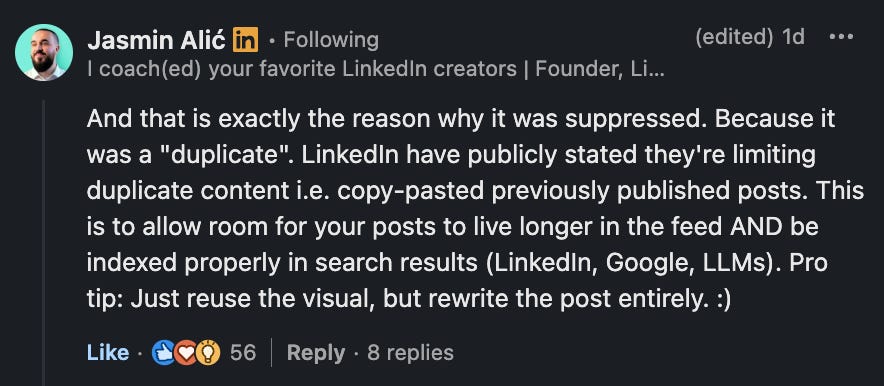
But that’s the gist…
If you don’t learn the rules on the platform you’re sharing on, your content isn’t going to do well.
Simple as.
To fix the second issue (people don’t like it), you’ve got to adopt a mindset called consumer perspective.
The idea is to become aware of what grabs your attention because what works on you works on everybody else.
I use a trick called “conscious scrolling” to train this muscle.
It involves scrolling through the platforms where I share content and paying attention to what stops me from scrolling.
Once I’ve stopped scrolling, I try to explain to myself WHY it stopped me from scrolling.
The goal is to develop awareness.
Mindset #2: Everything is content
If there’s one thing I wish I'd done more when I was starting out, it’s documenting the come-up.
This is one of the most valuable things you could do for your personal brand.
Why?
Because it hits 10x harder when you say you started in your parents’ basement and you have an image to back it up.
Or when you say you spent your last $100 on a course and there’s a screenshot of your bank statement from the time.
Visuals add a deeper layer of context.
This helps the content resonate more with the audience.
And increased resonance usually equates to increased engagement.
This explains why one of my most popular posts is about how I went from a religious cult to a 6-figure business owner, and why it’s important to vet your information sources…
I had an image that shows me during my ordination in the cult, and one of me at a wedding after I’ve left and built a successful business.
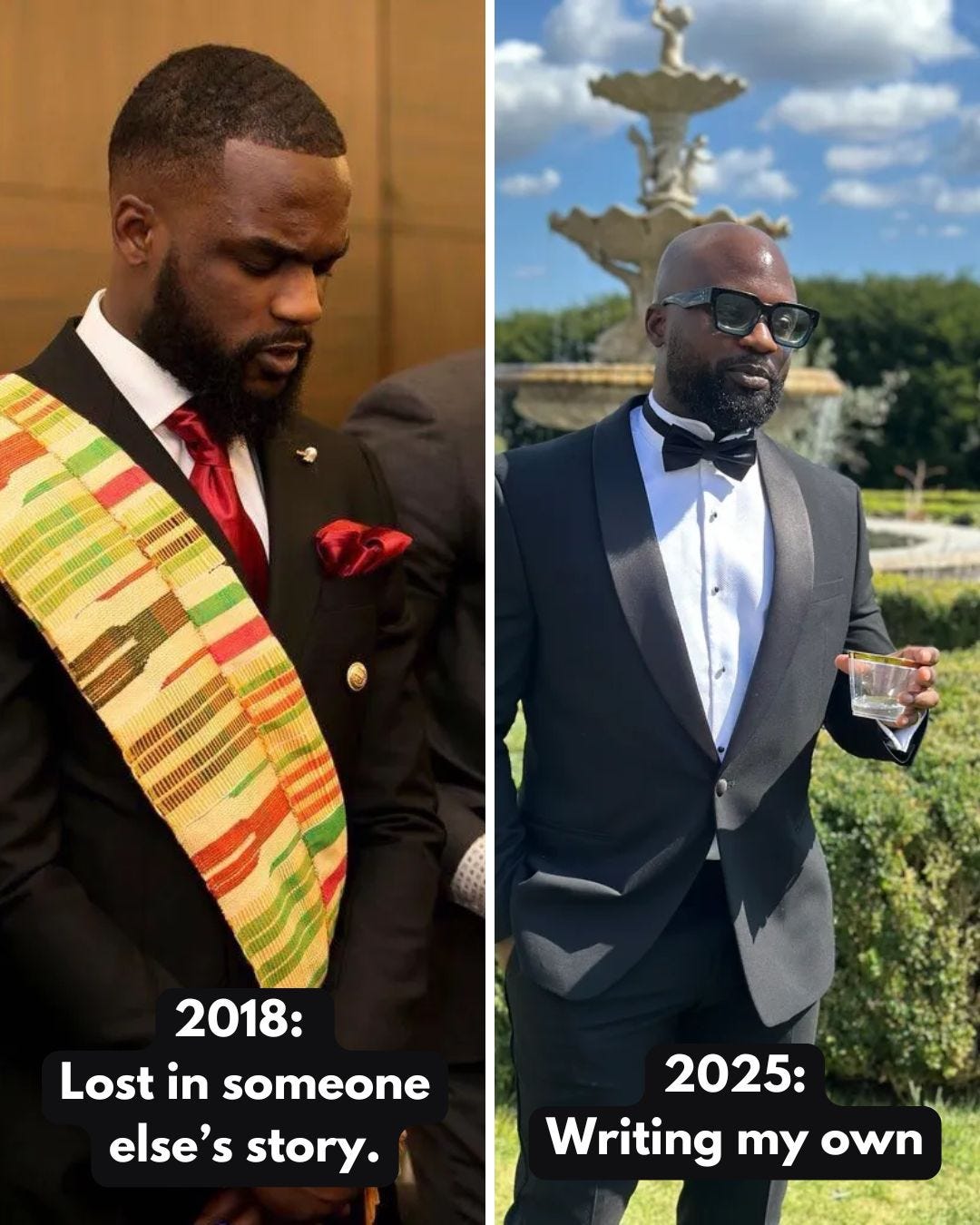
The most successful personal brand creators take many pictures of themselves in environments that align with their brand.
They document events that serve as proof for their stories.
Adopt this mindset by building the habit of documenting everything.
Not too long ago, I paid $8,500 for a program upfront.
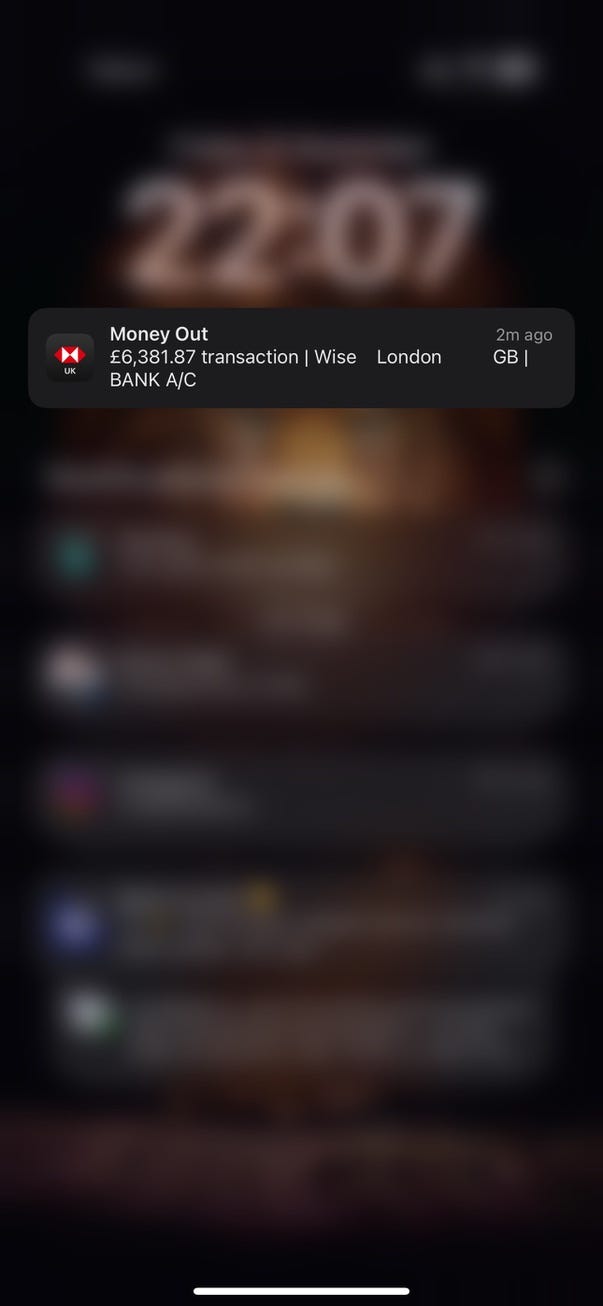
This was an important moment in my career because it was the first time I could make such a payment without going into debt.
So it was more of a testament to how far I’ve come, which is why I documented it.
Note: I’ve never used this image in content until now.
That’s the point…
You don’t have to use everything you document as content straight away.
But it’s better to have it there than not, because one day in the future you’re going to look back and want something to help you visualize a moment in your life.
Mindset #3: I play infinite games
Jeff Bezos once said, “Every company requires a long-term view.”
The same applies to your personal brand.
Why?
Because a major part of building a highly successful personal brand is discovering what works and what doesn’t for your specific audience.
And to develop this intuition, you must publish a lot of content to get enough data points.
This can only happen with time.
For example, I’ve been sharing content online for 6 years.
And I've written 1000+ LinkedIn posts for myself.
This is how I know about the 7 post types that perform extremely well on LinkedIn.
But there are caveats to this…
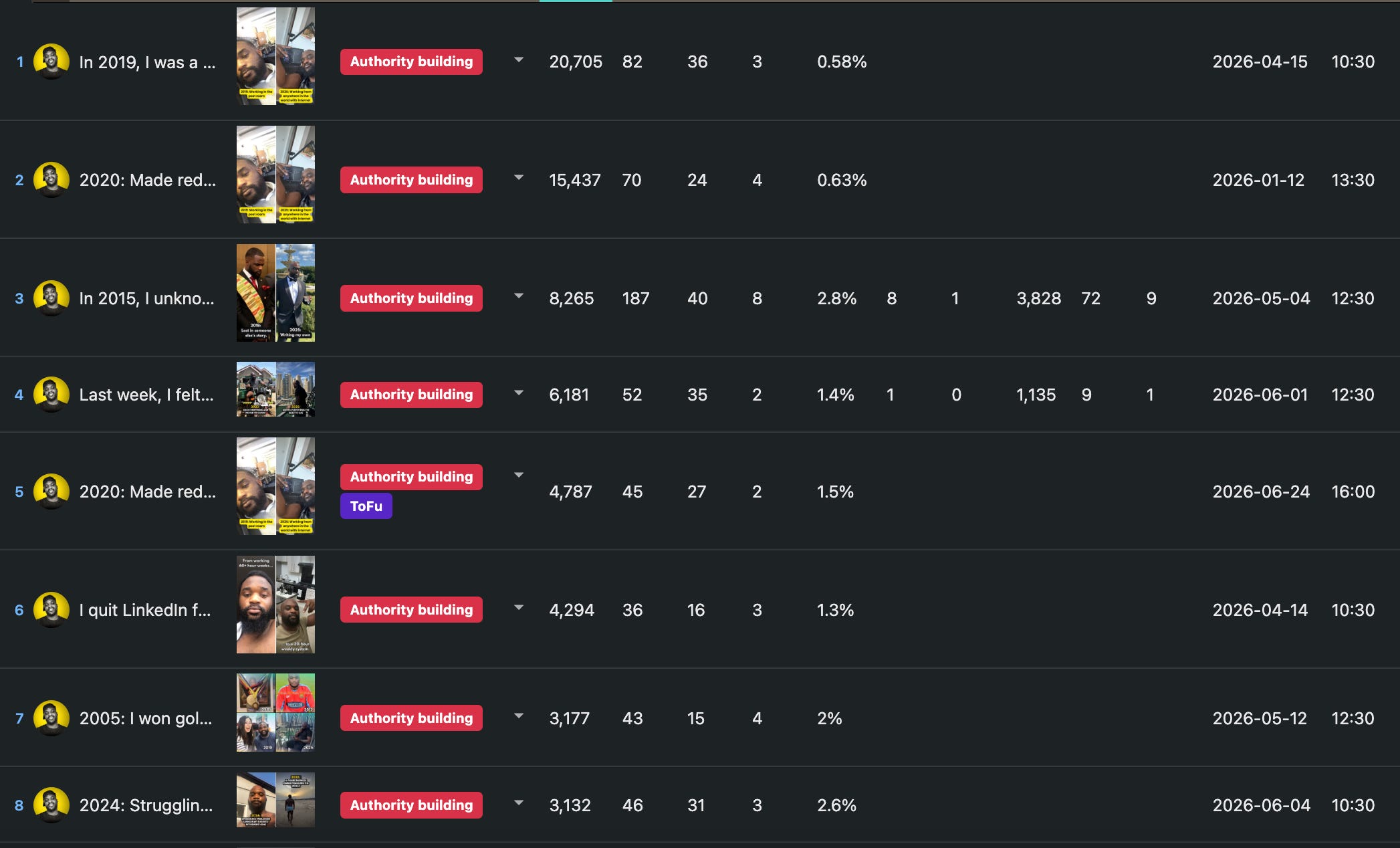
For example, I get far more impressions when I include before-and-after images in my posts.
Just take a look for yourself:
One client I worked with had content that only performed well when it included memes mocking the general expectations of people in his industry.
When I tried this with another client in a similar vertical, it flopped.
Another client of mine has content that only performs well when it includes a highly technical diagram that details the points he’s making.
But when I do this with my other client in the same niche, it flops.
Her content only does well when it’s giving advice about career decisions.
Essentially, what I’m saying is this:
You can follow all of the popular advice about creating content, and it may not work for you because that may not be the type of content your audience wants to see from you.
And it can take time for you to discover what resonates with your audience.
So you must give yourself time to experiment.
Of course, not everybody needs this, because some people join the platform and leave right away.
But they are anomalies.
If you try to replicate their approach, you’ll probably end up disappointed and quit - take this from someone who’s given up on LinkedIn personal branding and left the platform for 2 years.
Mindset #4: Learner’s hat
This ties into mindset #3…
One of my mentors told me, “People only fail when they think they know everything.”
And this perfectly explains why I gave up on LinkedIn in 2022.
I knew I had to:
Post 3-5x per week minimum
Use a catchy hook
Be polarizing
I was doing all of this - at least that’s what I thought
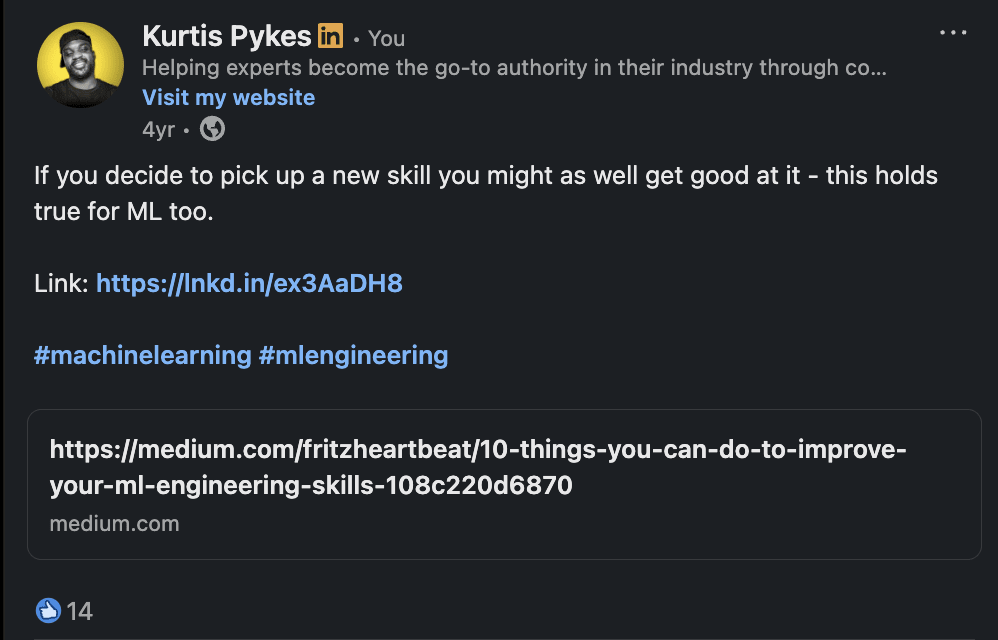
But my content still wasn’t receiving the attention I felt it deserved…
So I quit.
If I had adopted the learner’s hat mindset back then, I would have:
Created hypotheses about what was working
Viewed each post as a new experiment to test my hypothesis
Tweaked future posts based on the feedback I received
Ultimately, I never looked at what I was doing as the problem with my content.
I blamed everything else because I thought I had all of the answers, which lowered my ability to change my situation.
So here’s the gist…
Accept that you don’t know everything about personal branding.
This will give you the mental flexibility to try things.
And it will help you detach your self-esteem from your work.
Like Winston Churchill once said, “The price of greatness is responsibility.”
The more accountability you take, the more receptive you’ll be to feedback.
The more receptive you are to feedback, the more authority you have to change your situation.
This mindset is also vital for adopting the long-term vision required to build a highly successful personal brand.
Mindset #5: Delusional optimism about the future
Reality is always a lagging indicator.
Your current circumstances are the result of decisions you made months or years ago.
So right now, your results only tell you about things that have already happened.
What it doesn’t tell you is what’s possible.
There is absolutely nothing that says you can’t build one of the most reputable brands in the next 3 months or years.
In fact, this is what happened with an English footballer named Morgan Rogers.
He made his professional debut in the FA Cup / EFL Championship (2nd division of English football) era when he was 16 years old for West Bromwich Albion FC.

This got him snapped up by Manchester City, one of the most successful teams in the UK at the time of writing.
But he struggled to settle in at the club and was playing for the team’s academy - many would call this a setback because he went from playing with adults to playing with kids.
As a result, he went on a series of loans to clubs in the lower leagues but failed to make an impact.
Towards the end of his 4-year contract at Manchester City, he refused to sign a new deal and was snapped up by Middlesbrough FC in the Championship (one league below Manchester City and the same league as West Brom).
So effectively, he was back to where he started as a 16-year-old.
But he was now 20 years old.
In just 6 months, his career took off.
He helped Middlesbrough compete for a promotion spot to the Premier League.
Aston Villa, a successful Premier League side, noticed this and snapped him up for £8 million (rising to £15 million).
He stayed at Aston Villa for 2.5 years and became a vital member of their squad, helping them qualify for the Champions League - one of the most prestigious competitions in Europe.
He also helped the team win the Europa League (the second most prestigious competition in Europe) in the 25/26 season and was named player of the tournament and young player of the year in the Premier League.
This got him a call-up to England’s World Cup squad, where he made major goal contributions despite not getting plenty of minutes on the field.
And in July 2026, he was snapped up by Chelsea FC for £117 million, making him the most expensive English player and Chelsea’s most expensive signing.
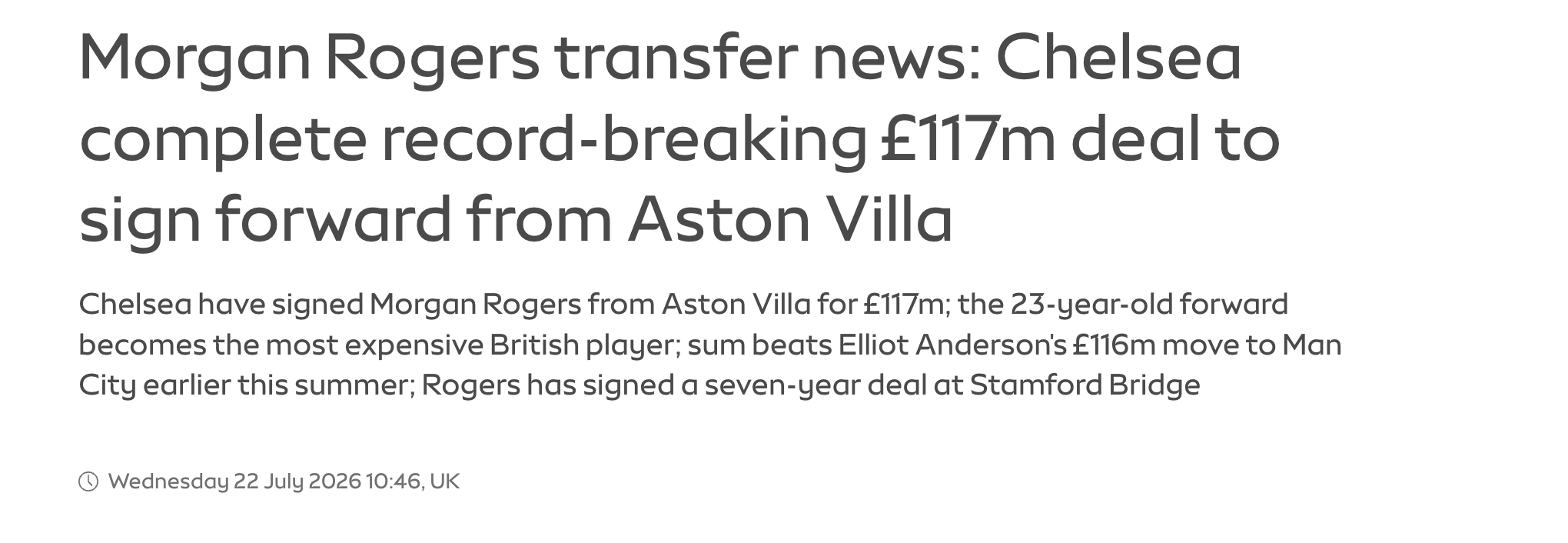
In 7 years, Morgan Rodgers went from being a rising prospect to a flop to a rising prospect again to a renowned talent to a world record English transfer.
The same can happen with your personal brand.
Here’s the gist:
If you let today’s reality determine tomorrow’s ambition, you’ll never create a future that’s different from your present.
You must remain radically delusional about what the future holds for you.
And take action towards realizing it.
Final thoughts
A successful personal brand is built by people who think differently.
They consume differently.
They experiment differently.
They document differently.
They interpret failure differently.
And perhaps most importantly...
They believe in a future nobody else can see yet.
Enjoyed this breakdown?
Building a brand is a marathon, but you don’t have to run it in the dark.
If this resonated with you, hit the Subscribe button to get practical, fluff-free frameworks on personal branding and authority building delivered straight to your inbox every week.
📬 Know someone struggling to get traction with their content? Forward this issue to them or share it on LinkedIn - it might be the exact mindset shift they need today.